Share this
ISO Audit Prep: What Spreadsheets Miss
by Christian Reyes on Jun 2, 2026, 3:21:54 PM
ISO Audit Prep: What You'll Learn in This Episode
-
Spreadsheets usually do not fail all at once. They fail quietly, then publicly, often during an audit, recall, investigation, or leadership review.
-
A spreadsheet can create the appearance of order without providing true control over current, complete, approved records.
-
Lost traceability is a major hidden cost because spreadsheets do not provide robust audit trails or dependable record history.
-
The manual workflow tax grows when CAPA, training, and follow-up rely on email, calendars, meetings, and personal heroics instead of controlled process.
-
Poor visibility keeps leadership reactive because reporting from disconnected spreadsheets is slow, incomplete, and often outdated.
-
The real turning point comes when teams spend more time maintaining files, preparing evidence, and chasing people than improving quality.
-
* Modern teams move toward connected digital systems so evidence is created as work happens, not reconstructed later.
The Hidden Cost of Using Spreadsheets in Regulated Manufacturing
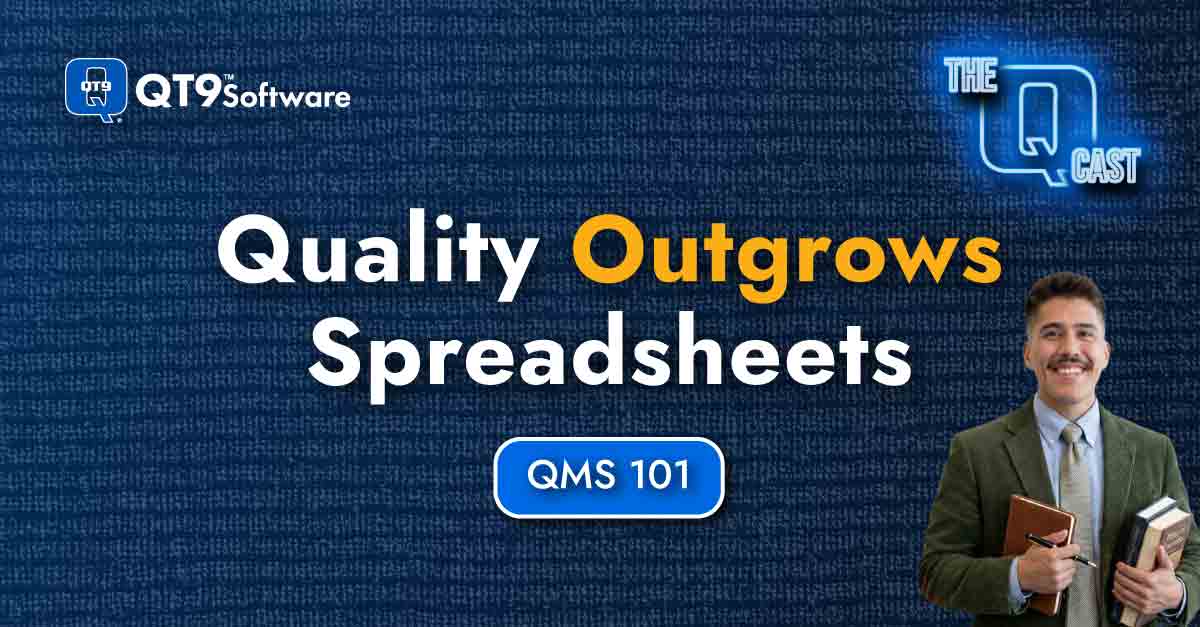
This episode examines the hidden operational and compliance cost of using spreadsheets as the system of record for regulated quality. Christian starts by acknowledging why spreadsheets stick, then walks through four specific costs that emerge over time: false control, missing history, manual workflow drag, and blind leadership visibility. The central argument is not that spreadsheets are inherently bad. It is that they become risky when quality teams outgrow them but keep relying on them as the operating model. The episode closes by contrasting file management with system management and showing why connected digital workflows matter in regulated operations.
Tags & Hashtags:
spreadsheet-based quality management, quality management spreadsheets, hidden cost of spreadsheets, spreadsheet QMS, regulated quality management, CAPA spreadsheet, document control spreadsheet, training records spreadsheet, audit readiness, traceability, audit trail, one source of truth, quality compliance, regulated industries, manual workflow tax, quality management system, digital QMS, connected quality system, supplier quality tracking, CAPA workflow, compliance is operations, operational visibility, QT9 Q-Cast
Episode Transcript
Christian Reyes (00:00)
Picture this. It's late in the afternoon. An auditor asks for three things. The current CAPA record, the training revision tied to it, and proof the action was effective. You know that that information exists. The problem is it exists across six spreadsheets, two email inboxes, and a shared drive that nobody fully trusts. That right there is the hidden cost of spreadsheet-based quality management.
It's not just inconvenience, it's uncertainty. And in regulated industries, uncertainty gets expensive very quickly. In this video, we'll break down the four biggest hidden costs of running quality on spreadsheets, why teams cling to them longer than they should, and what modern quality organizations do instead. First, let's be fair to spreadsheets. They became the default for a reason. They're fast.
They're flexible, they're cheap, and everybody already knows how to use them. A quality manager creates a catalog. Someone else builds a document control sheet. Training records start living in another file. Supplier issues are tracked in an ERP system. At first, this feels efficient, maybe even smart. And for a small team with limited complexity, it can work for a while. But...
Spreadsheets have a habit of becoming more than a tool. They become the operating model. And that's where trouble starts. Because the real problem is almost never the first spreadsheet. It's the 27th one. It's the duplicate file, the emailed copy, the local version that sits on someone's desktop, the manual reminder system built on memory, inboxes, and crossed fingers. Spreadsheets don't all fail at once. They fail quietly.
and then publicly, usually during an audit, a recall, a deviation investigation, or leadership review. Hidden cost number one. The first hidden cost is false control. Spreadsheets give the appearance of order, rows are filled in, columns are color coded, and there's a file name that even says final, maybe even final underscore final. But none of that guarantees that the record is current, complete, or controlled.
If two people can edit copies independently, you don't have control. You have competing versions of the truth. And in regulated quality, that is not a minor annoyance, that is a big risk. One person updates a corrective action. Another is working from last week's export. A third person references John's copy because that was the file attached in the email chain that they got. Now imagine an auditor asking a simple question. When exactly was this action implemented?
If the answer depends on which file you open first, the system is already broken. The hidden cost here is time, confusion, and credibility. Your team stops improving the process and starts proving which spreadsheet is real. The second hidden cost is lost traceability. In a strong quality system, a record tells a story. Who changed it? When they changed it? What was there before? Why the change happened? And whether the change was approved.
That history matters because regulators are not just reviewing your data. They are evaluating the integrity of the system, managing that data. Spreadsheets were never built to be robust audit trails. Yes, you can add notes. Yes, you can add dates. But if a row gets deleted, a cell gets overwritten on accident, or a copy gets saved over the wrong version, the context can disappear very quickly. And once context disappears, trust disappears with it.
Here's the gut check question if an auditor asks you tomorrow to show every change made to a quality record made over the past year, could you do it in minutes or would your team need to reconstruct the story from old files, email threads and memory? That reconstruction work is a hidden cost and it usually shows up at the worst possible time. Hidden cost number three. The third hidden cost is workflow drag. Spreadsheets can store information.
they do not manage processes. And quality is not just information, it is a workflow. Think about a typical CAPA. You identify the issue, you do your root cause investigation, you define your actions taken, assign ownership, set your due dates, implement the fix, verify your effectiveness, close the loop. In a spreadsheet based environment, that flow is usually held together manually. Follow up lives in the email.
Reminders live in someone's calendar. Escalation happens during a team meeting, and accountability lives in whoever cares the most that week. And that is a very fragile operating model. When work gets busy, the spreadsheet does not chase overdue tasks. It does not route the record to the right person. It does not enforce the next step. People do. And people are already overloaded. That's why investigations stall. Training follow-up gets missed.
Corrective actions stay open a lot longer than expected, not because teams are lazy, but because the system is dependent on heroics. The fourth hidden cost is lack of visibility. Quality data is not just there to satisfy auditors. It should help leaders run the business better. Where are nonconformances increasing? Which suppliers are creating recurring issues? How long are CAPAs staying open?
which process changes are actually reducing risk. When quality data is scattered across disconnected spreadsheets, answering these questions becomes a project. And if reporting is a project, it happens too slowly, oftentimes not at all. So leadership ends up managing quality based on partial data or outdated exports or whatever somebody was able to compile the night before the review. That creates a dangerous lag between what is happening
and what decision makers can actually see. And when visibility is weak, teams stay reactive. They spend more time chasing symptoms than spotting patterns. And this is one of the biggest hidden costs of spreadsheet-based quality management. The organization loses the ability to see risk clearly. Now, most organizations do not replace spreadsheets because they suddenly hate spreadsheets. They replace them because the business out
grows the operating model wrapped around them. Maybe the company adds a new site or a new product line. More suppliers, more audits, more training requirements, increased regulatory pressure. And suddenly, the old system that felt scrappy and efficient starts feeling slow, stressful, and brittle. That right there is the turning point. When quality teams realize they're spending more time maintaining files than improving quality.
More time preparing evidence than creating it. More time chasing people than driving improvement.
What do modern teams do differently? Modern quality teams move toward digital connected systems built for controlled work, not because software is trendy, because regulated operations need traceability, workflow control, and visibility by design. In the strongest environments, quality is not a side system. It sits in the flow of work. Document control affects training. Training affects execution.
Execution affects nonconformance, CAPA, and supplier performance. In a mature system, the current record is the record. Audit trails are automatic, approvals are controlled, training, CAPA, doc control, audits, supplier quality, and reporting all connect. Evidence is created as work happens, not reconstructed after the fact. And that's the real shift from file management to system management, from manual follow-up to structured workflow.
from fragmented records to one source of truth. And that is why platforms like KeyT9 QMS matter. They help regulated organizations replace disconnected spreadsheets with closed loop audit ready quality processes that are easier to scale, easier to trust, and much easier to defend. Spreadsheets still have value. Use them for analysis. Use them for quick calculations. Use them for temporary working notes. But...
When spreadsheets become the system of record for regulated quality, the hidden costs start stacking up. False control, missing history, manual workflow tax, and poor visibility. At first, those costs look manageable. Then one day they don't, because in regulated industries, compliance is operations. And the longer that control lives in disconnected spreadsheets, the more expensive it becomes to maintain, defend,
and scale. If this felt a little too familiar, subscribe to the Qt9 QCast for more practical conversations on quality, compliance, and operational excellence. And if you want to see what a connected audit ready quality system looks like, check out Qt9 QMS in the description below. Until next time, keep improving and stay compliant.
Share this
- QT9 QMS (12)
- Manufacturing (8)
- QMSR (3)
- FDA 21 CFR 820 (2)
- ISO 13485 (2)
- ISO 9001 (2)
- Supplier Management (2)
- AS9100 (1)
- Aerospace & Defense (1)
- Analytics & Reporting (1)
- Business Intelligence (1)
- CAPA (1)
- CMMC (1)
- COPQ (1)
- Cannabis (1)
- Change Control (1)
- Continuous Improvement (1)
- Inspections (1)
- QT9 BI (1)
- QT9 ERP (1)
- Software Validation (1)