Share this
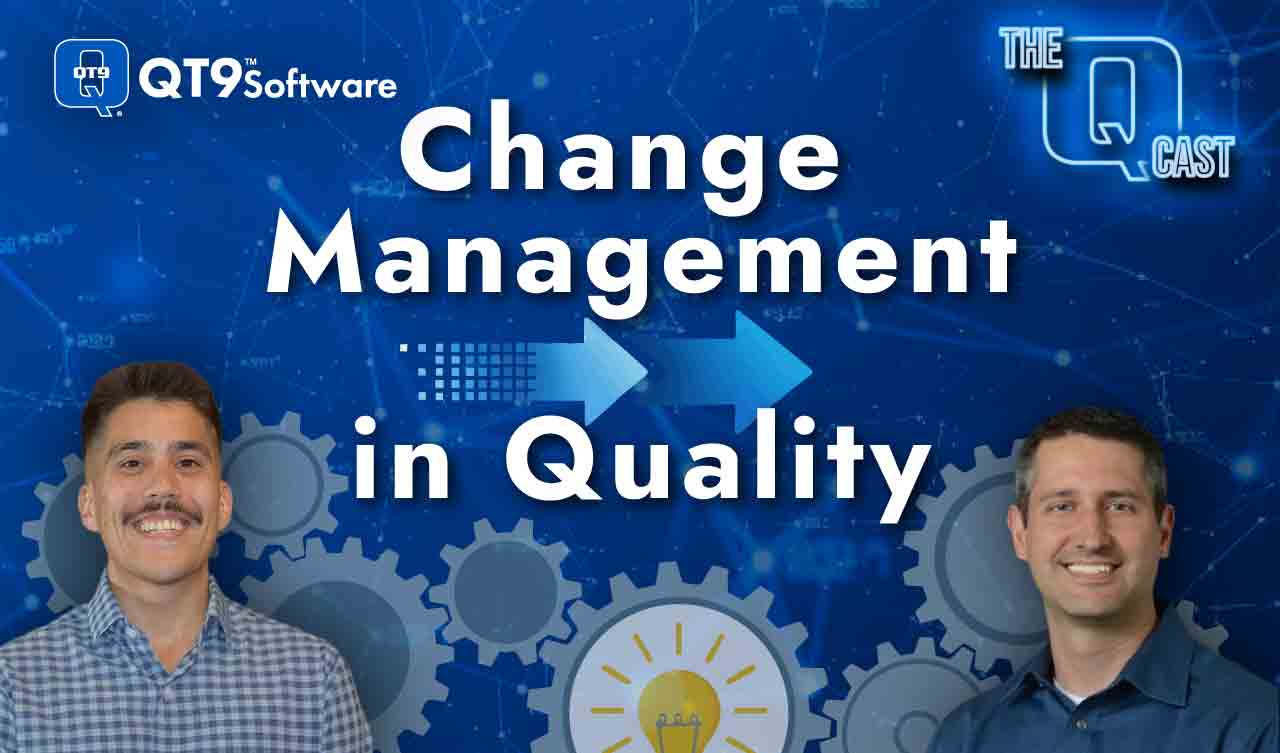
Episode 9: Why Change Management Fails in Quality
by Christian Reyes on Jan 27, 2026, 9:23:37 AM
Watch Episode 9 Below
Episode 9: Change is inevitable—but successful change is not. In this Q-CAST episode, QT9 Software sits down with Matt Kroll, President of Chalmers Street Consulting, to explore why change initiatives stall and how organizations can drive real adoption across quality and operations.
Drawing from real-world examples in manufacturing, distribution, and regulated industries, this conversation breaks down the people-centered realities of change management—from passive resistance and middle management alignment to training, governance, and measurable behavior change.
For organizations implementing or optimizing a QMS, ERP, or operational excellence initiative, this episode offers practical insights to help ensure change translates into sustained performance improvement.
Key points:
• Why resistance to change is often emotional, not rational
• How underestimating effort derails QMS and operational initiatives
• The critical role of middle management in sustaining change
• Using pilots, data, and structured problem-solving to drive adoption
• Measuring real behavior change beyond quality “platitudes”
Learn how QT9’s integrated, cloud-based QMS and ERP platform supports structured change, user adoption, and continuous improvement. Visit QT9 Software to see how connected quality and manufacturing systems help teams move from intention to execution.
Tags & hashtags:
Change management, QMS implementation, operational excellence, quality management systems, continuous improvement, manufacturing leadership, regulated manufacturing, process improvement, ERP and QMS integration
#QT9Software #ChangeManagement #QMS #OperationalExcellence #ManufacturingLeadership #ContinuousImprovement #QualityManagement
Episode Transcript
Hi, I'm Christian Reyes, your host, and welcome to the QCAST. It is human nature to resist change, so any change management brings about difficulties. Excellent change management is even more complicated. Over the next 20 minutes, we will talk through a practical guide to driving good change management. Joining us today is Matt Kroll. Matt is the president of Chalmers Street Consulting, seasoned industrial engineer with a sharp eye for operational strategy and process improvement.
A certified mastermind black belt with an MBA from the Booth School of Business, brings both analytical rigor and practical insight to the challenges of organizational change. Through TraumaStreet, he's making continuous improvement accessible to organizations of all sizes, empowering teams to turn aspiration into execution. Matt, thank you so much for joining us today. Thank you for inviting me. Absolutely. Absolutely. I'm excited that we get to do this in person. It's a rare thing.
nowadays so I appreciate you coming into the office here. what's one change lesson that you had learned the hard way early on in your career?
You know, I would say including the right people at the early stages of making a change. You forget little things, and when you don't have the right people in the room, you miss those little things, and then you regret it when you get into implementation. So that was definitely
something I try and remind myself over and over again when I make change. Absolutely, absolutely. The people involved are, extremely important. For sure. Big part of that equation. quality teams, they don't resist change. They resist confusion, risk, and rework. Where do you see most QMS and
operational excellent changes most often stall? SOPs, handoffs, metrics? You know, all those things can be places where change stalls. I often see the problem that when a company is going through, or organization is going through a change, they underestimate the effort required
and they overload the people that are trying to make the change in such a way that change that you're trying to make, if it's a QMS deployment, it's kind of towards the bottom of their priority list. So it's always getting pushed down. ⁓ we'll get to that. we'll get to that. ⁓ that meeting that we have once a week, only half the people attend because they're being pulled off into something else. So I think it's an underestimation of the effort.
And I would say that that is a problem in planning, right? So it's not thinking through fully what all this is gonna take. And some of those minor, you back to the small details, always get us some of those small things take longer to resolve than what we expected. And now it needs more effort and oh, it's, know, I got other priorities that are pulling for my time. Yeah, yeah. That's a good answer.
And I'm sure you've found resistance to change on a likely a daily basis. Yeah. Throughout your career. Yeah, I talk about this a lot actually. And there's a lot of different ways to think about it. So one is I always, so we teach organizations how to go and make change. And some of the things that they need to be careful of. We develop green belts and black belts.
and those kind of skill sets. And I always tell the people that I'm coaching, you know, look out for that passive resistance. That passive resistance is insidious because you don't know it's there, right? You know, it's the person that's probably quiet, maybe smiling, but when they leave the room, isn't really doing the things that you think are doing. Or it's just lots of excuses. And so that's, you know,
That is the sign or the show of resistance to change. But why it's there, I believe, and I'm not a psychologist, I believe that people generally want certainty and they generally want comfort seeking, right? Absolutely. And so it is comforting to know something as silly as when I pull up my computer in the morning,
the screen that I'm used to seeing is the screen that's there, That fields that I need to enter information in, those fields are there. It is uncomfortable to say, well, we're launching a new interface tomorrow and those things are gonna look a little bit different. That creates a whole bunch of uncertainty. It creates discomfort. People don't like it. And I think that, you know, it's an emotional response to change, you know, and people can be upfront with that.
they can kind of hide it and that's the passive resistance. That makes sense. I've not heard of passive resistance before but I can absolutely see how it's a bit more insidious. don't know what you're fighting. It's not on the sleeve. If I know what I'm up against, I can go work on that. If I don't know that it's there and that's kind of back to your original question which was what are the cold...
things I learned early in my career, it was look out for that. You gotta be hyper aware of where the different kinds of resistance are occurring, and I need to address those in different ways, right? Yeah, absolutely.
what signals do you look for in terms of being able to define resistance as either emotional or rational, if you will? That's really interesting. So I definitely subscribe to the idea that ultimately everything we do is emotional.
we can rationalize backwards, or we can rationalize that emotion. So I think it's almost always ⁓ emotional. The question is, am I able to get someone maybe beyond an irrational fear, right? Irrational fear to a rational...
maybe expectation or aspiration of what the future could be, like seeing something positive.
and then I start looking for the signs. Who's engaged in the meeting? Who's jumping on board? Who always seems to have a reason not to be there? Who's always late with their deliverables? Who always has an excuse as to why something isn't right? I gotta go address those. Change management is a people discipline. It's 100 % people. So I've gotta be very in tune, high EQ, very in tune with how people are behaving.
in my meetings, outside of my meetings, responding to communications. If I'm not in tune to those things, I won't see it and I will suffer the consequences. Absolutely, absolutely. That's fantastic answer. would you be able to tell us a quick story about a time where resistance was strong and ultimately what you did or the team did to shift to adoption? So I probably have many stories.
I like this story is an early story. And I'll just say I was in a distribution center and we shipped radios and radio parts and things like that out to public safety customers, a dealer network. there was within our sales team,
there was a belief, that's what it was. It was a belief that it was all about speed, right? Making the sale, keeping the customer happy, it was all about getting that radio out the door quickly. And anybody in distribution knows, you know, the challenge is how much stock do you keep? If you want to reduce the lead time, you're gonna generally carry more finished goods.
the point was that we were pressured to ship very quickly. It was very costly and we did frankly not the greatest job of shipping quickly. And so our sales team was anchored on that and beating us up month after month on our on-time delivery.
I don't think it was just me, but a group of us, suggested that customers really care about your promise. That's what they're really interested in. Yes, faster is better, no doubt. But within a range of relative speed, for us it was like next day, three days, those kinds of things. Customers are generally happy if you can promise three days and meet three days, right? It doesn't have to be the same day.
And who was completely rejected by your sales? No, not true You guys are just making excuses because you don't want to hit your numbers and sort of like well again Like we could hit our numbers. We have to drive up inventory. Nobody wants to spend money. Yeah. Yeah, where's the trade-off? Where's the trade-off? So the first thing in any kind of change is Helping people understand the underlying problem that we're trying to resolve
If people don't see the problem, then they're not going to get on board for trying things out. And that's the second piece, right? Is I have to get people open to trying things. So what we tried in this case,
we took one of the radios and we added a dollar. So the way customer ordered was they could just order the radio and we would ship it to whatever date they asked.
In this case, we said, if you want it fast, you have to pay a dollar, one dollar. It wasn't terribly expensive, right? It's pretty cost effective. And we ran this for three months. And prior to adding the dollar for asking for basically an expedited delivery, 80 % of our customers asked for a same day or next day ship on their radio, right? We added the dollar and it flipped.
80 % went with our standard lead time and 20 % asked for the standard. Really? Yeah. We put those numbers up in front of our executives, right? Along with the pain of what was really gonna need to happen if you really wanted to hit that kind of lead time ⁓ and that changed people's minds. I love that one because I actually changed jobs shortly afterwards.
That carried on for a couple years afterwards. We shifted all of our systems to a scheduled ship date. I believe that using that method of showing the problem, creating a pilot, going right at the objection created so much desire for this
this new, you know, this new path, that momentum was created, I stepped away and that project continued to roll after I left. And that's, I think that's a core piece of making change. Absolutely, absolutely.
ultimately, top management sponsors fund what they can understand. If they can't understand it, it'll be hard to get them to pony up any type of investment. So it does seem like it's important to kind of connect the change itself to the overlaying strategy or costs risk associated with making the change or not making the That's the word, connect is the word.
you've gotta know who you're dealing with, the profile of that leader and that leadership team. They're very pragmatic and analytical. There better be a very strong business case, quantifiable business case.
If they're very visionary, right, you better understand the underpinnings of that vision and connect the change with enabling that vision. Yeah, yeah, that makes sense. makes sense.
What type of governance tools or process controls have you used or seen used that allow you to keep the momentum of the project without creating too much bureaucracy or red tape? Yeah, so I don't know if this is a popular view or not, but I'm full in on DMAIC, Define, Measure, Analyze, Proof, Control. That's what I learned. I apply it in everything that we as Chalmers Street do or Plan, Check.
Sure, sure. I have nuanced reasons why I use one or the other but I wouldn't have started Chalmers Street Consulting and gone out and taught these things to people the way we have if I wasn't full believer that Formalized structured problem-solving is the only way to really create performance excellence and be sure that you're gonna get the kind of change a successful change that you need so
That's my workhorse engine for change. That's the go-to. Well, it's a... I appreciate the explanation. why is middle management so pivotal for...
control. Yeah.
What first comes to mind, most obvious is they're the ones really directing the folks that are gonna have to do this, right? If you think of frontline management, and if you have a, let's say a lower scale workforce, right? Doing some more repetitive type tasks, they're very used to being directed like, hey, here's the plan, follow this, here's the instructions, right?
⁓ As you get up into middle management, right? They're the ones providing the direction If they're not aligned with the executive vision, right if they're fearful I'm gonna lose I'm gonna lose my job This is what you know, this knowledge that I have is what what everything yeah What keeps my job secure back to that uncertainty right that discomfort? Yeah, you're gonna have passive resistance. They're not gonna follow through it It's very hard. We say go to the gumball, right? We say
Go see the work happening. So in theory, right, our executives should go out and see that that change is taking place. But the reality is, especially when you talk about larger companies and larger change, very hard for them to get to see all the time to make sure that those middle managers are following the new directive and pushing that on to the folks below them, right? So that's the biggest one. But there's a second one in there too that I think is really important, especially
in the larger companies or larger mid-size companies is middle management is usually some kind of specialist, right? Like when a company starts to grow to fix it, it has no management. they have a call center person who just knows these types of clients and those kinds of products.
and they know how that change is going to affect those products and those types of clients better than anybody else in the company. And so there is local knowledge inside of that middle management that is going to either help make this successful or it's going to cause it to fail. And it may not even be in the case of passive resistance, right? A problem of the person doesn't want to do it, right? It could truly be that when we do a
coming up with this new way of entering client information, we didn't think about this subset of customers and those products that they use and my gosh, it doesn't work for them. And only that middle manager knows it. So that person better be, we better be talking to them. And so there's really, that's why I say there's multiple reasons why middle managers are so important. Those are certainly two that jump to my mind. That's very thorough.
But both are both very good points.
Now we've talked about top management, we've talked about middle management, but at the end of the day, the end users are, the frontline folks are the ones that are living the change.
What's your preferred method for involving operators or frontline employees early on, without slowing the delivery? slow down to go faster. So I say without slowing down, well, maybe the target that we have is not realistic given the number of people that we need to go and win the hearts and minds.
Right? Because if I go fast but I run off the rails without...
But with that said, with that said.
I really need to think about, who's impacted? who's the customer of the change, who's touching different parts of the change, who's the supplier of the change, like thinking of that and giving yourself a list of who's, people and names. And then,
determining what level of communication that you need with them. Change management is heavily, heavily on communication. It's a people discipline, it's a communication discipline. So I have to be thinking about how I'm communicating to them. There's some people that I am going to just tell, like, here's what we're doing, so that you know. But there's people that I, and again, if I understand suppliers, people inside, customers, I'm gonna...
Involves of those people more closely to say how are you impacted by that and that's where we use like kites and events Your pilots different things so that we can kind of test out the impact on those folks But having them involved all the way through from the point of the charter right going back to domain that the charter Part of the part of the charter is stakeholders and team members Because I want to think about again who needs to be
involved in the ideation, you are there influencers in the company that I better get on board now? Not because of their specific role in the hierarchy, but because they are super influential, right? Or they have some really important customer relationships. And gosh, I want to know what they have to say. And frankly, if they're part of this, that's the beauty of good change management. If I involve the right folks, it's not my solution, it's not my idea, it's theirs and...
I have now a team of people all rowing in the same direction that really want this to be successful and they'll get through whatever obstacles are in the way. But you really have to think about who are the customers of this change? Who are the people that are going to be involved in whatever processes are actually different? Who are the suppliers to that change? And then making your list of, well, these are stakeholders, these are team members, and now let me use Kaizen events and different things to involve them. Sure.
Sure. Writing down a variable, who's who. I mean, in bigger, smaller changes, might be four or five people. Sure. Bigger changes, though, that we've run, 50 people. Not at all unusual to have a list of 50 people and with their different functions and how they might be involved. And if we're talking a large enough benefit, the work, back to kind of like, I might have to slow down to go faster.
the work and effort to make sure all those people are on board, it's gonna pay off. It's gonna pay off because I will go faster, right, once I have that online. If I've got a whole bunch of people rowing in the same direction, that boat's gonna go a lot faster than if two people row in the opposite of everyone else. Yeah, even if they started a day before. It only takes one. That is very true. Where do you see training help versus
Where is it a of a red herring in terms of the workflow design and eating someone doing their job? I don't know if I would never see if you're saying red herring from the standpoint of whatever we have a problem we always say is true. the person wasn't trained. The person wasn't trained, right? Or worse we say, it's common sense. That was common sense.
But my general perspective is most organizations don't train enough. They don't invest. Like you read the Toyota books. Toyota spends a ton of time training. They have whole production lines that are set up just for experimentation and training. One of the coolest things that I did, I worked with McDonald's to look at the speed of their coffee making machines.
and they have a technology center that just allows people to go and experiment and try to train, right? They take training very, very seriously. You see that in a lot of great companies. They take training very, very seriously. So I don't think we spend enough time in training, and I believe it's because we talk about it terms of training. It's not, it's what skill is lacking.
Right? Is ⁓ it a communication skill? Is it a coordination skill? What is the skill that is lacking? And then what is the best way to teach someone that skill? That's what we mean by training. Not a bunch of people sitting in a room getting lectured about, you know, the new software upgrade that's coming next week. No, no, no, no, no. Hands on. Really understanding. A coach checking.
Good training is a coach-mentor relationship, not a lecture, not a lecture at formal. And so I don't think, I think it's only a red herring because we don't think about it in the proper way and then we don't do it normally. Yeah, yeah. That's a great answer. Thank you.
for a quality or operational excellence change, what are three to five measures that prove behavior change in value realization? that prove.
behavior change. mean, so initially, as you're asking that, my thinking is always, I want to go to kind of bottom line, the lagging measures, Are my financials getting better? Is my quality getting better? Is my on-time delivery getting better and I'm more efficient? Ultimately, if I'm not affecting those things, it's really just platitudes. Yeah. And too often, I think...
think we end up with quality platitudes To see behavior change. So one of my most recent client projects is one of my favorites. And we walked into a firm where the president was in, not new, let's say, but he was two years in.
and he had taken over for a fairly autocratic leader who made all the decisions himself. And so the employee base was very much used to that. And what that often drives is a very siloed behavior, very protective behavior amongst the team, amongst the organization. And our approach, we use a program called CI Mastermind, and we develop role models.
My belief is if I want culture change, there's got to be some faces to that culture change. And if I've got role models that talk the way you and I are talking right now about process and change, and they are recognized by the leadership as really helping or being leaders of the company, I guess there's no other way to say it.
that other people start to follow along. Other people start to follow along. So we put these folks, right? So this president hired us, asked for RCI Master my program and he gave us 10 people to run through the program. And the first, you know, two months, three months even, I mean, gosh, we worked with them for two years. So it was wild. You felt...
the silos in the room. People did not help each other out. People did not bring their issues to the table. And if you think about process improvement and lots of projects, you're always talking about issues. It's not possible to walk into that room and not talk about issues. It took a while to break that behavior of holding things close to the best, not talking about it. And by, let's just say, six months in,
we saw the signs of change. We saw them starting to help each other out. As a facilitator, and actually it was me and another facilitator for this group, we got to say less and less and less as our work with them went on because they were becoming more more capable of interacting, aligning, working through friction points, asking the questions, validating alignment.
validating change, starting to measure things themselves. So when you say, are the behaviors I look for? I look for collaboration. If I see good collaboration, and if I see people that can call each other out without becoming a argument, let's say constructive feedback, I know I've got an organization that can drive change and that is changing in a very positive performance excellence way.
I feel like that's a great place to leave off. So Matt, thank you very much. We really appreciate you coming on and sharing your wisdom with us. Where can folks find you in Chalmers Street? Yeah, so first, thanks for having me and giving me the opportunity. If you can't tell, I love talking about this. And so it is what I do. I mean, it's part of what I do.
We really do set out to make these concepts accessible at all levels. And in trying to achieve that, I put a lot of free content out on LinkedIn. So you can look me up. Matthew R. Kroll, I believe, on LinkedIn. So look me up on LinkedIn, because I post ⁓ every week.
I also run a CI mastermind live session, which is totally free. And we talk about these things and we work through problems live so that people can go back and solve them. And you can find that on our website. It's ChalmersStreets. That's chalmersst.com. And go take a look at the videos. We do have a YouTube page. those are all ways that you can go and search me out, find me.
And there's a team around me too, we're all quite passionate about this. Absolutely, absolutely. And we'll put that in the show notes for our listeners so they can just click on the link and navigate over there. And we definitely want you listeners to reach out. If you guys enjoyed the conversation today, please like, comment, subscribe so you don't miss another episode. But Matt, thanks again for your time today. Our listeners, thank you for tuning in. And thanks to our production team here at QT9,
And until next time, keep improving.
Share this
- QT9 QMS (12)
- Manufacturing (8)
- QMSR (3)
- FDA 21 CFR 820 (2)
- ISO 13485 (2)
- ISO 9001 (2)
- Supplier Management (2)
- AS9100 (1)
- Aerospace & Defense (1)
- Analytics & Reporting (1)
- Business Intelligence (1)
- CAPA (1)
- CMMC (1)
- COPQ (1)
- Cannabis (1)
- Change Control (1)
- Continuous Improvement (1)
- Inspections (1)
- QT9 BI Tool (1)
- QT9 ERP (1)
- Software Validation (1)