Share this
Episode 8: Quality Management Made Paperless
by Christian Reyes on Jan 13, 2026, 10:25:38 AM
Watch Episode 8 Below
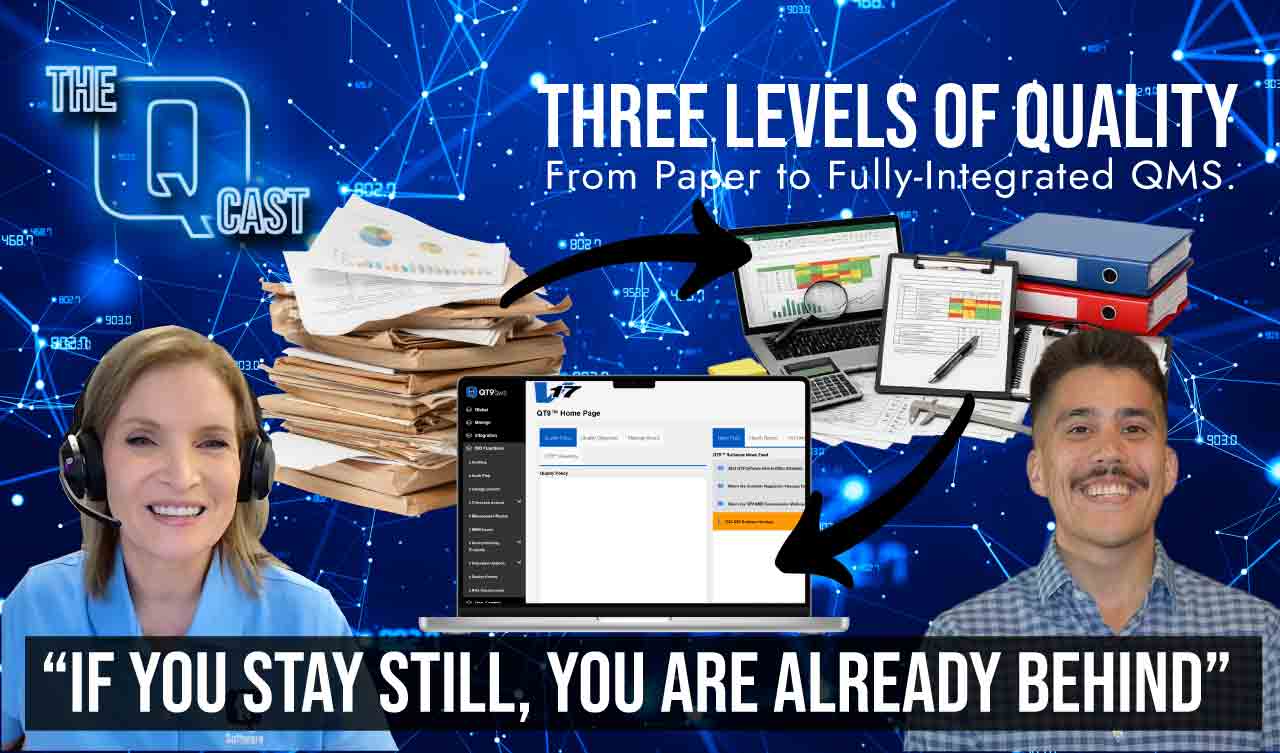
Episode 8: In this Q-CAST episode, QT9’s Director of Operations for EMEA, Angela O’Sullivan, shares real-world insight from decades in regulated industries on why paper-based quality systems create hidden risk and cost. Drawing on experience across automotive and medical devices, Angela explains how manual and fragmented systems impact compliance, audit readiness, and overall business performance.
The discussion explores the evolution from paper and spreadsheets to fully integrated QMS platforms, highlighting how connected quality data helps organizations shift from reactive firefighting to proactive, preventive quality management. For manufacturers facing growing regulatory pressure, this conversation outlines a clear path to improving visibility, traceability, and ROI through an integrated, cloud-based approach .
Key points:
-
The hidden costs and compliance risks of paper-based quality systems
-
How fragmented “islands of software” slow audits and decision-making
-
The three levels of QMS maturity and why integration matters
-
Using quality data to reduce the cost of poor quality and protect reputation
-
Shifting quality from a cost center to a competitive advantage
Call to action:
Learn how QT9’s integrated, cloud-based QMS helps manufacturers streamline compliance, improve visibility, and turn quality into a growth driver—visit QT9 Software to see how an integrated system can support your organization.
Tags & hashtags:
QT9 Software, QMS, EQMS, quality management system, paper to digital, audit readiness, compliance management, ISO 9001, ISO 13485, IATF 16949, medical device manufacturing, automotive manufacturing, regulated industries, cost of quality, integrated QMS, cloud QMS
#QT9Software #QMS #EQMS #QualityManagement #ManufacturingCompliance #AuditReadiness #PaperlessQMS #RegulatedIndustries
Episode Transcript
Christian (00:04)
Welcome to the QCAST. Joining me today is someone who knows quality systems inside and out, Angela O'Sullivan. Angela started off as a consultant within life sciences and accumulated a wealth of experiences. And she is currently the director of operations over across the pond for QT9 EMEA over in Ireland. Angela has worked with me for the better part of a decade. and I've witnessed firsthand her work in the trenches, helping companies solve big complex compliance issues.
as well as turning quality really into a driver of growth at every level of the organization. Angela, thank you so much for taking the time to join me today. How are you doing?
Angela (00:41)
doing very well, Christian. Thank you very much for having me today and it's great to be here and I look forward to diving into our topic for today. So thank you very much.
Christian (00:51)
Absolutely, absolutely. It's truly my pleasure to have you on.
What first drew you into the world of quality systems?
Angela (00:58)
So Christian, my first quality systems project was early in my career with an automotive company who wanted to upgrade from ISO 9001 to the automotive quality standard, IATF 16949. For those of you familiar, I found I was good at this. I like this type of work. I enjoyed it. And I went on to work with various standards at different companies over the years.
Christian (01:11)
yeah.
Angela (01:19)
So I moved from working in a big company setting into a consultive, consultive setting. And the need was there for the smaller startup medical device companies or even medium-sized who needed temporary support. And also a lot of it was getting companies ready for ISO 13485 certification. So I had a lot of experience of getting companies ready for certification.
getting them through the audits, really fun times and all of this. And this is ultimately what was my initial exposure to Qt and QMS software or an EQMS even. So yeah, that was the reason I moved from automotive to medical. And it's an easy enough transition. They're both highly regulated industries. And the fact that I was working in quality systems meant I could make that lateral move, I guess, from automotive to medical.
Christian (02:09)
Sure, No, that definitely makes sense. mean, from my understanding, I believe the automotive industry really was an early driver of the development of the early quality systems and developing those type of processes. So both highly regulated and obviously there is a lot of commonality between the different quality standards. know, most use 9001 as a base, as we all well know.
Angela (02:22)
Yes.
Definitely, yeah, definitely.
Christian (02:37)
But it's very interesting that you've had that level of experience in different verticals within different regulated environments. Have you seen differences between those different verticals in terms of companies using paper to manage their quality systems versus using other types of systems, electronic or otherwise?
Angela (02:57)
Sure, definitely. I have seen a trend towards the more highly regulated the industry, the more likely you are to see an EQMS being used. And the reason for this is that you more compliance, more regulations to keep up with, in particular with medical devices, for example. They have a lot of different regulations, all the different territories that they place their devices in, the sheer amount of documentation and level of detail that's expected in these industries.
So yes, I have definitely seen that the more highly regulated the industry for sure, the more likelihood they have an EQMS and indeed it's a necessity at that level.
Christian (03:37)
Absolutely, absolutely. I may be biased, but that's definitely been my experience as well ⁓ as a trainer implementer. It's 2025 and we still have a of companies that are clinging to paper systems. ⁓ Do you have any insight around that as to why companies are inclined to stay on the manual system as opposed to transitioning to an EQMS?
Angela (03:41)
Yeah.
Yes.
Yeah, we definitely see a couple of different reasons for this. again, as I said, the lower the risk, e.g. lower regulated industries, the more you will see this. But and indeed, the thing is they would benefit very much from an EQMS. But there is that fear of change. There is maybe staff not buying into it. There's also a fear of the project failing.
the cost as well. The cost is always a factor and that they're not understanding the return on investment. They can't see it, you know, right up. They do see it afterwards, but at the very start, you know, they do have to sell it, for example, to management to get that budget approved for an EQMS because there is a cost associated with it, but also there's a cost associated with not having an EQMS.
Christian (04:47)
ultimately manual systems, they're not just old school, but they're actually quite expensive. According to Compliance Quest, US companies spend over $8 billion a year just managing paper. And filing a single document can cost $20. And with teams spending more than 77,000 hours on tasks that could be automated,
you add all that up and that adds up to quite a chunk of change. Those pain points in terms of using paper systems, mean, it can be a bit of a hidden cost, can you give me an example of how paper processes hide quality risks?
Angela (05:13)
Yes.
⁓ I can give you a number of examples and starting off with any manual process has a risk of human error. This is something I learned many, many years ago when I started training in quality that you cannot do 100 % inspection, but it applies to every single manual process. So for example, entering the incorrect date on a batch record, this is going to cause you issues if you were doing, for example, a product recall.
This could affect money. This could affect time. This could affect human life, you know, safety issues. Using the incorrect revision of a document, you're making the wrong parts, using equipment that's out of calibration. You're talking about defective product recalls, even basic data integrity. So if you're using paper, ink can fade, know, paper can be deteriorate and even things like flood, fire risk. So we've all heard examples of that in the past where
If you physical records, if you have a catastrophic event like that, then your records are destroyed. Whereas with an EQMS, typically your data is kept in the cloud nice and secure. So yeah, there are risks definitely associated with and costs associated with doing manual systems.
Christian (06:25)
Yes.
Definitely. Those are great examples, but ultimately they might not even be as clear as that. You have to do a little bit of digging to see where those costs are racking up. I know you mentioned in terms of costs and risks associated with paper processes, but how do outdated systems actually impact the audits or audit readiness
Angela (06:38)
Yes.
it's very, very big impact in terms of audit readiness. So the first thing you very limited visibility as to where you stand with regard to the audit. It's a little bit like not being able to see the wood for the trees. So you're looking at Excel logs, you know, for things like open CAPAs, open audits. Then you're looking at trying to manually link documents together. So I'm just going to use an example of, let's say if you have a nonconformity by an external auditor, you're typically looking at, you need a CAPA.
but then you also need a document update. It always needs a document update. But then you have to look at the cost or the record of training people in this updated document. You're talking about a minimum four five different documents that need to be linked together, but in reality you could have dozens. So it's harder to see if you're missing something. And then the other thing then is that it's retrievability of documents during the audit. So it's not just being able to quickly confirm before an audit.
that you have everything that you need. It's about actually during the audit, which believe you me is a very high stress situation. And you know, know, the more stressed you are, the less chance you have of finding something. So it's just that peace of mind that you know, with an EQMS, you can put your hands on the data really quickly and give that confidence to the auditor that everything is where it should be. But definitely a manual system preparing for audits and the
binders and the photocopying and the checking the revisions. You know, once you start using an EQMS compared to a paper based system, it's very, very hard to go back.
Christian (08:28)
Yeah, yeah, I mean, ultimately, you know, people can get burnt out, you know, by the manual work that goes into maintaining a manual system. You know, all the efforts going towards doing more repeatable tasks and documentation, as opposed to, you know, taking a ⁓ more proactive approach towards
Angela (08:38)
yeah.
Christian (08:51)
Now, I saw your webinar a bit ago on the three levels of quality systems. And first of all, let me say that it was fantastic. You did a wonderful job with that. I truly learned a lot in that. And for our listeners, we'll have a link.
Angela (09:00)
Thank you.
Christian (09:04)
to Angela's webinar that she did on the three levels of QMS, the maturity model in the show notes. So if you're interested in a deeper dive on the three levels of QMS, I definitely recommend checking that out. Again, link is in the show notes. But for our listeners here today, can you explain a little bit about the three levels of QMS?
Angela (09:23)
Of course, thank you, Christian. So we have three levels and level one is where you have a hybrid system of maybe paper. Like a lot of people aren't just using paper now. It's maybe Microsoft Excel, Microsoft Word and combined with paper. So that's kind of level one. We consider that kind of the most basic level. Level two then is where you have multiple islands of software and maybe paper as well, of course. So this would be like maybe a customer complaint software.
It might be calibration software, doc control, risk management. So it's different little islands, if you like, of different software packages. And they're all kind of, you know, separate to each other. And then along with the paper, level three then is where you have a fully integrated QMS product. So everything is contained in one package. As I mentioned, customer complaints, calibration, doc control, risk assessments, even safety, incident reporting, everything is all together. So you're not looking.
different logins, different software, you just have the one thing to log into. So this matters because ideally type three is the most efficient way to manage your QMS. It's the most efficient, most effective way. So this is why we would encourage people to move up the levels and ideally go from level one to level three and not go through that level two kind of hybrid period. Because the issue there is that you've got people kind of develop software fatigue.
You know, it's like, no, another, another new software. And then you're too late or there's something else new coming in and people just get, that, that can work against. That can work against you when you get to level three and you want to bring in an integrated solution. And they're like, this is another new software. So ideally if you're at level one, don't go through level two, just go straight to level three and get an integrated QMS software.
Christian (11:08)
That's a great piece of advice. ultimately, I guess you don't have to, it's not like you have to go sequentially. You don't have to hit level two before you get to level three. ⁓ Get mired down in the islands of software. I like the way you phrase that, islands of software. Because ultimately, yeah, that's what they are. If the boats aren't being sent back and forth between the islands, it's gonna be quite hard to manage those processes, much less be able to pull them up come audit time.
Angela (11:14)
Nope. No.
Christian (11:35)
If you're having to flip between different software systems, log into different websites, if you're needing to pull a non-conformance, and you have to go to this website for the latest revision of a document and a separate website. Definitely not. For sure. For sure. Absolutely.
Angela (11:41)
Yeah.
and it's costly. Yeah, it's costly. know,
so what you want to do is get everybody to the mainland, off the islands. Then it's easier to work together.
Christian (11:58)
Yes. Yeah.
Move away from the archipelago ⁓ model.
Angela (12:07)
Yes, exactly.
Christian (12:11)
So I guess what would be the first step for a company that's at level one that's looking to move to level three? Or even level two, looking to the level three.
Angela (12:20)
Yeah, definitely looking at your cost. So it can be a little bit more difficult at your level one. So, but just looking at your staff costs, looking at the number of hours people are spending on doing different tasks. And again, you need to justify. in any company, it does come down to finances, very important part of any company. So you need to justify any kind of investment. It's easier at level two to make that assessment because you're just adding up the cost of the different software.
packages. But again, just getting that cost to get that justification to go to level three. Indeed, if you're at level one, you also might have other drivers like, for example, you have a new customer, they're in medical, they're in automotive, they're in aerospace, they have higher levels of requirements, then it might be saying, okay, now it's time to go to an integrated QMS. So, but again, it's just looking at the cost really and just making that business case.
Essentially that's what you have to make to management to get that budget approval.
Christian (13:19)
Absolutely, Essentially, outlining both the costs and the return on investment are key pieces to getting high end, right?
Angela (13:27)
Good point. Yeah. Yeah. The return on investment. Yeah.
Yeah.
Christian (13:32)
Let's talk about return on investment. Let's talk about the ROI. You know, first of all, In terms of the cost of quality, you mentioned the first step kind of being to get an idea of what your current costs are, whether you're at level one, level two.
You know, so obviously for comparison purposes, you need to do that. But that can be difficult.
So can you speak a little bit on the costs in terms of the costs of quality, costs of good quality, costs of poor quality, so that our listeners have a good idea of what to sum up?
Angela (14:03)
be very happy to. by the way, this cost of good quality, cost of poor quality, this is around a long, long time. And this is something that most quality departments in most manufacturing companies especially would track because these are very real costs and there is a way to track them. And of course, with an EQMS, it's easier to track them. But the difference between the cost of good quality and the cost of bad quality or poor quality.
The cost of good quality are the costs you pay out in what we call prevention and appraisal. So prevention is things like FMEA training, the calibration, registration costs. Your appraisal costs are like inspection. So your inspectors, your incoming goods department, your outgoing quality department. So it's kind of inspection costs and then also your prevention costs. cost of poor quality then is where you have defects. So
These essentially are internal and external failures. So with this, you have things like rework, scrap, product screening, warranty, downtime, loss of sales, of course. So this is the difference between the two. So you want to be, I guess, focusing on your cost or your investment in the cost of good quality.
Christian (15:19)
Absolutely, that's kind of the traditional perspective in terms of the costs of, yes, exactly, Being proactive rather than reactive, but it can be hard to do that. Practically speaking, when the rubber meets the road, if you're not in a level three system like QT9, ⁓
Angela (15:24)
prevention rather than cure.
Christian (15:41)
It can be kind of hard to get out of the day-to-day being stuck in the mire of being reactive. If a lot of non-conformance is coming off the line, so on and so forth, it becomes a lot more about documentation of that and less about truly getting into the root cause and cutting it out from the base of whatever is really causing that issue within the organization.
Which of the ⁓ costs of poor quality do you think are the most dangerous or the hardest to track?
Angela (16:11)
So great question, by the way. So external failures are the ones that customer becomes aware of or they have left your facility. So they're outside of your control. Not only are these more expensive to manage because you things like you have to send staff to the customer site. You have to do screening. You might have to recruit local screening companies. You have to look at disposing of the parts, replacement of parts.
You know, and, and again, I have done this in practice and we had to track every single thing down to airline costs. these, these can be tracked. these are, but that side of things, even just the cost of doing that is actually the lesser of the two evils. The other one is the reputational damage and the damage you're doing with your customer at having this, you know, supplying bad components. It's a interrupting their.
You know, the automotive industry, you're basically stopping a line. So, you know, you the car manufacturing lines, they're always moving. So you can't stop that line. If you've bad parts, you are stopping that line. You've got cars imported in the port. They can't be shipped to the customers. So you've got reputational damage and loss of existing or future business. This is definitely the hardest to quantify and by far the most damaging to a company. in theory, companies think, well, look, I've got really good controls.
We might have internal defects, but we make sure they don't get out. But if you are producing faulty product, it's very hard to ensure that they don't get out. the point of it is, as we said earlier, prevention is better than cure. So putting that focus into the prevention side, the auditing, the anticipating issues, like I the FMBA control plan.
good work instructions, good involvement in cross-functional teams and anticipating issues. And then when you do get internal defects, that analysis, so this is where again, an EQMS is very useful. You have that root cause analysis, your actions to make sure that you're not getting that same problem recurring over and over again. Because eventually they are going to get out to the customer.
Christian (18:16)
Yeah, yeah, there's no preventing it in that case. And that's one of the things that we're going to provide to our listeners ⁓ is the ROI calculator. So as we're talking about these costs, if any of our listeners are curious to do that for their own companies, again, if you look in the show notes, we have a link to the ROI calculator, which again, we'll.
Allows you to plug in your company details and it will basically calculate your ROI and and break down the the various areas where you would save on costs and and where value would be created So definitely check out that ROI calculator that we've got in the show notes And again that that might help you contextualize some of the the costs that you're seeing in your organization
what's one piece of advice that you would have, Angela, for quality teams that are currently stuck at level one?
Angela (19:09)
You know, not to be repeating myself, but as I said, the biggest tip is don't go to level two, just go to level three. So just look at getting an integrated QMS because of the cost and the time and the delay that you have with being stuck at level two. And then it's harder to get into level three because people become attached to those, the islands that they're living on and the software that they're using, they become attached to that.
and they don't want to move. if you're at level one, my best advice is just try to go straight to level three.
Christian (19:39)
That's fantastic. I honestly think that is worth repeating that advice because that is 100 % true. That is 100 % true. It would make your life harder ultimately and probably cost a lot more if you went to level two and before going to level three. So that is very important. That's a great answer. Do you think that there needs to be a shift in mindset at all in terms of quality leaders going into 2026?
Angela (19:43)
Yeah.
Yeah. Yep. Yeah.
Christian (20:05)
I know there are lot of standards that are changing and we'll be talking about those changes and in future episodes of the QCAST, we'll be breaking it down. But just generally speaking, do you think a shift in mindset for 2026 would help quality leaders?
Angela (20:08)
Mm.
think there is a mindset of what we are doing right now is working. Why should we change? You know, there is this thing called founders bias where people get attached to something that they've created or produced or been part of and they just become attached to it and they don't want to look at any other solution. it's if what we have right now is working, why should we change? But as we know, in business, if you stay still, you're actually falling behind.
So I would say just to be open to new ways of doing things and have an open-minded attitude towards there might be a better way to do something. in all of the ISO standards, continuous improvement is baked into it, that you do have to look at that, you what can we do better? So yeah, I would like to see that mindset changing, you know.
for quality leaders. Yeah.
Christian (21:11)
Absolutely.
Absolutely. That's a fantastic answer. And so, yeah, I guess that wraps up our time today. Do you have any final thoughts on turning quality from a cost center into a strategic advantage?
Angela (21:26)
So we've been talking today about, I guess, paper versus electronic systems, paper versus EQMS. But when you think about it, for me, the real question isn't about compliance or efficiency or all those. It's really about how you look at quality as a whole. So essentially, every company is paying for quality. There is a cost there. Every company is paying for it. So it's something you can't get away from.
But I think the smart companies turn that cost into a competitive advantage and looking at new ways of doing things as a way of doing that, such as an EQMS.
Christian (22:03)
absolutely. Well, as always fantastic answer and Again, Angela, I just want to thank you. Thank you so much for for joining us on the cue cast today I know that I learned a lot as you said every day is a class day every day is a school day Especially when when speaking with you, so thank you. Thank you very much Absolutely
Angela (22:19)
Well, thank you, Christian. Thank you very
much as well, Christian. Thank you for your thought provoking questions and discussing with you and as always a pleasure working with you as we have for many, many years, as you said.
Christian (22:32)
Yes, yes, and many more, ⁓ for sure.
Angela (22:35)
Many more. Yeah, many more.
Christian (22:37)
All right, well, thanks again, Angela. I hope you have a great rest of the day there. And ⁓ for our listeners, again, you can find Angela's webinar on the three levels of quality in the show notes, as well as the calculator on ROI.
Angela (22:40)
Thank you. You too.
Christian (22:51)
if you enjoyed our conversation today, please be sure to like, comment and subscribe so you don't miss what's coming next. Feel free to reach out to myself or Angela on LinkedIn or email and we'd be happy to follow up with you. Until next time, goodbye.
Share this
- QT9 QMS (12)
- Manufacturing (8)
- QMSR (3)
- FDA 21 CFR 820 (2)
- ISO 13485 (2)
- ISO 9001 (2)
- Supplier Management (2)
- AS9100 (1)
- Aerospace & Defense (1)
- Analytics & Reporting (1)
- Business Intelligence (1)
- CAPA (1)
- CMMC (1)
- COPQ (1)
- Cannabis (1)
- Change Control (1)
- Continuous Improvement (1)
- Inspections (1)
- QT9 BI Tool (1)
- QT9 ERP (1)
- Software Validation (1)