Share this
QMS Implementation Mistakes: The Checklist Leaders Skip
by Christian Reyes on Mar 10, 2026, 9:06:28 AM
QMS Implementation: What You’ll Learn in This Episode
- 5-phase QMS implementation framework
- Common implementation mistakes
- Training strategies that drive adoption
- Real-world lessons from 300+ deployments
QMS Implementation Mistakes Leaders Skip
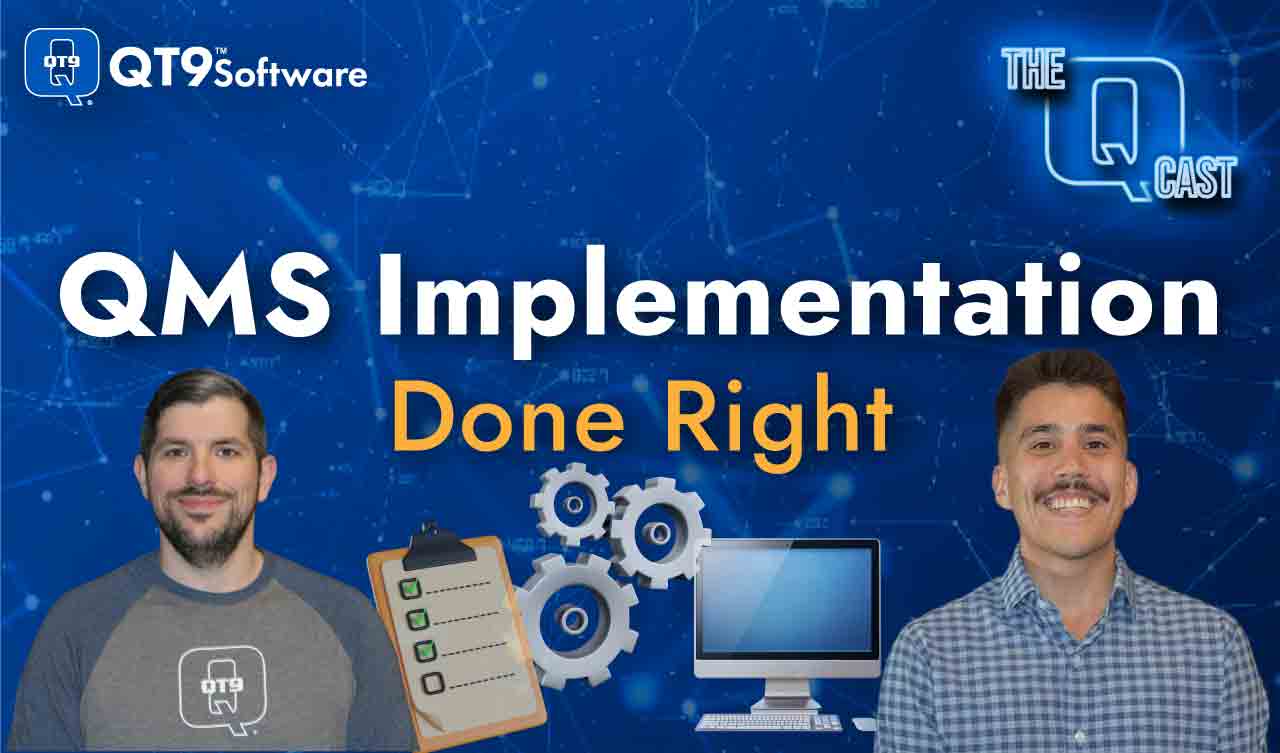
Episode 12: In this episode of The QT9 Q-CAST, host Christian Reyes sits down with James Schloz, Lead Trainer and Implementer at QT9, to break down how QT9 approaches QMS implementation and training for customers across regulated industries.
James walks through QT9’s customer-centric implementation model, explaining the five key phases used to successfully deploy QT9 QMS—from project planning and data setup to rolling out core quality modules. He also shares real-world insights from helping implement the system for hundreds of companies, highlighting the most common challenges organizations face when transitioning to a digital quality management system.
The discussion also covers why unlimited training and ongoing access to QT9 University plays a critical role in driving adoption, improving ROI, and helping organizations confidently scale their quality systems.
Whether you are evaluating QMS software or currently implementing QT9, this episode offers practical insight into how structured implementation, data preparation, and continuous training help organizations achieve long-term success.
Learn more about how QT9’s integrated, cloud-based QMS helps organizations streamline compliance and improve operational visibility. Visit qt9software.com or request a demo to see the platform in action.
00:00 – QCAST Introduction: QMS Implementation & Training
00:45 – Why Training Is Critical for QMS Adoption and ROI
02:30 – Implementing QMS for 300+ Companies in Regulated Industries
03:48 – The 5 Phases of QT9 QMS Implementation
06:38 – Unlimited QMS Training with QT9 University
07:57 – On-Demand Training, Resources, and Learning Tools
11:49 – Migrating Historical Data into a QMS System
14:05 – Common QMS Implementation Challenges (Documents & Multi-Site)
20:48 – What to Ask When Evaluating QMS Software
Tags & hashtags:
QT9 Software, QMS implementation, quality management system, QMS training, QT9 University, CAPA software, document control software, regulated manufacturing, medical device QMS, pharma quality management, aerospace quality management, ISO compliance software, FDA compliance software
#QT9 #QMS #QualityManagement #RegulatedIndustries #CAPA #ManufacturingQuality #ISOCompliance #QT9Software
Episode Transcript
Christian (00:00)
Welcome to today's episode of the QCAST, where we dive into people, processes, and technology driving quality management forward. I'm your host, Christian Reyes, and today I'm joined by a very special guest, James Sloats, lead trainer and implementer here at QT9 QMS. In this episode, we're going to cover exactly how QT9 approaches training and implementation for our QMS customers. James is going to walk us through the process step by step, share why our unlimited training implementation really makes such a difference, and we're going to talk about the common challenges that James and his team sees and
and how they help our customers overcome them during the training implementation process. Whether you're exploring QT9 for the first time or if you're already a customer, this episode will give you some valuable insight into how training and implementation is done and how it will benefit you. James, thank you so much for joining us today.
James (00:43)
Glad to be here.
Christian (00:45)
to start off, why is training implementation such an important part of adopting a QMS?
James (00:49)
mean, when you really think about it, it's getting it right up front is so vital to actually getting the return on the investment, right? Because QMS software, it doesn't matter where you go, it's an investment. It's not cheap, right? So putting a real premium on getting the data right up front, just like the data that's coming in, is so vital because that is going to just, that's going to drive adoption for the customer. And to me, I think that's the vital part, right?
we're helping them get from point A to point B, but we don't get there if we have bad data.
Christian (01:23)
absolutely. You can purchase the system all day and you check that box, you've got the system. But does that mean you're using it?
We as humans, tend to shy away from change just in general. yeah.
James (01:33)
Yeah, absolutely. And I mean, when you really think about a lot of the industries we are involved in, AS9100, ISO 1345, mean, MedDevice, Pharma, these are highly regulated industries and they have very set ways that they do things. When we're challenging that or when we're asking them to make a minor shift to adopt to a new system, that's gonna have pushback and it should.
But it's also like, we acknowledge that, we know it's a piece of it, and it's just something that we have to help them push through. But these are really highly regulated individuals, and we want to make sure that they're getting out of it what they need to. So the pushback, think, is natural. I think they just have to come into it with a little bit more of an open mind and understand that we've seen it, we've done it, we know we can make it work. I think that's always like the key to me.
Christian (02:25)
And you've certainly done it time and time again. Yeah. So you've been at QT9 for how long now?
James (02:30)
I've been here five years as of August. this is my fifth year. Throughout that time, if my tally is correct, I think I've implemented around 300 plus customers in that timeframe. And then my team, if we throw everybody in there, we've taken on probably closer to like 600 new customers in my time here. So just to be clear, like what we do, the volume that we do it at,
You see everything. You see every industry. You talk to people from foods and pharma and certain certain things go through like kappa processes, things like that. But really, when you think about it, the volume that we see, it really helps our team get a really good sense for what the what's out there in the industry. Which I think is vital for what we do and being able to provide just being able to provide a little bit to customers like, hey, here's our experience.
Christian (03:16)
Absolutely.
James (03:24)
Take your knowledge, adopt it. Make sure you guys are keeping that in mind. We're not going to tell you how to do anything. We're going to give you options, and we're going to let you run with it. Easiest way.
Christian (03:33)
Absolutely, absolutely. And I know there's a lot of different implementation models out there. Yeah. Probably every individual software company that has a QMS or any software solution has their own kind of spin on how they handle it. How does QT9 handle it?
James (03:48)
We, would say we're unique throughout my time here. We've really changed the implementation model and the way we did it before and previously it wasn't bad. It wasn't bad at all. But what we did find is a very customer centric model. So we tend to do, I would say we tend to break things down on the implementation side.
into like five really simple phases. We have a scope and planning phase where we're really focused on getting people like aware of what the process is gonna be, get them educated on the tools that we're gonna use, the content delivery mechanisms, all of it. The other thing we're gonna do in that phase is we're going to do like an actual true kickoff call where we're teaching them from a baseline level how to use the system, how to get familiar, how to really be able to be a global admin.
Because if you have global admin rights, whether you want to or not, you can do a lot of damage if you don't know what your strength is, right? When we get through that, we get into our data phase and phase two, that's getting everything in the system, your suppliers, customers, products, docs, gauges, equipment. That all happens then.
The key thing about it is, and I guess for me in my experience, phase two is always the, it's always the sticking point. Because we're asking you to do a lot of admin work. We're there to help you, But once we get that baseline built in phase two, phase three on, it's a sprint. Because at that point, you're ready to do your core modules. So you're ready to get doc control up. You're ready to attack CAPA.
you're ready to go at the training module or the preventative maintenance, calibration, quality events. After you get through that core, it's basically building the pyramid. We're there to help you, but you get that baseline in and afterwards it becomes very rudimentary at that point because really it's just a matter of you tell us what you need now that you got the core and we're just going to keep building and you're going to keep getting more integration. You're going to keep getting more functionality.
I mean, when you really think about it, it's that simple. And the thing that makes this unique, we don't run it where you're with one person for the whole time. We leverage the entire team, right?
we find that the way that we do it now as a team, we actually get a better result because you don't, you're not booking with one person, you're booking with the whole crew. You may not know who you're gonna get, but all of us are read in on what people do and what they need. We all take great notes and people really have the ability to book with us when they need us. And that never changes even when we wrap the initial implementation. So.
There's a lot of pieces and components that go with it, but we manage it as a crew, as a team, and we take a lot of pride in that. So for us, we're unique. And I would say we have a very talented team that's very dedicated and very good at what they do.
Christian (06:30)
Absolutely.
So the way QT9 handles the training and implementation, is there a cost with that initially? Or is it like per hour? Are people buying blocks of your team's time?
James (06:38)
No, no, no, that's all. So upfront, when you actually purchase QT9, the implementation training's paid right up front. The only other time you have any type of fees if you add on licenses, because obviously the more people you bring in, you're probably gonna be doing more support, more training. So that just is the offset. Outside of that though, you can train with us, whether you've been with us for a year, whether you've been with us 10 years, because you know we have some customers that have been long-timers with us, they could come back.
right now and they could attend QT9 University immediately for free. It's all part of what they paid for. We're never going to ask you, hey, you need to book time with me. Where's the credit card?
Right? If I was in their shoes, I would want it to be that way. It's upfront pricing. You know what you're getting and you know if you need help. It's not like we're asking you to pay just to use the system that you you purchase. We've got you covered from point A to point B. So for me, that's really vital on that side. But from an implementation and training side,
That is huge. If I was in the customer shoes, I'd be utilizing that as much as humanly possible.
Christian (07:40)
Absolutely, absolutely. If the resources are at your disposal, you might as well utilize them. It can lead to system improvements outside of the digital meetings that you have with QT9 customers. What other resources or tools does your team utilize?
James (07:57)
So we have a few things. So anytime anybody implements with us, they have a full project page. That's usually where we have a full Gantt chart with the targets that we're looking at, the timeframes. But most importantly, what that contains is all of our resources. whether, you know, we know people learn in different ways, right? Not everybody learns with a live presentation or guided presentation where they're, we're presenting and they're driving. So we try to accommodate for that.
The key thing I would say is when we're really getting into the actual implementation, we do have what we call on-demand videos. In that project page, it is loaded with different videos on how to go through imports, how to do basic functions inside the system. We actually have a lot of archived videos from QT9 University in there. So if somebody can't attend on the schedule that's out there, they have the ability to watch it right there.
So the project page itself is loaded with what we call on-demand videos, and that library is only growing as we grow. So you guys, people will be seeing more and more of You've obviously seen a little bit of what we have. At some point, I'll have to go and give you the full tour, but it is a really comprehensive library of content that's there to help. So we'd like to use that in conjunction with what we offer from the live training, the Q &As.
and with what's available in the help center and in the community.
And understanding too, like you have different generations of quality managers. You've got young quality managers that grew up on YouTube how-to videos on TikTok. Like the amount of educational stuff on TikTok itself, it's a two minute video that may teach you how to do something in the kitchen. There could be a three minute video to teach you really basics on corrective actions. The idea is...
People learn in so many different mechanisms, right? Your older quality managers or more experienced quality managers, they may want to learn in more of a classroom setting. Great, we got you covered. Some people just wanted him writing so they can figure it out. Great, we have an awesome document team here that does an incredible job. You can learn that way too. We just want to give everybody the option.
Christian (09:58)
I don't have to talk to you about customers that have a different view on the system, have a different perspective. Generally we see on the other side, they're not happy with another system, so they're evaluating QT9. People do not hesitate to move systems. If it's not fitting the bill, if they don't see a return on investment. just because they signed up once doesn't mean that they're locked in forever.
It really comes down to the training, the implementation, the adoption of the tool that drives that.
James (10:20)
I agree with that entirely. think you are right. When you see people coming to us from other manual systems, they're coming to us from a home-baked system, or they're coming to us from a competitor, you'd be shocked on some of the small reasons why people want to transfer. But when you think about it in the greater whole, they have to see value in what we're doing, what we're providing. they have to see, and they have to be able to envision themselves in the system.
and their usage, the way they approach it. So I think there's a piece of it where, it's shocking sometimes like why people are moving. But then when you really get to talk to them and you really get to understand them at the level that my team does when we're working with them, it makes sense. You understand the people behind it. It's just not the numbers, right? We can crow about the numbers all we want. At the end of the day, it's people business. And if they're not happy,
Christian (11:10)
Totally.
James (11:13)
with where they are at the time and they want to do better. That's why they're coming here. And it's up to our side of the business to provide it to them and to give them that next step up.
Christian (11:23)
Yeah, yep. Give them the return that they're looking for. Yeah.
James (11:25)
Because
return on investment is key, man. That's got to be it.
Christian (11:28)
It is top management probably will not sign off on something if you don't have that behind it.
James (11:34)
No,
no. And if you're selling software, if you're wanting to make a difference, return on investment is key. That's my team's biggest, the biggest thing we hammer all the time as a group is are the customers getting the return on their investment? If they're not, then we need to change. It's that simple.
Christian (11:49)
Sure,
How does your team handle historical data? So let's say a new customer comes on, purchases QT9, they've been using a homebaked system, they've got five years of historical data. Talk to me a little bit, how does QT9 handle that when they transition to QT9 QMS?
James (12:03)
No, absolutely. So there's really two schools of thought. Now, the one that I tend to prescribe to or ascribe to is we want a kind of a line in the sand, right? You've got your historical data, but chances are a lot of it wasn't really set up with our forms in mind or our structure in mind. So that's kind of a, that's a problem that we have to overcome, but also having that line in the sand makes it easier for audits, right?
we'll use corrective actions, right? We'll use something simple. You have open corrective actions that are out there. And let's say you've got 200 historical, you've got five that are open. Yeah, we can bring in the five that are open. We do want to keep the 200 in their original format, right? Because you didn't do it inside of QT9. It wasn't there during the transition period. If you have to think about it from the auditor side,
That line in the sand is so much easier. If I can tell my auditor, hey, we bought QT9 in August of 2025. We went live with CAPA on 9-1-2025. So everything prior is here. Everything after is in the system. It just makes it cleaner. So when we're talking about bringing data in, we'll use documents as one other example, right? We don't want to bring in every previous revision of a document.
we want to bring in the active current revision. We can make a reference with the master list of records area in doc control to reference other spots. But really, when we think about it, we want to bring in the active revision documents, bring them in, get them active and live so people can start turning and burning with revisions, reviews. We want to get them in, get them rolling, and get that system up and running.
You draw that line in the sand to make life easier for everyone.
Christian (13:39)
For sure, for sure. As with any change, like we were talking about earlier, it's not all roses and rainbows.
James (13:45)
No, and you're going to have people that resist because that's how change works, right? But when people see the value and when they also see the training that they can get, a lot of people will be a lot more open.
Christian (13:58)
Definitely, definitely. I've seen it myself. What are some of the more common challenges that you see our customers running into during implementation?
James (14:05)
It's a really great question because it can vary based off the customer. can vary based off their compliance level. But I would say there's a few like things that are pretty, pretty set across the board. One of the most common challenges we see is people coming in with a decentralized quality management system, which means they may have controlled documents in SharePoint on a network drive on, you know, an old server.
The problem is they have to aggregate all of those documents together to get them into QT9 to get to that single point of truth, right? So to me, one of the most common things we see is people actually struggling to get ready for an implementation because they're trying to gather all of these documents and they think they have everything, but then they really dig and they don't. Or they're missing, oh, I missed 100 documents here because they were hidden behind this file folder that was locked.
that I couldn't get to. So documents are a pretty common, like a common thing, especially if people are migrating in like a mass volume. And it's not that it's a hard process, just to be clear, like it's really not difficult. It's more a matter of organizing and cleaning prior to that tends to be the biggest like headache that people run into. for, you from our experience in that second phase,
that tends to be one of the bigger, points of contention because you've got to get people together to go over it, to go through what documents need to come in. So that's a piece of it. The other thing I would say that we see as a common challenge is some of our larger organizations that have multi-site, right? Let's say they've got five different locations across the United States that historically have done their own thing from a quality perspective.
When we start centralizing, means site A or site one, their processes are entirely different than site five. How do we meet in the middle and come up with a unified structure? So we can give guidance, we can help with that, but at the end of the day, the customer has to be able to come to terms with there's gonna be a change. How do we make a change that works for everybody? Because if we're unifying, we're centralizing, we all have to come to some agreements.
on nomenclature, on structure, on process. So we see that a lot. It's not anything that's always a showstopper, but it's a challenge. And it's a common one, especially as we've gotten far more mid-market and large customers. You see it more and more and more. Yeah. But I would say those are the big challenges I've seen, or the most common ones I've seen.
Christian (16:28)
Sure, for sure. And when you are implementing a customer that has multiple sites, you know, generally speaking, most commonly do people try and roll out, you know, let's say doc control at all five sites simultaneously. Do they try and pilot at one location and then roll out or are they trying to do like a full system across all five sites? What are you seeing?
James (16:48)
I've seen a bit of everything, the most common thing that we see is they want to use one site. Typically, the most common usage I see is they want to bring in the most quality, mature site, because if they can get them in there with more rigid process or more established process in, whether it be for doc control, CAPA, whatever,
they can then adapt the lessons they've learned and then they can say, all right, now we're gonna roll it out across all five sites. And then they'll level set, they'll go back to the kind of the pilot site again and then, all right, now we're gonna roll out CAPA. And then they'll go through the process all the way across. And as they go, just with the way the system's designed, you've seen it, you've probably commented on it before, the system itself is a universal design. So once you get that core knowledge in, then you're get
the next module a little bit easier. Then it gets a little bit easier. Then it gets a little bit easier. So if they start with a pilot site, a lot of times it makes it easier. But I have had some where they're like, yeah, we want to push everybody all at one time. It's a bit hectic, but a lot of it. And what that really comes down to is how on the ball the project manager is from their side and how much they're communicating with us. So we can handle whatever you want to do. It's just a matter of communication.
So just to give you like the high well.
Christian (17:58)
Absolutely, absolutely. The unlimited training is a huge, huge differentiator. Is that the main thing that you think makes QT9's model as effective as it is? The fact that they don't have to pay every time they need some help?
James (18:11)
I think that's a big piece of it. have a crew behind the scenes and people here that we want our customers to win, right? We want them to be successful. If they know they have a resource that they can contact anytime free of charge, they're going to and they often do. And to us, that's valuable. Like we hang our hat on that. We want people to come back and talk to us. We want
you we want you to get your wins because your wins are our wins. So to me, I think that's a big part of why it's successful. The implementation side too, we don't expect you to set up all 28 modules right off the bat. We want you to get three or four, maybe five. Then we want you to take a break. We want you to level set. Then we want you to come back and see us in a month or so and say, all right, now I'm ready for calibration. Now I'm ready for safety. Now I'm ready for the training module.
We want that because you're getting it incrementally. You're not having to drink from the fire hose. It's not, hey, you've got eight months to implement, and then after that, we're going to charge you. It doesn't matter. You go at your pace. We can implement as rapidly or as slowly as you need us to. I think those things all kind of go into why we're successful.
Christian (19:15)
Absolutely, absolutely. As we've talked about throughout this entire podcast, we've got a great team, lot of good resources available. Where can listeners go to connect with you and your team?
James (19:25)
So if you are a customer of QT9 right now, ⁓ anytime you go to QT9 University, that's my team. We are there. ⁓ I also present in the university, so I'm there too, but you can connect there. If you're also a current customer and you're not sure how to reach out to implementation, we want you to reach out to support. They'll actually get you links to book with us directly. So we give the ability to basically book with us. You don't have to email us and ask for a meeting.
We'll just give you a link that looks at all of our calendars and lets you book with us when you want to. The other thing is if you are a current customer, talk to your customer success rep. They also have our contact info. They can get you submitted over to us. We'll get you squared away. You can also interact with us on the community. The user community, it's a newer thing, but... ⁓
My team is on there constantly answering questions, talking with customers. So if you do want to interact with us there, that's another great way to do it. If you're currently in the sales process or if you do want to talk to somebody from implementation during the sales process, let your salesperson know. I'll jump on. We'll have conversations. Make sure that you're comfortable with everything from our side. I'd rather you ask questions up front.
and know what you're getting yourself into. Definitely. So we're here to help. And that's the best way pretty much to connect with us would be through those avenues.
Christian (20:32)
Awesome, awesome. to wrap it up here, do you have any suggestions to our listeners if they're looking at any EQMS solution? What questions should they ask their sales rep or the implementation team before making the purchase?
James (20:48)
No, that's a really great question. If I was out there looking for quality software and especially being in the business for five years here, I think asking upfront, what is the training model? Tell me upfront, how am I going to be trained? How is that covered? Is it billable hours? Is there a set amount of hours? What does this actually look like? The other thing that you want to understand really upfront though too is
how many man hours from my team, how many resources is this gonna take? What data specifically do you need? Try to ask the more pointed questions so you can get the more honest answer.
Just be prepared. Have a flexible approach
and know upfront what data is going to be needed and what your investment in time is going to be. That is how you're going to be successful every time.
Christian (21:31)
Absolutely. Words of wisdom. Words of wisdom, for sure. Well, that's all the time that we have for today. So that is a wrap for today's episode of the QCast. A big thanks to you. Big Big thanks to James Slotes for sharing your expertise and your lessons learned, giving us a little behind the scenes peek. We really appreciate it. For all of our listeners, thank you for tuning in today. If you enjoyed, if you learned something, please like, comment, subscribe so you don't miss an episode of the QCast.
James (21:41)
Thank you.
Christian (21:56)
and we will see you next time.

Share this
- QT9 QMS (12)
- Manufacturing (8)
- QMSR (3)
- FDA 21 CFR 820 (2)
- ISO 13485 (2)
- ISO 9001 (2)
- Supplier Management (2)
- AS9100 (1)
- Aerospace & Defense (1)
- Analytics & Reporting (1)
- Business Intelligence (1)
- CAPA (1)
- CMMC (1)
- COPQ (1)
- Cannabis (1)
- Change Control (1)
- Continuous Improvement (1)
- Inspections (1)
- QT9 BI (1)
- QT9 ERP (1)
- Software Validation (1)