Share this
From Inspection Overload to Process Control: Smarter QMS Strategies
by Christian Reyes on Apr 21, 2026, 9:28:45 AM
Over Inspection Bottleneck: What You'll Learn in This Episode
- Over-inspection often starts as a fix but turns into a long-term slowdown
- It becomes a problem when it replaces strong processes instead of supporting them
- Treating everything as “high risk” makes work heavier and less efficient
- Temporary checks need clear end points or they become permanent clutter
- The real delay is often waiting in line for inspection, not the inspection itself
- Focus on the right metrics: wait time, cycle time, yield, and defect trends
- The better approach is stronger processes, risk-based checks, and clear rules
The Hidden Cost of Over-Inspection in Regulated Manufacturing
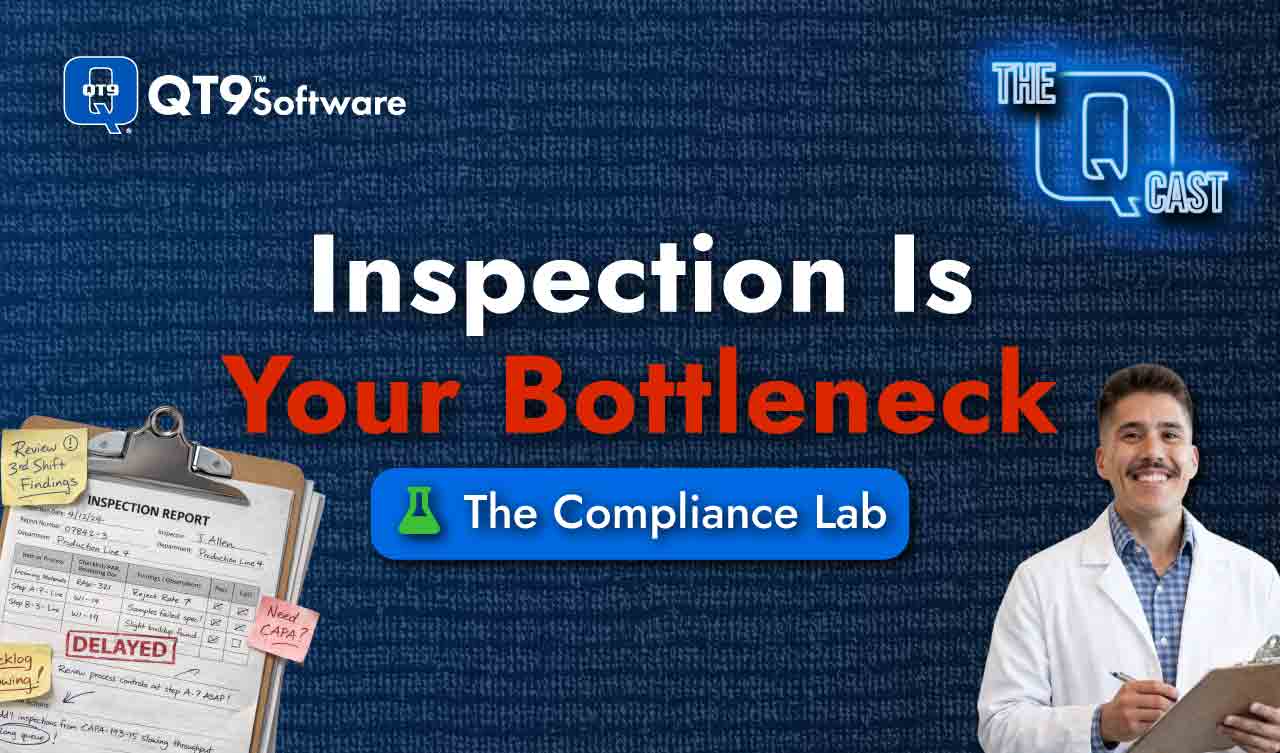
In this Compliance Lab episode, Christian Reyes breaks down a problem many regulated manufacturers quietly normalize: over-inspection. What starts as a reasonable response to a complaint, deviation, supplier issue, or defect escape can quickly become a heavier release process, longer queues, overloaded inspectors, and a slower, more expensive QMS.
This episode explains why inspection becomes a crutch, how one-size-fits-all checks distort risk priorities, and why many teams measure inspection touch time while missing the queue time that is actually choking throughput. Christian also walks through a practical 30-day implementation sprint: map the inspection path, segment controls by risk, pilot a smarter control strategy, and lock in governance so temporary checks do not become permanent drag.
If your organization wants to protect compliance without sacrificing flow, this is a useful reset.
Tags & Hashtags:
CAPA backlog, CAPA management, open CAPAs, CAPA workflow, CAPA triage, CAPA closure time, cost of poor quality, COPQ manufacturing, audit readiness, ISO 13485 CAPA, FDA CAPA requirements, quality management system QMS, closed loop CAPA, manufacturing compliance, QT9 Software
#CAPA #QualityManagement #COPQ #Manufacturing #AuditReadiness #QMS #ISO13485 #FDACompliance #OperationalExcellence #QT9 #QT9Software #QCast
Episode Transcript
Christian Reyes (00:03)
Welcome back to the compliance lab on the QT9 QCast. Let me paint a picture for you. A customer complaint comes in. Leadership gets nervous. Production is told to slow down. Quality adds another check and then another review and then another approval. And pretty soon everybody feels safer, but nothing is actually moving. Plots are waiting. Inspectors are overloaded and release is delayed. And your QMS starts acting less like a quality system and more like a traffic jam.
And that's what we're talking about here today, the over-inspection bottleneck. Because inspection is important and inspection has a place. But when inspection becomes the answer to every quality problem, it stops being a safeguard and starts becoming a throughput killer. And that is where a lot of companies get stuck. In this episode, we're breaking down what happens when inspection becomes a crutch, not a control, not a smart checkpoint, a crutch. And when inspection stops protecting quality,
and starts choking throughput. This is usually what happens after something goes wrong. There's a deviation, a complaint, a failed audit or a supplier issue. The fastest most visible response is to add more inspection and on paper that feels responsible. But in reality, it often creates a system where product is constantly waiting to be checked, rechecked, reviewed and approved while the real root causes stay upstream. So the business thinks it has become more compliant, but what is really done
is build a slower, more expensive QMS. And here's the dangerous part, teams can normalize it. They'll start saying things like, that's just our release process or quality has to review everything, or we'd rather over-inspect than miss something. But if inspection is covering for weak process control, poor risk decisions or missing metrics, and the system is not getting stronger, it is just getting heavier. So let's make this real. Imagine a regulated manufacturer
that had a defect escape six months ago. In response, they added incoming inspection on more materials, expanded their in-process checks, and then added a second final review right before release. Nobody ever removed these temporary controls. Now fast forward, production finishes on Wednesday, but the release does not actually happen until the following Monday. Inspectors are working hard, but the line is growing. Quality managers are spending more time reviewing routine checks
than solving actual quality risks. Operations gets frustrated, customers are starting to wait longer, and leadership thinks that the answer is to add even more review. And that is the over-inspection bottleneck. It's not always this dramatic. Sometimes it looks disciplined. Sometimes it can even look mature. But if the system keeps adding checks without reducing risk at the source, inspection becomes a place where throughput goes to die.
Failure number one. The first failure is relying on inspection to make up for a process that is not actually under control. This is one of the most common traps in quality. Instead of asking, why is this process unstable? Teams ask, how can we catch more defects at the end? That approach feels safe, but it's backwards. Because when a process is truly capable, validated, monitored, and understood, you shouldn't need layers of manual checking just to feel confident in the output.
The fix, move quality assurance upstream. That means identifying the process steps that truly drive quality. It means strengthening validation. It means clearly defining the control strategy. And it means being honest about which outcomes can be verified later and which ones need to be built into the process itself. In medical device environments, that may mean revisiting process validation. In pharma and biotech, it may mean stronger in-process controls.
better process understanding, and more justified real-time release strategies, instead of depending so heavily on end-of-the-line testing. The core idea is simple, build confidence into the process, not just into the inspection queue. Failure number two. The second failure is a one-size-fits-all inspection method. And this happens when organizations start treating every characteristic, every lot, every supplier, and every workflow with the exact same level of scrutiny.
everything becomes critical. Everything gets 100 % attention. Every exception turns into another permanent check. But when everything is urgent, nothing is prioritized well. A mature quality system does not inspect everything with the same intensity. It aligns control to risk, which means high risk characteristics may require 100 % verification or tighter controls. Medium risk areas may justify targeted sampling and trend monitoring.
Whereas low risk areas may only need streamline checks backed by supplier performance, process capability, and historical evidence. The fix, inspection segmentation, not random reduction, not blind cost cutting segmentation. Define what truly needs full inspection, define what can be sampled, define what can move to automated or inline controls. And most importantly, define when enhanced inspection is supposed to end. Because one of the easiest ways over inspection grows
is when temporary controls quietly become permanent. If a check was added after a CAPA, ask what evidence would allow us to remove it?
And if nobody can answer that, the review is likely more managing fear as opposed to managing risk. Failure number three. The third failure is lack of operational visibility. A lot of companies know how long an inspection itself takes, but very few know how long the product waits for inspection. And that difference matters because a 10 minute inspection step is not really a 10 minute inspection step if material sits for 36 hours before anyone touches it.
and that's the hidden cost of over-inspection. The quality system feels overloaded, but often the real problem is not the inspection activity itself. It's the waiting around it, the batching, the handoffs, the approvals, the queue buildup. And when nobody measures that, that bottleneck stays invisible. The fix, treat inspection as a flow problem, not just a quality task. Measure touch time, measure queue time, measure release cycle time, measure first-pass yield.
measure defect escapes, and measure appraisal cost. Then compare what the organization is spending on inspections to what that inspection is actually preventing. Because if inspection hours keep rising and escapes are not dropping, you are not buying more quality. You're buying more delay. So let's start to close this out with a 30-day implementation sprint. Here's how I would tackle this given one month. Week one, map the current inspection path.
list every inspection and review step from incoming all the way through release, and then identify which ones were added recently and why. Separate touch time from queue time, and that step alone usually changes the conversation. Week two, start to segment by risk. Identify which checks are truly critical, which ones are risk-based candidates for sampling, and which are compensating for controls that may be temporary. Put an owner on each one. Week three.
Pilot a smarter control strategy. Choose one product family, choose one product family, one line or one release path. Test a revised inspection plan with stronger upstream control, clear decision rules and fewer redundant handoffs. Week four, lock in governance. Set sunset criteria for temporary inspections. Define when additional checks can be added, who approves them and what evidence is required to keep them.
and then bring those results into management review. If you do that for 30 days, you won't solve every problem overnight, but you will stop confusing more inspection with better quality. Now, before we wrap up, let's talk a little about key metrics that matter here. When you're talking about inspections in quality management, there are a bunch of metrics that really matter because they help you understand not just whether quality issues are being caught,
but how well the overall process is working. One of the first metrics to look at is first pass yield. This tells you how many products pass inspection the first time without needing any rework, repairs, or extra attention. When that number is high, it usually means that your process is running consistently and producing good results right out of the gate. Another important one is defect rate. This measures how many defects are found compared to the total number of items inspected.
It's a simple but powerful way to see how often problems are showing up and whether quality performance is getting better or worse over time. The next metric is inspection acceptance rate. And this is the percentage of items that meet requirements and are approved during inspection. It gives you a quick read on whether your materials, products, or processes are consistently hitting the standards that you expect. You also want to pay attention to rework or reject rate.
This shows how many items fail inspection and either have to be fixed or scrapped altogether. And that is a big one because it points directly to wasted time, wasted materials, and areas where the process may be breaking down. And finally, there is inspection cycle time. This looks at how long it takes to complete an inspection from start to finish. It's an important metric even if your inspections are effective.
because they also need to be efficient so they do not create bottlenecks or slow everything else down. When you put all of these metrics together, you start to get a much clearer picture of inspection performance. You can see where quality is strong, where inefficiencies are creeping in, and where there may be more opportunities to improve both compliance and operations. In conclusion, if today's episode had one message, it's this. Inspection should support quality. It should not carry the entire quality system on its back.
When inspection becomes the default response to every issue, the result is usually slower release, heavier workflows, rising quality costs, and less focus on the true root causes. Build the quality into the process, match controls to risk, and measure the queue, not just the task. And that is how you protect compliance without sacrificing throughput. On the compliance lab, we walk through tips and ideas that can be applied in almost any ERP or quality management system.
The whole point of this series is to look at common issues in quality and in operations and share practical ways to tackle them so companies of any maturity level can work smarter and more efficiently. Of course, putting changes like this into action is a lot easier when your quality and operation systems are already connected. And that's one of the big advantages of using a platform like QT9, where QMS and ERP are built to work together and share information seamlessly. To learn more, check out qt9software.com.
Thank you for joining me on another episode of the Compliance Lab on the QT9 QCast. If you found this helpful, be sure to like, comment, and subscribe. And don't miss our upcoming releases of the Compliance Lab, QMS 101, and more exciting guest interviews. See you next time, and until then, keep improving and stay compliant.
Share this
- QT9 QMS (12)
- Manufacturing (8)
- QMSR (3)
- FDA 21 CFR 820 (2)
- ISO 13485 (2)
- ISO 9001 (2)
- Supplier Management (2)
- AS9100 (1)
- Aerospace & Defense (1)
- Analytics & Reporting (1)
- Business Intelligence (1)
- CAPA (1)
- CMMC (1)
- COPQ (1)
- Cannabis (1)
- Change Control (1)
- Continuous Improvement (1)
- Inspections (1)
- QT9 BI (1)
- QT9 ERP (1)
- Software Validation (1)