Share this
From Kickoff to Go-Live: How QT9’s Implementation Team Brings QMS Success to Life
by Christian Reyes on Jul 28, 2026, 11:48:44 AM
QMS Implementation: What You’ll Learn in This Episode
- Meet the QT9 QMS Implementation Team
- What happens during the first week after purchase
- Typical QMS implementation timeline and milestones
- Why preparation and clean data matter
- Common mistakes that delay implementation
- Best practices for faster adoption and user confidence
- How QT9 simplifies quality management and compliance
- Why implementation is a partnership—not just software deployment
QT9 QMS Implementation: Meet the Team That Supports You
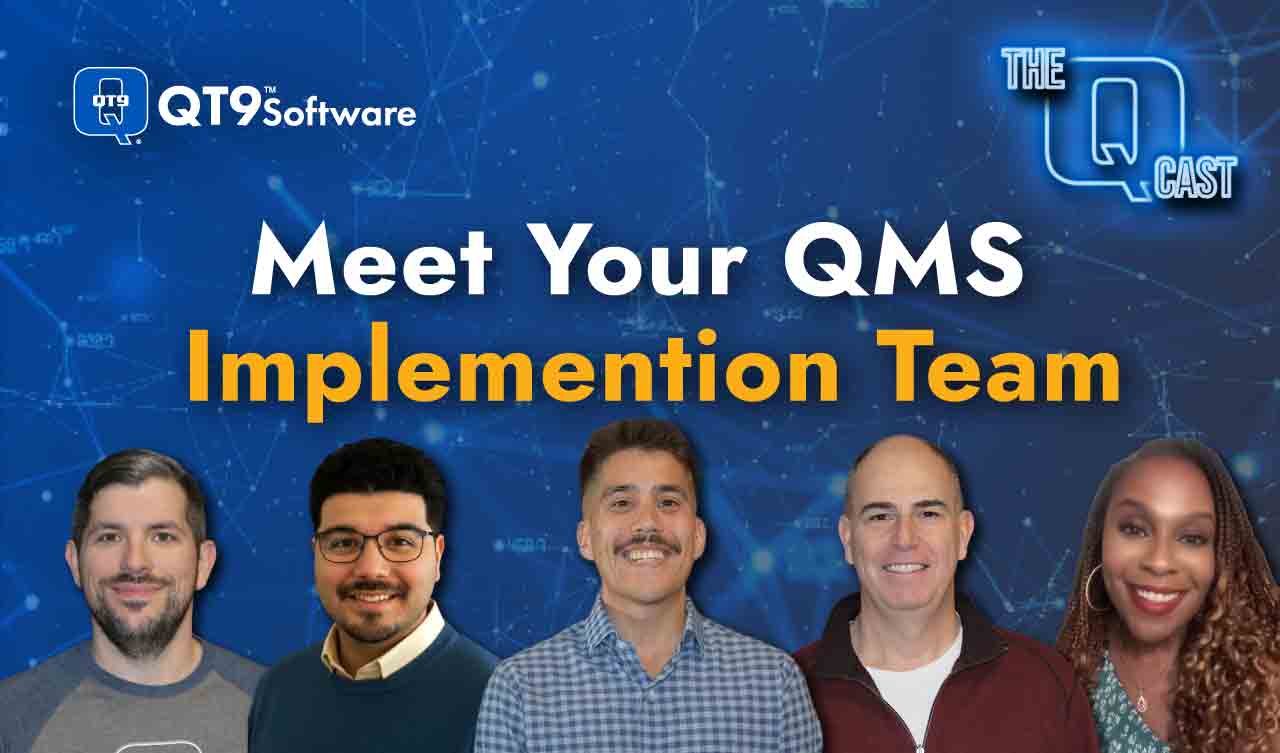
Episode 21: In this episode of The QT9 Q-CAST, host Christian Reyes sits down with some of our amazing QMS implementors at QT9, to break down how QT9 approaches QMS implementation and training for customers across regulated industries as well as their own personal takes on implementation.
The implementation process begins with onboarding, kickoff meetings, and administrator training before progressing into module configuration and education. The team works alongside customers to establish priorities, organize data, and ensure users are confident before go-live. Most organizations complete implementation in approximately three to four months, depending on preparation and internal engagement.
Successful implementations share several common characteristics: organized data, dedicated project ownership, team alignment, and a willingness to adapt existing processes. Rather than striving for perfection before starting, organizations achieve better results by working collaboratively and continuously improving within the QT9 platform.
QT9's implementation specialists, customer success team, and support organization work together to help manufacturers maximize their investment. By combining expert guidance with an integrated cloud-based Quality Management System, organizations gain improved visibility, stronger compliance, streamlined workflows, and greater operational efficiency across quality and manufacturing processes.
Learn more about how QT9’s integrated, cloud-based QMS helps organizations streamline compliance and improve operational visibility. Visit qt9software.com or request a demo to see the platform in action.
Chapters:
00:00 - Introduction: Meet the QT9 QMS Implementation Team
04:10 - Explain implementation
06:40 - What are customers trying to get away from?
08:20 - How long does implementation take?
09:30 - Is it hard to manage expectations?
12:00 - Keys to a Successful QMS Implementation
14:00 - Common Implementation Challenges and How to Avoid Them
15:40 - Tell us a special moment you had with a QT9 customer!
17:10 - What is one piece of advice you have for a new QMS customer?
Tags & hashtags:
QT9 Software, QMS implementation, quality management system, QMS training, QT9 University, CAPA software, document control software, regulated manufacturing, medical device QMS, pharma quality management, aerospace quality management, ISO compliance software, FDA compliance software
#QT9 #QMS #QualityManagement #RegulatedIndustries #CAPA #ManufacturingQuality #ISOCompliance #QT9Software
Episode Transcript
00:00:26 C
Sure, The buying quality software. Choosing a QMS isn’t really choosing software. Or just choosing software, it’s choosing a team. It’s choosing the people who help you take everything that you’ve got: your documents, your training records, your corrective actions, Your audits, all the moving pieces of your quality system and turning it into something structured, usable, and built to last within Qt Nine. So today, we’re pulling back the curtain on some of the people behind that experience : the Qt Nine QMS implementation team. I am sitting down with Kamikia Ricky.
00:00:59 C
Phil and James, and we’re going to talk about what implementation really means. What happens right after you sign on with Qt Nine? What the most successful customers do well, And how this team guides you from kickoff all the way through to go live. So whether you’re a Qt Nine customer, You’re getting ready for implementation or just trying to picture what that looks like after purchase, this one’s for you. Let’s meet the team. So let’s go down the bar real quick. Kind of start with some background. What did you do before Qt Nine? How long have you been here, and what is your favorite part of helping our customers implement?
00:01:32 Kemecia
So I’ve been here a little over a year now. And prior to this role, there was a common denominator in the roles that I had, and it was like project management, systems training as well as systems implementation. Okay. And so this role allows all of those skill sets to come together, and it was just a very natural flow. Getting into this role.
00:01:52 Ricky
Yeah, so I’ve been here for just about four years now with the company. Um, before believe it or not, I used to work at Best Buy in retail. So that was my uh skill set. So I know I remember when one of my first interviews here when I first started, you know, I was always nervous saying, like you know, like I don’t know the software, but when I walked into that interview, I did tell the person that was interviewing me saying, hey, i know people, and i know how to create those relationships. And sometimes you just need that normal guy behind camera. Really help out that person, and that’s why I feel like I’ve been really successful. And, it’s part of one of my favorite parts about working here is normalizing it. Qt nine QMS, like it is a really easy software, but at the same time it could be really difficult to someone new. I am the guy to make that easy. So that’s why I found a lot of success with my implementations on here. I am just an average Joe trying to help you out and then just learn the software and be successful with it.
00:02:46 Phil
So I’ve been with Qt nine for about a year and a half. Prior to coming here, I’ve spent nearly twenty years in implementation and training, having different roles like director of implementation with other organizations. I have a wide skill set, dealing with customers and helping them implement software solutions, something I really enjoy.
00:03:12 James
I’ve been here about six years; it’ll be six years in August, which is crazy because time goes quick here. But yeah, prior to here, I was a trainer at another enterprise software, and I was I started kind of like cut my teeth in SaaS. There it was kind of training implementation and then transitioned over here. I’ve been in implementation here ever since. I think for me, one of the key things or one of the things like I’ve enjoyed the most, I would say, looking at the different industries that we work with working with people you know, in med device, working with people in pharma uh people that you know.
00:03:46 James
Make that are in you know steel fabrication stuff like that. You get a, you get such a broad slice of the industry, and you get such a broad slice of process, the way people do things things like that. So I think the thing I’ve I’ve always loved and things I’ve always brought to implementation is, Taking a really broad based approach with everybody and trying to get people to understand that the standard is it’s not necessarily chapter verse letter. It’s more so understanding the intention behind it. And for me, like as as an implementer, That’s always been something I’ve tried to bring to the table from from the get go. And I’m sure you see that with.
00:04:21 C
Everyone that you speak to because you’re with them for a pretty good amount of time. Let’s say you’re at a backyard barbecue and someone asks you what implementation means. How do you explain your role to someone at a barbecue?
00:04:33 Ricky
Well, usually the first question they ask is, What is QMS? Right? What is that like? I don’t even know what that is. They kind of give me like that glassed eye look like Oh yeah. Well, what I always try to explain is just like, hey, implementation. I just make sure you understand the software and I just make sure that you’re confident in the software. And if you have both of those, you know it and you’re confident with it. You’re going to be successful with it every single time.
00:04:55 Kemecia
I look at it as purchasing software is like purchasing a gym membership, right? You can make the purchase but you have to show up. You have to put the time into it, and implementation is everything that happens after purchase. Successfully being able to use the software every day. And that’s what I get great joy in helping the people have those aha moments that allow them to build their confidence, like Ricky said, and find all of the ways that they can successfully implement the software and find ways to make it more effective for their business processes.
00:05:31 James
Absolutely. We’re there to spark ideas. We’re there to bring up, hey, does this process still marry up with the new system? Yes or no. And sometimes those are easy conversations, sometimes those are hard conversations. But that’s something that this team does an exceedingly good job at managing.
00:05:46 C
A customer just signed on with Qt Nine. What actually happens in that first week? And what should they expect from the implementation team?
00:05:53 Phil
So the first step in the process is customer receiving a welcome, right? And their credentials to get into the system. What we ask them to do then is to schedule the first call. That call is more of a get to know you. Setting the milestones, setting the expectations. You know, here is what you can expect from our team. Here are some of the things that we would expect from you to get the application from A to Z. And then once those are set, the rest of the team kind of jumps in. Right? We go to what’s called a kickoff call where we start to get into the application. The higher level administrators start to get into the application, and we kind of show them around.
00:06:33 Phil
You know how to organize their data, how to extract the data where the general settings are for the different modules, and then from there, really begin to get into the educational portion of the application. Learning about the different modules that they consider priorities to get up and running.
00:06:52 C
When customers come to Qt Nine, what are they usually trying to get away from spreadsheets, binders, applications, shared folders?
00:07:02 James
I’ve seen kind of the gambit in my time. You’ve got some people that are coming from a fully manual system, Like they are binders or spreadsheets with shared drive with files and folders and kind of the nightmare that that is of maintaining right. But you see people come from that. You see a lot of startups come in where they’re planning on building their quality system around what we do here at Q T Nine. So you get, You get that you get startups, you get people that are coming from mature quality systems, maybe from a you know different e Q M S. So, they already know some of the ethos behind e Q M S versus manual, But they also have to start flipping that switch of while it worked this way here. It works this way here. So you kind of run the gambit with that.
00:07:51 Ricky
I’ve noticed where the big thing that a lot of customers would really want to get away is inconvenience. I am tired of, Going to this folder, I am tired of finding these documents. I am tired of the sometimes misorganizations or hey, I am tired of findings. You know, like you know that can be a little scary too. But either way, Like that’s kind of like the big thing. And and that’s what’s really cool about what we have here. We try to simplify it and put it in one spot. So that when they go in, they know it’s in a safe spot, secure spot. They grab it and go. It makes their daily life easier.
00:08:23 Kemecia
There are so many people who reach out because they’re leaving the organization or someone else is taking on their role. Instead of trying to find out who used to be the owner of that binder or the owner of that process, all of that is now automated in our system. It helps with handoffs and changes in terms of personnel and things like that as well.
00:08:46 C
Absolutely. That’s big people do leave, people do move companies. It’s the business world we live in today. The question that every prospect asks: How long does a QMS implementation usually take, and what makes one implementation move faster or slower than another?
00:09:03 Ricky
So I always say, we’ve always noticed that we found a lot of success, and we always try to aim for that three to four months routine. We want to try to get you in and out within three to four months. And not just in and out. You understand the product, you are confident with it, and you are able to use it right after.
00:09:19 Phil
I think a lot of it depends on, The time that customers have available to dedicate to the project, okay. Setting realistic goals if you have personnel, If you have the resources to give to the project implementation is going to go very smoothly. And having the data, you know, All of your customers and your suppliers and your product information gathered, right? And you know where it is and it doesn’t need to be cleaned up, everything moves.
00:09:50 Phil
Very, very quickly, but the planning on the customer side is very, very important.
00:09:56 C
Absolutely. Have you ever run into a situation where it’s difficult to make the expectations realistic? They come in with unrealistic expectations and you’ve had to adjust?
00:10:08 James
I’ve seen it a lot over my years here. I think what I think what some people think is that, And I think this is any system people have the the mentality of, well, I am going to come into the system and I am not going to change anything. I am not going to have to adapt to a new system. Um, the system is going to mold to me and that’s not always the case. I mean, I think the statistic or like what people always kind of talk about or joke about in sales cycle, you are going to get about eighty five percent of like your process into there and the other fifteen twenty percent.
00:10:40 James
That flux is really going to be like you having to adapt. Somebody may have a what they consider like a rock solid document control process, But it may work for manual where in an eQMS adding, all those layers is going to become painful. And it’s going to slow the process down. But the other thing is having that adaptable mindset, Understanding that we’re going to help you get to a more efficient place and a place that’s super compliant with ISO, but you have to have that trust. That we’ve done it, we’ve been there, and they have to have that adaptability to say like okay, I have to get out of this mental pathway, and I have to kind of cut a new one. So the adaptability, preparation and honestly like clean data. If you can get those three things, That’s like a unicorn implementation. Because at that point, those are the people that are going to be in. And out in a month because they know what they know what to expect. They know like we’re going to adapt, and they know like we’re going to come prepared.
00:11:38 James
If you get all three of those things, or if you use an organization of those three things, we’ll have you in and out before you can blink.
00:11:45 C
I am hearing you guys can move as fast as a customer wants to within realistic. That’s awesome.
00:11:53 Ricky
That bar we love matching it. We’re all about that. We want that because we want you to win. I am excited for the software. I hope you are excited. Get in there, make your life easier. Let’s do that.
00:12:07 Kemecia
And Like Phil mentioned a little bit ago, he talks about the pre- implementation call, the kickoff call. We provide them with so many resources. So we are resources as well, but our implementation plan that we provide to our customers has so many resources. So if they were self- directed in their learning style, They can go there and they can learn as much as they want about all of the different modules that we have. And then use us as resources to help along the way. So you are exactly right, Christian. It moves as fast as they move, and we’re flexible enough to move with them as well.
00:12:42 C
That’s awesome. That’s great. What did those companies have in common?
00:12:47 James
But I mean, from my like to me like the ultimate like unicorn customers, they’re the ones that come in. And they know. Already, Like here is what here is where we they have a mental idea of where they want to be. They know what their priority modules are from the get go, not just the ones we recommend. They know what they need from a business case to, they already have been doing the homework, um from their sales room from looking at the documentation that’s provided. Honestly, It’s kind of like going to college when you when they actually tell you to read the course syllabus. Yeah.
00:13:23 James
So, if you are doing that during the sales process, Those people come in. So well informed about what we’re going to expect of them and what the expectations they should have of us are. So having having that, but also having a sense of unity within their team. The amount of times you’ve got a leader coming in bringing this new system in, but people can’t agree on well what type of corrective action. What’s the corrective action types we’re going to have? They haven’t had those conversations yet. They don’t know how they’re going to categorize. And those are things that slow things down. If you can’t get unity or consensus on, hey, all these sites need to have these corrective action types, these problem types. If they don’t have that sense of identity with that, you’re going to run it like that is going to slow things down. But the smoothest they have unity across the board. They have a they have a group mentality where they are ready to go as a team. Like I talked about, they’re adaptable and they’re prepared.
00:14:21 James
If they have those traits, they will have a successful implementation with what we provide. It’s that simple. It doesn’t have to be anything complex. It really is that simple. And I understand simple isn’t always easy, but if they have those things, everything gets smoother.
00:14:37 Ricky
Because I always forget that our forty hours is this, their forty hours is their job plus this implementation. It’s a good point. So I always want to make sure like hey, I understand life is out there is happening, What can I do and how can I support you in the goals that you are making to get you done next week? So, as I always say, like, you know, if you are about to climb a difficult set of stairs, what’s the easiest way of doing it? Just take the first step. So what is that first step going to be for you? Right. So and that’s that’s really where I try aiming for there.
00:15:07 Kemecia
So James mentioned the unity in terms of having the personnel on board and having the buy-in for this major change. And then Phil mentioned the organization and the preparation around getting the data together and in the system. Ricky mentions relationship building. All of those things have really aided in my smoothest implementations because I get to know the customer and I get to know what it is that they’re looking to solve by implementing the software.
00:15:38 Kemecia
And then we work to figure out those solutions. As long as they are continuing to meet with us with some type of frequency or regularity, everything flows very smoothly because there is constant learning happening, and there is constant sharing of knowledge that they then go and share with other members of their organization.
00:16:00 C
Great answer, everyone. Real team effort on that one. So here’s the honest one. What is the most common way you see a customer accidentally slow down their own implementation? And how do you get them back on track?
00:16:13 Ricky
I think for me is that yes, self drive right like it’s really hard to sometimes like sometimes we get customers who just completely disappear, you know and we’re trying to do whatever we can to reach out, get them back on track whatever. Um, but something either happens and like I said before, life happens, right? But just know that we’re always here to support that. But sometimes that may overwhelm it, and they like things may happen where they put other projects or other things focusing on their daily life or on their work over the QMS implementation. And that is sometimes like you know you purchase software, right? And we’re here to help you win. I want you to win and I want you to make sure you are there and ready to go. And.
00:16:56 Ricky
When they lose that contact on there, like we we we look forward just a little bit of the contact. That’s it. Like we understand, like hey, this is what’s happening and this is what’s slowing us down. We’re going to ask you the same question, how can we support you after that? Right? But please just contact us. You know, like tell tell us something. You know, like but when they go completely like empty in darkness, Like that’s where we were like if we were like, hey, you know, we want you to win, where are you?
00:17:21 James
I would say one particular thing I see that slows people down is almost, and this is usually related to documents and document control. Which topic is relevant for just about anybody going to an EQMS. But one of the biggest things that will block people is if they’re like, okay, well we have to have the documents perfect before they come in. Or they’re at that almost like a decision lock where they can’t get past it. Do I make sure the documents are perfect before they come in or do I bring in everything?
00:17:53 James
And then I start using the system right off the bat. Like, so if you know for me, I would err on the side of being a little bit more aggressive. Where it’s hey bring in everything. You may you may know? Hey, we’re going to use your kappa process, but we still want to bring in our old document. That’s great because when you import it, you are going to review it, You are going to then obsolete it in the system. And then so hey, guess what? You are now using the system and your obsolete. You now have history Inside the system, you are starting to build that story right off, you know, right from the beginning. So that decision of do I perfect every document that slows things down. That mentality of like, oh, it’s got to be perfectly clean before it comes in. I am going to be the first one to tell you especially for documents, It doesn’t have to be perfect as long as you’ve got a plan that you can prove to an auditor because we’ve got the timelines. We’ve got everything you need to get there, but people get so caught up in that initial data phase.
00:18:52 James
So that quest for perfect slows things down.
00:18:56 C
For sure. Can you tell me about a time you helped a customer realize there was an easier way to do something in Qt Nine than the specific manual process they were used to?
00:19:05 Ricky
I had a good moment with the customer and it was a long call, but it was it was so worth at the very end. And it was basically a change control process that they had. You know, we have to follow A B and C every single time. And before B happens, you know one two three needs to happen and everything from there. And I remember just, Talking to the customer and saying like you are able to do that all in one spot. And finally, I went to the point where I was like, “What is making you say no to this? What is making you say what is going on? Why such a difficult understanding of that?” Right. And the customer just kind of just looked at me, just like it’s just too easy. It’s just too easy. You’re telling me I don’t need to do it. I’m like yeah, like that’s it, you know? And and I just remember I was just like looking.
00:19:49 Ricky
There was this amazing silence. He didn’t have his camera on. I wish he did. I remember that. I could hear the guy Chris Ryan. He’s just like Ricky, do you know how much easier this is going to be from now on? That’s what we’re.
00:20:06 Phil
Here’s music to your ears, just like that happened because you were asking probing questions. Very important during an implementation asking the questions probing, wondering, if you are doing this now, what do you anticipate doing at some point in the future? Asking questions is critical.
00:20:27 C
Fantastic. What would you have as one piece of advice for a company starting its Q T nine journey next week? What would you tell them?
00:20:38 Kemecia
Book a call with Phil.
00:20:41 Phil
Immediately. I would say just come in and be as organized as you possibly can. I mean, you know, through the sales process, you know what you are getting into. And you’ve already had that great interaction with our sales team. Begin as soon as you can begin to gather that data. Begin to organize. Begin to determine here are the roles within the implementation that we want the team to play You know, Phil, You are going to be responsible for gathering all the data at least initially, right, and then You know Steve or Tina, you are going to be the one who’s managing the project internally.
00:21:15 Phil
Being the main point of contact, so just the organization piece before the implementation process even begins.
00:21:23 James
If you treat us like a partner, If you understand that we are here to support your success and all we want is that success and that return on that investment. If, you can keep that in the forefront of your mind and like I talked about earlier, be adaptable. If you can do those things, that’s a superpower. For being able to implement a piece of software, so you have to be willing to take that ownership up front. Use the use the resources that are here and realize that you’re not just buying a platform, you’re buying partners. And you have a whole army of partners behind you, not just implementation, customer success support. You’ve got an entire ecosystem of partners here at this at the company that wants nothing more than you to win. So, if you can come into it with that mentality, and you can see us in that light, not just like your your vendor.
00:22:09 James
I guarantee you, your mindset will change. You will be successful if you approach it that way.
00:22:15 Ricky
To add on top of that, I would say the biggest thing I would advise is trust software. Right? You you got here for a reason. Uh, you chose this software for a reason and I understand change is never easy. Mhm Everyone has to go through it. Everyone handles that way differently. What I can confidently say that you could trust the software. You know, you may not trust me. That’s fine Like, you know Hey maybe not happen like But either way like, There’s a reason why you purchase that software. There’s a reason why you are confident in the purchase that you made. You went through that whole experience of buying that software, or even if you’re not the person who made that purchase, people around you, that work with you every single day, made that decision for you too. So did you trust that? You know and trust the software in doing what you want to do because we’ll support you every single part of the way. But just know that it’ll help you. It’s going to make your process easier.
00:23:06 Ricky
Just be ready to learn what that is.
00:23:08 C
Fantastic. Thank you all for joining me today. We really appreciate you giving your perspective and perhaps we’ll have the rest of the implementation team on at some point. But, until then again, thank you for your time and to our listeners. Thanks for joining in.

Share this
- QT9 QMS (12)
- Manufacturing (8)
- QMSR (3)
- FDA 21 CFR 820 (2)
- ISO 13485 (2)
- ISO 9001 (2)
- Supplier Management (2)
- AS9100 (1)
- Aerospace & Defense (1)
- Analytics & Reporting (1)
- Business Intelligence (1)
- CAPA (1)
- CMMC (1)
- COPQ (1)
- Cannabis (1)
- Change Control (1)
- Continuous Improvement (1)
- Inspections (1)
- QT9 BI (1)
- QT9 ERP (1)
- Software Validation (1)