Share this
Episode 6: High Cost of Low Quality: QMS in Cannabis
by Christian Reyes on Dec 16, 2025, 9:11:30 AM
Watch Episode 6 Below
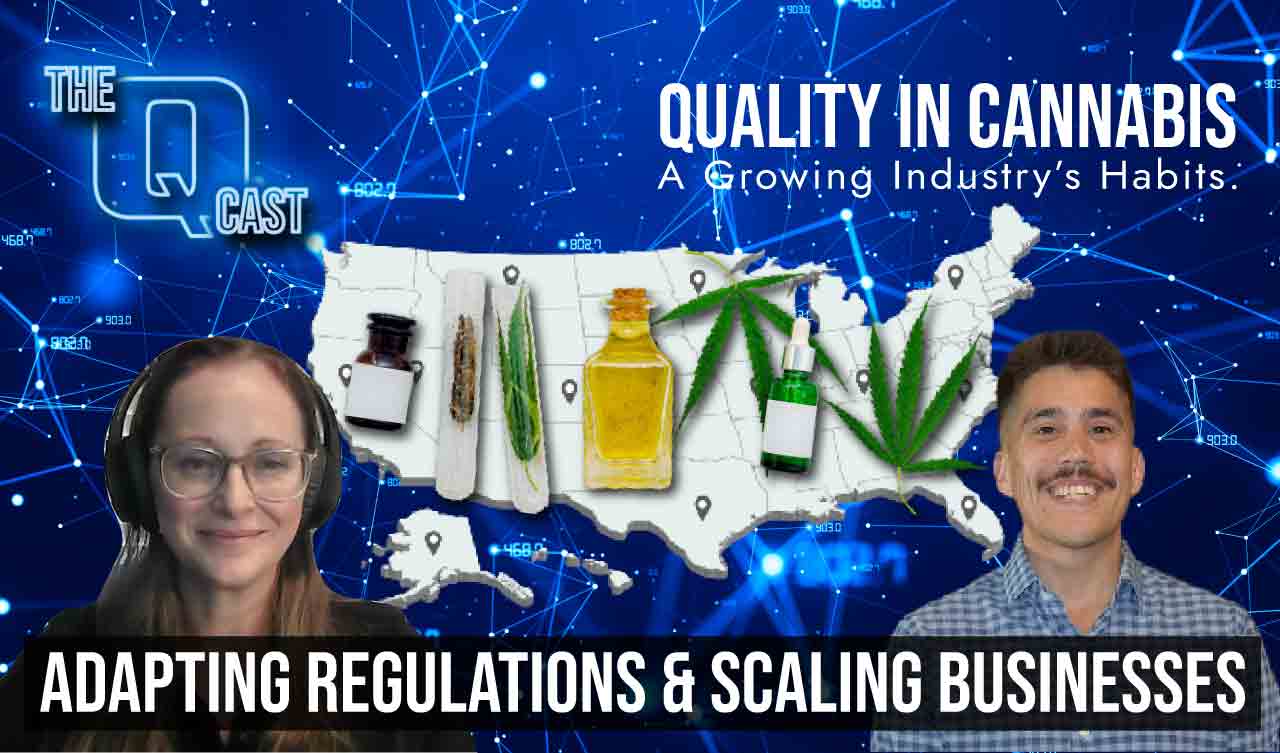
Episode 6: In this episode of The QT9 Q-Cast, host Christian Reyes sits down with Samantha Miller, pioneering cannabis scientist, quality expert, and entrepreneur, to unpack what quality management really means in the rapidly evolving cannabis industry.
As cannabis businesses scale and face increasing regulatory scrutiny, the need for structured, defensible quality systems has never been greater. Samantha shares her firsthand experience helping cannabis companies transition from informal processes to robust Quality Management Systems (QMS) that support consistency, compliance, and long-term operational success.
The conversation explores:
-
Why quality management is a competitive advantage, not just a compliance requirement, in cannabis
-
Common challenges cannabis operators face when implementing QMS frameworks
-
How ISO standards can be adapted to cannabis operations and laboratories
-
The relationship between quality, data integrity, and operational excellence
-
How regulatory compliance impacts growth, investor confidence, and brand credibility
Samantha also discusses how quality systems help cannabis companies prepare for future federal oversight, reduce risk, and build repeatable, scalable operations—lessons that apply across all regulated industries.
Whether you are a cannabis operator, quality professional, or business leader navigating compliance in a highly regulated environment, this episode delivers practical insights on turning quality into a strategic asset.
Connect with Samantha Miller:
Website: https://pureanalytics.net
Email: info@pureanalytics.net
Hashtags:
#CannabisIndustry #QualityManagement #QMS #ISOStandards #OperationalExcellence #RegulatoryCompliance #CannabisCompliance #QualitySystems #DataIntegrity #ContinuousImprovement
Episode Transcript
Christian Reyes (00:00)
Hello, welcome to the QCast. My name is Christian Reyes and I'm your host.
Today we're gonna be talking about cannabis and quality management. And I'm excited for today's episode. It's one that I have been personally involved with here at QT9, as well as just the sheer amount of questions that we get from people surrounding how quality management is handled within the cannabis industry. the cannabis industry is one of the fastest growing, most dynamic
in the modern world. today we're really gonna try and put quality management into the cannabis context. And joining me today is Samantha Miller. Sam is a pioneering cannabis scientist and successful entrepreneur, has been featured in Forbes as well as in Rolling Stone Magazine.
Sam founded Pure Analytics Lab in 2010, one of the first licensed ISO accredited cannabis testing labs. And she was the founding chief science officer at DOSIST, whose DOSPEN was named one of Time's 25 best inventions of 2016. Sam now leads the Pure Analytics Innovation and Consulting team, advising companies on quality, product development, and scaling sustainably. Sam, welcome to the QCAST.
Samantha Miller (01:07)
Really excited to be here, Christian, and talk a bit more about the solutions that I think QT9 can really bring to cannabis companies that are looking to take that first step to the next level of operational excellence as they transition out of that startup mode to a more mature operational model.
Christian Reyes (01:23)
For sure, it's obviously a relatively new industry, It seems like a lot of companies are kind of getting to that point where it's a little bit out of startup mode. You you've been operating for a number of years. You've got processes set in place and it's a little less shoot from the hip, But just to start kind of.
in terms of the quality management systems as it relates to cannabis for those wondering, is there a specific standard? Is there an ISO standard? Are there any FDA regulations? Is there a hard compliance that's been posted for the cannabis industry?
Samantha Miller (01:58)
You know, depending on what area of the cannabis industry you're working on, there's probably a different ISO system that best applies to you. You know, for example, in cannabis laboratory analysis, ISO 17025 is actually prescribed by the regulations so requirement. In other cases, in say a manufacturing type business, ISO 9001 may be more appropriate. In a cultivation business, it might be GACP or it might be ISO 22,000. Also in manufacturing,
might
be ISO 22,000 or a combination thereof. So there's a lot of different flavors of ISO, so to speak, to choose from. And in some cases, it may be a combination of different types of quality systems. Say for a business that has complexity and is operating across multiple different license types within a regulatory system, they may have a need for a GACP for their cultivation side and a need for ISO 22,000 as they move into the making of their product.
and the control of those outputs. there's definitely a variety of systems to look at. And so the first step is really understanding what system is right for you and what best applies to your type of business. That's pretty obvious once you dive into them as they're geared towards manufacturing, laboratory, food processing, cultivation, and things like that. So that's probably the first step. And ultimately,
The quality system really goes way beyond quality and is ultimately an operational tool that helps create structure across your organization.
Christian Reyes (03:26)
Absolutely, I've talked to numerous quality teams over the years, in my years as a trainer implementer at QT9. And there does seem to be a bit of a push and pull, right, between the quality team and operations teams. Yes, yes.
Samantha Miller (03:40)
and engineering and finance and marketing. Yes, indeed.
Christian Reyes (03:45)
Do you see that in the cannabis industry as well?
Samantha Miller (03:48)
I think that's something that's just ubiquitous around operational structures. There's often natural alliances between different factions and companies and kind of natural tensions. often say there's a natural tension between engineering and operations often. One is the developer of the idea and the other is the one that actualizes it. And in between that, there's both collaboration and the tension. And often that's where operational excellence actually arises from.
And it's been my experience that quality is often one
one that steps in and has that point of view that unifies both sides and finds a solution oriented approach that meets the needs of both the customer and the business. And in that way, I'd say that one of the, I think one of the most important facets of quality systems, especially as organizations grow, is that unification that it brings to the voice of the customer, the voice of the business and the voice of the employee,
Christian Reyes (04:39)
And that can tie into the return on investment that you see from running a quality management system. It's not just, we need to check these boxes and we need to have a log of corrective actions and we need to have our control documents.
as not necessarily the best way to look at quality, right is just a box to check off.
Samantha Miller (04:56)
Well, you know, that's an interesting comment, Christian.
Quality can very easily become a cost center, but in its best form, quality is something that helps propel the business forward, that helps the business save money because it's driving operational excellence, it's driving efficiencies, it's identifying things that aren't working and finding a solutions-oriented approach that's in alignment with, say, Lean or Six Sigma or the other operational excellence initiatives
a company has and making things work. And I think that quality, as we've been talking about, becomes a very unifying force across all of that.
Christian Reyes (05:30)
Yes, yeah, absolutely. In regards to how cannabis companies currently approach their QMS, obviously you work with a number of different clients
In general, how do you see most cannabis companies approaching quality management Can you give us any perspective there?
Samantha Miller (05:47)
Sure, know, Christian is quite a spectrum. You know, just like in any industry or any market, there is a variety of scale of operators from smaller to larger. However, quality management systems tends to be one of the last ones that cannabis operations layer on.
I'd say in smaller companies, quality probably takes the form of it may just be a technician or a lead who's checking the quality of product on the line. And other facets of what traditionally be a quality role are spread across multiple different individuals in an organization. I'd say that's probably the scrappier, smaller company mode where you see everybody participating in quality, but it's not necessarily anybody particular's responsibility.
Christian Reyes (06:26)
Sure. Sure.
Samantha Miller (06:26)
Then
you see other more mature companies who have done the development of a quality department. They've hired qualified personnel. They've implemented systems. In many cases, one of the things I see around quality and cannabis is that they may hire in the people, very qualified people who build great systems. But because at the very top, the management isn't aware of the function of quality systems, how they work, and the magic, quite frankly, that they bring to an organization.
they don't necessarily provide the support and the buy-in that you truly need in the best implemented quality systems to get the broad adoption and the culture change that comes with it. Because at the end of the day,
That's one of the biggest hurdles that one is leaping over, whether it's in cannabis or another startup marketplace, is that culture transition from startup mode where everything is get it done, get it done fast, who cares how much it costs, right? Throw money at it and get it done. And then as we fast forward into the later parts of market maturity, it's get it done as cheaply as possible, get it done on time, but get it done as cheaply and efficiently as possible, right?
Christian Reyes (07:32)
Yeah.
Samantha Miller (07:37)
And so that...
What goes along with that, of course, is having to build additional systems that focus on efficiency and cost. And there's a change in culture around that. That has to happen for that adoption to truly be reflected across the organization from engineering to operations to marketing and finance. So I'd say that's one of the biggest hurdles. And it's probably the place that a lot of cannabis companies find themselves is in that transition phase with systems that perhaps they've built. Maybe they've got a document system.
Maybe they've got a corrective action system, but it's not being lived 100%. And that's probably where I see the majority of the larger companies in cannabis existing right now is in that state. And they just need that final and a keystone moment, resource and tool to take them to the next level and to really drive that culture change.
Christian Reyes (08:27)
Absolutely, as we've discussed, there isn't a specific standard, but as with every industry, quality has a
terminology, some jargon that is prevalent throughout the standards, throughout documentation, what have you. for cannabis companies that are kind of new to the quality game, jargon can be a barrier to entry. It can be a little bit hard to understand. ⁓ you have any suggestions or any specific resources that you would
Samantha Miller (08:37)
Yes.
I agree.
Christian Reyes (09:00)
point a cannabis client to in terms of that very initial introduction to quality and defining quality terms within the context of cannabis.
Samantha Miller (09:10)
Well, know, Christian, it's interesting, I think.
know, jargon is a choice that you make, but you don't have to live that. You know, one of the things I thought that I saw about the Qt9 software interface when I compared it to other quality management software solutions was just how actually intuitive the language was and how absent jargon that may be alienating is to people. And I'd say at the end of the day, the problem with jargon is it's just that, to many people it's alienating. And when you consider that, there's many
Christian Reyes (09:14)
Yeah.
Samantha Miller (09:40)
tiers of a company that are going to engage with a quality management system and the tools associated with it. Some of those people may be quality professionals and some of them are certainly not. Some of them may be the lowest level workers in the company who are interacting with the tool and with the system. It needs to be intuitive and clear and understandable to everyone. And so just because the standard ISO language uses particular words, it doesn't mean that you have to use those.
you can use words that mean the same things, that are easier, more intuitive to your staff to understand. And in many cases in cannabis between management and workers, there may also be a difference in native language. And in that case, jargon actually becomes even more difficult to use. And it's important to choose intuitive language to use to implement your system. And like I said, it's one of the things I really like about QT9 is it really doesn't force the jargon on you. It's up to you how
Christian Reyes (10:23)
yeah.
Samantha Miller (10:34)
you're going to reflect that within your system. But in terms of the interface, very clear and very intuitive and easy for a team to learn and implement even if they don't have a deep background in quality systems, which in the case of most cannabis companies is what you should expect to be the case.
Christian Reyes (10:48)
Sure, sure, now that makes sense. As we discussed, there's not a particular regulation that says you need to have this quality management system, There isn't a ⁓ specific way that the quality management system needs to be documented. But that being said, obviously, as you and I well understand,
there is a huge benefit to putting these systems in place. Outside of just we need to have something that complies with this regulation. It's looking at it, like you said, taking quality kind of out of just a cost center where you're paying this to check this box, but it's actually a tool or an archetype that you can use to strategically grow, to scale your company.
Samantha Miller (11:20)
Yes.
Christian Reyes (11:28)
to enter new markets, product development, literally every facet of business can be driven by the principles that are established within the quality management system. Could you just touch on for a few moments some of the tangible benefits that you've seen with companies that you've worked with in the cannabis industry that have taken formal steps to putting a QMS in place?
Samantha Miller (11:49)
Yeah, there's so many benefits, Christian. At the end of the day, it helps institute an operational excellence mindset. As I said, I really feel like the first step to that next level of growth for any business is the culture shift that happens from startup to that more sustainable business model.
And it's actually the tools I think that we put around it, one of which is the type of reporting and executive dashboard visibility that you can get from having implemented these systems. One of the things that people in cannabis really struggle with at the top is making decisions based on data rather than a thumb in the wind.
So when your systems aren't talking to each other and they're not coordinated, it's really difficult to say, what is my cost really in this area? What are the major risks to my business? I've got X capital dollars to spend in this period. Where are they actually best spent to prevent risk, to promote a growth?
Quality management systems and the data gathering and the reporting that it does provides really key visibility to do data-driven decision-making at the top level of a company, whether it's cannabis or otherwise. But that's one of the things that cannabis companies really struggle with.
Now there is a lot of regulation, Christian, it's actually one of the biggest operational challenges that cannabis companies have is they have this very long list of very specific requirements that they will be audited upon and that they actually represent an enormous risk to their business that if they don't meet one of those requirements they could lose their license. They could be fined, a significant fine, $40,000, $50,000, $100,000, $200,000. These are the kinds of fines that you see around cannabis license violations, right?
So there's a long list of requirements for manufacturing, a long list of requirements that's different for cultivation, and similarly for laboratory. And so the quality management system
becomes a structure which you integrate all of those requirements into the organized structure of the quality management system. And it creates a cohesion across for what many licensees feels like a scatter shot of requirements. You can actually create a cohesion
across those requirements that drive results for your company, that create efficiency in your reporting requirements to your regulatory agencies, and have you in the ready for any audit that could cross your desk. And that, Christian, is becoming more more important.
As cannabis markets mature, regulators do as well. And what we're seeing is that while there's been an absence in regulatory action in the last, three to five years in many of the large markets, there's been quite a step up. California is one state to note, where there's been a significant increase in regulatory enforcement. So it was the case where operators could have gone for a couple of years at a time, perhaps, without an audit, without a regulatory inquiry.
So maybe I'm not going to fill out that form each time because again, it wasn't part of a cohesive system, just part of a list of requirements that need to be fulfilled. in integrating those requirements into a quality management system, it makes it easier for your team to fulfill. creates systems of accountability and visibility to senior management. So you know, if these things are happy or not, you can evaluate your own risk and you can take action if you need
to
say we need to apply more resources to this regulatory requirement that's not getting done. We need to be in compliance. So I think in that way, you know, the quality management system, the way it shows up now and the way it could show up in the future for cannabis is really something that's going to drive the odds of is who is more successful and not.
Christian Reyes (15:14)
For brands that are scaling to new states, what's kind of the minimum viable QMS processes that you would see or that you would suggest that keep quality consistent across co-manufacturing sites?
Samantha Miller (15:25)
they really need a complete system. They really do Christian. At that point, if you want to keep things in control and you want to have control over the output of your product, if you're okay with huge variation, lots of downtime, of loss, then hey, have at it without structure. at the end of the day, it's that structure that allows you to reflect what you did in one location to another with integrity.
Right? You know, one of the things that was a big lesson for me in ISO and the building of systems was building my own for my own laboratory. We started out very small as just a few people. And even though I'd come from very large companies with huge quality management systems, I thought to myself, is this really necessary for three to five people? I really need all these controls or am I just adding cost?
by putting all these requirements on my operational work that, I mean, I can control the outputs of three to five people, can't I? And what was fascinating, Christian, was even though I there every day, the answer is no, I could not. No, I could not. And it was a lesson I had to learn for myself because it was obvious to me, yeah, you need it for a hundred person company. Of course you do.
Christian Reyes (16:25)
Yeah ⁓
Samantha Miller (16:35)
I needed it for my five person company to control the outputs, to maintain the integrity. And that's even more of the case when you're taking an already functional complex organization that's already grown to a certain size of significance and then reflecting that in a whole other physical space with a whole other team. You got to have great documentation. You got to have great change control. You have to have excellent corrective action, preventative action. You need management reporting. need internal
it. You need all those things or you're not going to have your eye on the ball in a way that's going to make sure you get to keep what you just grew.
Christian Reyes (17:11)
Absolutely, It's not just one process that you have to do. It's numerous. And you've got to keep them in line. And any changes that might occur in one process, will it change in the other process? And if so, how are we going to control that? What are the risks relevant to this scenario?
Samantha Miller (17:27)
And then I think also that from on the multi-state operator basis, the quality management system lets them compartmentalize a little bit better and not have to reinvent the wheel for each new state in each new location they do. Now, one of the things about ISO as you know, is that it's specific to a location, right? So your ISO accreditation is specific to a physical location, but you can certainly take the core aspects of that system and reflect them onto as many locations as you want with the minor changes and tweaks that you need to accommodate the
specific
regulations of that region or the specific subset of processes that that location is going to perform. So not having to reinvent the wheel every time you go to a new state from a quality systems perspective, but then also providing the cohesion and visibility of all your different locations, quality systems rolled up into one dashboard view is really valuable.
Christian Reyes (18:17)
Absolutely, absolutely.
I just wanted to get a little bit of information on your experience in terms of manual systems.
Is it has it been your experience that cannabis companies are you know more inclined because I would say personally in in almost every industry that I've worked with 9,000 one and above top management's initial, reaction to quality is let's do a manual system Why do we need to pay for something? Let's just let's just structure. Let's just build it out Do you see that in cannabis or do you?
Are people more open to kind of that initial jump going straight into EQMS?
Samantha Miller (18:55)
You know, what's one of the amazing things about cannabis is an industry. It is an industry of early adopters as people who are
hungry for solutions, technology-based solutions that can help them amplify their resources because everybody has fewer resources than they need at startup. And so the first time that I evaluated the QT9 solution was really an aha moment for me. At the end of the day, I first approached it just looking for some document control software because that's probably the majority of companies that I've worked with,
Christian Reyes (19:12)
yeah.
Samantha Miller (19:26)
at the very minimum, they'll have a document management software. And so I was somewhat in that mode myself of like, well, you document manage, that's the bit you need that because it's really difficult to do change control on documents and all of the notification follow up that you need to do if you're running your system properly, just as an individual, if you have a system of any size, more than five people, right? So, so. ⁓
Christian Reyes (19:47)
Yeah.
Samantha Miller (19:49)
I went into the mindset of what I really needed was document control. But when I got into the software and I saw everything that it did for me and understood what that meant in the context of my role as a quality manager or quality director in different jobs that I've had, it was a no-brainer from a value
And I think that's really the beauty of a QMS solution is that it really does allow you to amplify your resources. And the automation lets you focus on the value-added work in quality. Why are there as a quality professional isn't just to email people like, did you get your car done? Right? To really bring your knowledge to the table and help propel your company forward. Because I tell you, quality people
Christian Reyes (20:21)
Yeah.
Samantha Miller (20:28)
They are hands down the most passionate people in any business that I have ever met. They care so much. That's why they do what they do. You can't be in quality and not care, right? They care so much. So letting them perform their value added work rather than menial tasks, they can really bring a whole other level of excellence and...
Christian Reyes (20:39)
Yep, 100%.
Samantha Miller (20:51)
and momentum forward to project tasks, to the cohesion between all the different facets of the system that fall into them, from maintenance to quality alerts to corrective actions to change control to document control. And it goes way beyond quality at that point to become an operational tool that helps create structure, drive results and provide clear visibility to management on operational performance and completion of key tasks and projects.
on target on time.
Christian Reyes (21:17)
Just kind of wrapping this up here, are there any myths that you've ran into that you want to dispel today for our listeners? Whether it's about potency or terpenes or lab shopping.
Samantha Miller (21:25)
Go.
You know, on the laboratory side, the controversy is real. There are a lot of unscrupulous operators and there are a lot of desperate operators. And both of those groups of people are susceptible to influence.
of doing other than the most above board things with respect to potency results. I ran the longest operating cannabis laboratory in the US for 15 years. The reason I actually stopped providing laboratory services was it just wasn't an environment in California that I felt I could operate in because of the context of people demanding that you falsify their results. The clients actually overtly demand falsification of their results. And if you won't falsify their results,
Christian Reyes (22:01)
Wow.
Samantha Miller (22:06)
don't get the business.
You know, there was probably even the last six months that I provided laboratory services over 30 people who expressly said that to me. We think you're great, great service. We love working with you, but we need potency results that are up here, which were about 50 % higher than what their actuals were. So the inflation rate, it has varied over time. The majority of service providers seem to inflate about 25 to 50%. Some of them actually double results, and that's real.
Christian Reyes (22:22)
wow.
Samantha Miller (22:32)
There's lots of, I say every time you hear a story from your lab about why their results are better, just understand that that's a story.
at the end of the day, there will be a reckoning because it's not sustainable what's happening right now. And as I mentioned during our discussion, regulatory agencies across the US are stepping up enforcement, understanding this is real problem and also understanding what are the controls that need to be in place and what are the types of investigations and what data to investigate. There are many ways to falsify data and it's happening in many, different ways. And so that's the challenge of the regulators is understand
what is the true value and then what is an influence value and to date that's been difficult for them to discern. It recently seems to become much easier. So I'm hopeful that through the pressure that regulators put on the industry that you will see a rationalization back to actual results in cannabis where the average you know is in the low 20s.
Christian Reyes (23:29)
Wow, that's good to know. I did not know that. So I appreciate that tidbit. And Sam, just appreciate you coming on the podcast. We've talked about some great things today. I've learned a lot as always. As I said, every time I talk to you, I learn something new. And so if any of our listeners have any follow-up questions or...
you know, would like to contact you. How do they do that? How do they contact you? How could they go about connecting with you to see if you could help them out?
Samantha Miller (23:59)
Thanks, Christian. They can reach me by going to the Pure Analytics website. That's pureanalytics.net. If they'd like to email me, they certainly can at info at pureanalytics.net. You can certainly reach us through the contact page on the website as well.
Christian Reyes (24:15)
Awesome. Awesome. And we'll have the link to that in our show notes any of you listeners that want to reach out to Sam, I highly recommend it. She's extremely knowledgeable and has worn so many different hats ⁓ within the industry. You will not regret reaching out to Sam. And as always, we really appreciate everyone that joined us today, all of our listeners.
so Sam, again, thank you so much for your time today. We really appreciate it. You always bring something new and always drop a few gems for us to mull over. So really appreciate coming on the podcast and doing that today. And yeah, I hope you have a great rest of the day here.
Samantha Miller (24:51)
Thanks, Christian It was a pleasure.
Christian Reyes (24:53)
If you enjoyed the conversation today, please don't forget to like, comment, and subscribe. And we will catch you next time on the QCast.
Share this
- QT9 QMS (12)
- Manufacturing (8)
- QMSR (3)
- FDA 21 CFR 820 (2)
- ISO 13485 (2)
- ISO 9001 (2)
- Supplier Management (2)
- AS9100 (1)
- Aerospace & Defense (1)
- Analytics & Reporting (1)
- Business Intelligence (1)
- CAPA (1)
- CMMC (1)
- COPQ (1)
- Cannabis (1)
- Change Control (1)
- Continuous Improvement (1)
- Inspections (1)
- QT9 BI Tool (1)
- QT9 ERP (1)
- Software Validation (1)