Share this
The Future of Quality Management, According to a 30-Year Auditor
by Christian Reyes on Mar 25, 2026, 2:10:38 PM
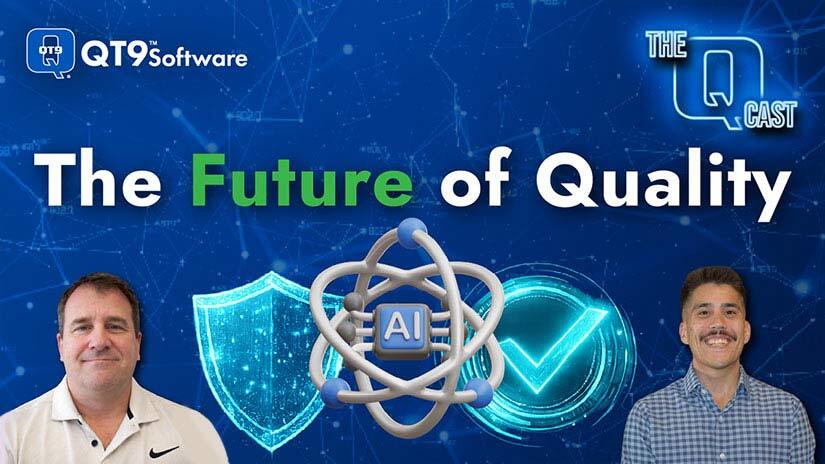
The Future of Quality: What You'll Learn in This Episode
- How quality management evolved from paper-based systems and spreadsheets to modern digital QMS platforms
- Key insights from a 30-year ISO auditor on audit processes, compliance, and continuous improvement
- Why poor data analysis is one of the biggest hidden risks in quality management systems
- How emerging technologies like AI, automation, and continuous auditing are shaping the future of quality and ISO compliance
From Paper Binders to AI: How Quality Management Is Evolving
In this episode of the QT9 Q-Cast, Christian Reyes sits down with Brian Powers of World Quality Systems to explore how quality management and auditing have evolved over the past three decades. From the early days of paper binders, handwritten records, and spreadsheet-heavy systems to today’s digital QMS environments, Brian shares what has changed, what has improved, and what still holds companies back.
The conversation covers the shift from manual documentation to searchable software systems, why data analysis remains one of the biggest weaknesses in many quality programs, and how digital tools have changed audit speed, traceability, and continuity when key personnel leave. Brian also explains why mature quality systems do more than help companies look compliant; they create structure, consistency, and a stronger foundation for continuous improvement.
Looking ahead, Christian and Brian discuss AI, predictive quality, continuous auditing, evolving ISO standards, and what the future could hold for companies trying to turn quality data into better decisions. Whether you are still managing documents manually, working inside an eQMS, or preparing for the next era of compliance, this episode offers practical insight into where quality has been and where it is going next.
Chapters / timestamps:
These chapter points follow the transcript flow and should work well for both YouTube and the website.
00:00 – From paper binders to the future of quality
00:33 – Brian Powers’ path into quality auditing
02:29 – What quality systems looked like in the early days
04:13 – When software started changing the game
05:26 – QMS maturity and what it reveals about a company
06:04 – The biggest weakness in quality: data analysis
07:08 – Does ISO make companies better or just look compliant?
08:03 – When digital systems became common in audits
09:36 – How software changed audit speed and traceability
10:16 – What can be compliant on paper but risky in practice?
11:10 – The silent failure companies miss until it is too late
11:28 – AI, QR codes, and better access to quality information
13:07 – What continuous auditing could look like
14:44 – ERP systems, eQMS adoption, and predictive quality
16:02 – How leadership’s view of quality has changed
16:39 – ISO 9001 revisions, risk, and evolving regulations
18:40 – The North Star metric for quality
19:08 – Closing thoughts
Tags:
QT9 Q-Cast, QT9 Software, quality management, quality auditing, ISO auditing, ISO 9001, eQMS, QMS software, digital quality systems, continuous improvement, data analysis, predictive quality, continuous auditing, ERP and QMS, audit readiness, compliance management, regulated industries, quality culture, Brian Powers, World Quality Systems
Hashtags:
#QT9 #QT9Software #QCast #QualityManagement #QualityAuditing #ISO9001 #eQMS #QMS #ContinuousImprovement #PredictiveQuality #ContinuousAuditing #Compliance #AuditReadiness #DigitalTransformation #RegulatedIndustries
Episode Transcript
Christian (00:00)
All right, everyone, picture this. It's the early 2000s. Quality managers everywhere are wrestling with paper binders thick enough to block out the sun. Auditors are asking for documents that nobody can find. And spreadsheets? They're multiplying faster than capas at a bad audit. Today, we're taking a journey from that world to the one we live in now. Our guide on this journey is an expert auditor from World Quality Systems who's been doing it for nearly 30 years, Mr. Brian Powers. We're talking about the past, the present, and the future of quality and auditing.
Brian, welcome to the show. It's great to have you on.
Brian (00:31)
Thank you.
Christian (00:33)
Talk to me about your path into quality auditing. How did you get into it?
Brian (00:38)
Well, in the late 90s, I was working for a health food company. And the health food company had an industry standard called an organic certification. And I was part of a larger team effort to get that done. My role was to do job descriptions, work instructions, quality manual, and the procedures, some of the
hierarchy of the documentation triangle and as sick as it sounds I enjoy doing it. my sister actually married a gentleman that was a consultant for the environmental industry and ⁓ he started kind of whispering in my ear about
Christian (01:13)
Okay.
Brian (01:18)
if you enjoy structure and standards and creating work instructions that people have to follow, then ISO is the perfect world for you. And so it took a couple more years for me to actually make that transition from the company or the industry that I was in into the
ISO standards industry and so I started working for a larger consulting company and really learned and just soaked in everything that I possibly could. They sent me on some jobs early on to help companies become ISO certified and I implemented a number of companies and got them certified and I really enjoyed it.
Christian (01:54)
Okay.
Brian (01:57)
And at the same time, I knew that I wanted to be in business for myself as well. And so, through networking and what have you, I was able to land a few of my own jobs. And so I quit the larger consulting company and just turned around and
I contracted for the registrar side of their business. And that's where I started doing more of the auditing side of things. And been doing that for about 25 years.
Christian (02:14)
Gotcha.
Gotcha.
Okay, that's it's quite a long time.
What did quality look like when you first stepped into the quality world?
Brian (02:29)
a lot of binders, a lot of binders, you know, and it was both good and bad. you would step into an audit and they would lay down some, books for you or some binders and tell you, OK, there's the quality manual
there's the procedures and there's the work instructions and then we would have a form binder you know and that was kind of their master list of documents.
you would just start working through it making sure that all the quality manual meets the requirements and the standard and then the procedures. And sometimes you started ended up proofreading instead of auditing. when I started auditing,
the 1994 standard was still in effect.
And then when the 2000 standard revision came around, that was revolutionary because a lot of the procedure requirements disappeared. But it took a while to take effect for companies to even grasp the concept and make the change. So I would say probably for the next 10 years, I still dealt with binder type systems.
Christian (03:20)
Okay.
Right.
Okay.
Brian (03:39)
And usually when they gave you the binders, you would see some dust on them. Because if there's dust on it, then you know it's not being used.
And so, know, early on I knew that ⁓ software was going to be the answer to, these four or five binders that I would have, placed in front of me.
Every once in a while I would bump into a company that was using a quality management software and ⁓ I thought that was the best thing, know, since sliced bread. was very few and far between. Yeah,
Christian (04:08)
Yeah.
Okay, yeah, back then.
Brian (04:13)
a lot of spreadsheets and Word documents, and even the quality management system itself was more of a typewritten ⁓ procedures. Every Blue Moon company that I would audit,
I saw some
And I thought that was, you know, that was the next step. That was the best practice. But not everyone was doing it.
Christian (04:35)
That was, yeah.
Brian (04:40)
because you know pictures and diagrams are so much easier to follow for most folks and it kind of forces you to describe things in the order in which it occurs instead of typewritten you know procedures that sometimes jump around from subject to subject and don't follow a logical order.
Christian (04:45)
Absolutely.
Yeah.
Brian (05:00)
so now when I go to a company as a consultant and I'm trying to help them out I try to assess what is this company you know what's their competency what's skill sets do they even have flowcharting software or anything like that you know and and I try to make that assessment and determine okay can we go to that next level or are they are they still babies and we need to start with some typewritten text.
Christian (05:25)
Right.
Brian (05:26)
every company goes through that evolution of being a baby, toddler, teenager.
And sometimes their QMS is a good indicator of their maturity level.
Every once in a while, I still come across the binders and, their system hasn't been revised in years, And that kind of tells me, I'm sure they're making quality product, which is a very good thing, but many of the other principles have fallen.
Christian (05:56)
Yeah, the continuous improvement has been applied to product, perhaps not the system itself, the management system itself.
Brian (06:04)
Well, and the data analysis. the biggest weakness in companies that I go to is the data analysis. most companies are great at collecting data, but they're horrible at processing the data and then presenting the data in a way that will help their managers make better decisions or even top management understand.
in the early days of auditing, again, not much use of software, even though there was software available in the early most companies just weren't doing it because...
it's stuck on a piece of paper, you know, it's handwritten, or it's even in an Excel spreadsheet. that's one of my pet peeves is, collecting information and then doing nothing with it.
it's just a waste of time if you're not going to do anything with the data.
Christian (06:52)
Yeah, collecting for the sake of collecting is pointless.
Brian (06:56)
And not every data has maybe value, but you do have to at least try to analyze it and then figure out, okay, where is the most valuable data?
Christian (07:05)
so that's you create value.
Brian (07:07)
Right, exactly.
Christian (07:08)
so moving a bit now to the present day here we are Would you say I ISO compliance is making is it making companies better or just better at looking compliant?
Brian (07:18)
I would, no, think, ⁓ I don't think there's any fakeness about it anymore.
maybe because the standards are changing and evolving too, ⁓ you know, it seems like people are buying into the idea of continuous improvement and...
you know, I guess the values in making sure that you have procedures, structure, know, structure is good. Most people do very well with structure. And I think also, you know, with the standard changing and not having as many procedure requirements, you know, many of the quality manuals that I've seen now, you know, went from four inch binders down to maybe, you know, half inch binder,
Christian (08:03)
When did you start seeing digital systems become more, not necessarily essential, but more common in audits?
Brian (08:12)
I would say probably like 2015-ish. Yeah, maybe 10 years ago.
I've come across more and more in the last 10 years. And it's totally welcome. I mean, that is excellent. Because many times I'll get called because a company lost their quality manager
And if that person leaves, somebody else has to step in and they don't know where certain files are at.
if they had a software system, searchable files,
There's structure, there's action items, there's to-dos. These things just keep going no matter who's in charge. so that was one of the best benefits of the software that I've started seeing more and more.
Christian (08:58)
For sure. That sounds like a huge turning point. the amount of time that's available, capacity of quality teams. I'm sure that changes based on whether they're in a paper system, using spreadsheets in software.
Brian (09:11)
Well, in so many companies, although 2015 introduced risk, and every company does risk
Christian (09:21)
whether they know it or not.
Absolutely.
Brian (09:22)
That's where software helps. know,
Qt9 or many other software systems, it just keeps rolling.
Christian (09:31)
Might need to create a new login, other than that, everything's still there. It's all in one spot.
Brian (09:33)
Other than that...
Christian (09:36)
How have auditors themselves or your behaviors changed since companies have moved to more digital systems? Is it time spent? Do you approach things differently?
Brian (09:49)
I would say overall it's probably sped up the audit process.
Certainly retrieval of the records is a lot faster now, whether it's a QMS or an ERP, MRP type system. during audits we do traceability exercises. And so we'll randomly pick a couple of orders or jobs. And the faster our clients can retrieve those records, obviously the quicker we can get our audit report done.
So yeah, that's definitely been a plus.
Christian (10:16)
What is one thing that that you see currently that is technically compliant but practically dangerous for a company to be doing?
Brian (10:23)
famous phrase for ISO is say what you do and do what you say.
there is ⁓ the system, the process forces you to be
compliant and not dangerous.
Christian (10:40)
Yeah.
Brian (10:41)
whether it's an auditor or a company, you're constantly going through that triangle to make sure that you're compliant with everything.
But that continuous improvement that affect them, and making sure that everything is checkboxed forces you to produce good product and satisfied customers,
Christian (11:04)
Describe the most common silent failure that companies don't catch until it's too late.
Brian (11:10)
I would have to go back to the, the analysis of data. I think that portion of the ISO standard and all the ISO standards gets overlooked.
Again, companies are great at collecting data, horrible at processing and analyzing it.
Christian (11:28)
Yeah.
So let's have some fun and look ahead a little bit. Predict the role of AI in quality.
Brian (11:35)
Well, I think that AI will help process the data. I certainly think that's one benefit.
I also think that if AI is as good as it says it's going to be, it might help present the data in a way that will help upper management, middle management, and even frontline employees. one company the other day
told me that they started allowing their frontline employees to carry their phones. and they were able to quickly search on proper processes or procedures to handle certain nonconforming products.
Christian (12:16)
Okay, interesting.
Brian (12:18)
Other technology, the use of QR codes and making information available, you know, basically at their fingertips so that people can make better decisions.
And I think that's what it really comes down to. And I hope AI can maybe speed that up. if you can eliminate those mistakes by making sure that information is available at employees' fingertips,
They can ask their phone for help.
Christian (12:44)
it's a lot easier than going to someone.
Brian (12:47)
yeah, raising your hand, supervisor, come over here. Meanwhile, they're under the stress of trying to make sure that product's produced and all that good stuff. So that's definitely gonna help and that's just a little microcosm of it. But how middle management and upper management uses AI will be interesting. It'll be a new frontier.
Christian (13:07)
One term that I've heard come up a lot recently is continuous auditing. What is continuous auditing?
Brian (13:15)
maybe this is something that AI is going to help out with.
If the software knows what the requirements are and the input from the user is able to, you know, match up with what the requirements are, whether it's corrective actions, CAPAs need to be done within 30 days, the software should know whether or not that's being done.
Seems like to me that the QMS software should be able to audit itself or at least maybe on a somewhat of a limited level. there should be ways to monitor performance and that is to some degree auditing and knowing
how well people are doing, whether or not they're following procedure, you know, and things like that. Where it might be challenging is outside inputs, if there's any statutory or regulatory requirements, you know, how does that get injected into the audit? Customer requirements that might be buried in terms and conditions.
Christian (14:07)
Yeah.
Brian (14:12)
go to some food packaging companies that, they do audits almost every day, you know, of certain segments of the, the business.
And they're constantly monitoring those activities. So, I think there is an opportunity for, you know, companies that use software to develop the software to audit itself and see, you know, who's doing what and performing well or not. Spitting out some sort of report to say, you know, that certain departments or processes are
performing at this efficiency level.
Christian (14:44)
How ubiquitous is it that you see companies running both an EQMS solution and an ERP solution in software?
Brian (14:52)
I probably see more the ERP, MRP systems and then I usually encourage them, know, hey maybe this software has a QMS add-on.
if I could throw a percentage out, I mean, almost every company I go to now is running some sort of ERP,
But QMS, I would say maybe 20 % of the time.
Christian (15:16)
Yeah, yeah, for sure. Another thing that I've been hearing a lot about predictive quality. What are your thoughts on predictive quality?
Brian (15:23)
Yeah, well, I mean, again, I think that's where the data analysis is going to, feed back into that, and, and ultimately that's where the benefit of software is.
that's where the predictive side of quality could come in. Again, if the right software is used and the right you might be able to find some trends, some little quirks, something in the data that could tell you, okay, something's going on here.
Christian (15:37)
Yeah.
How has top management, that little C-suite, how has their perception and valuation of quality and quality management changed since you first started auditing, if at all?
Brian (16:02)
Yeah, I think it's gotten a lot better.
I definitely think they're on board. Do I go to company sometimes and you know there's not a single upper management that wants to be available for me? Sure. You know it still happens. I think it's mostly fear, nervousness, things like that to just deal with an auditor.
But I think that the health of the quality system is a direct reflection on upper management. I would definitely say that in recent years, a lot of companies are on board with it. And they're not just pencil whipping the paperwork and just trying to get their certification. Yeah, it's definitely a shift.
Christian (16:39)
Yeah, so, yeah.
That's good to hear. Yeah, that's definitely good How have global regulations adapted? mean, obviously we've got a lot coming this year with the 9001 revision expected out later this year. Aerospace is being revised. We've got QMSR and life sciences coming. Do you see that the standards and regulations are adapting well and evolving with the use of new tools?
digital tools, things like that. ⁓
Brian (17:08)
Yeah,
ISO is really big in Europe. So there's many times a big influence over there and it affects us here. I know many of the changes with the standard are going to be related to climate change and the environment and fortunately or unfortunately sometimes that can be controversial.
I think that they're trying to stay relevant ⁓ with some of the changes. at least, and these are all just rumors, I haven't confirmed the climate change and then the, I believe, the separation of risk and opportunity. ⁓ And I think they're gonna expand on risk a little bit more, which is great. Add a little bit more definition to it.
Christian (17:53)
Yeah.
Brian (17:56)
the ISO standard needs to keep evolving and changing. I'm glad they didn't make too many drastic changes. I think with the way the economy is and just the way the standards change, the way it's written from 2015, I don't want to say it's perfect, but it's pretty close. If they're just redefining things or clarifying things at this point, that is great.
Christian (17:59)
Yep.
You know? Yeah.
That's not a bad thing. Not a bad thing. if quality management has a North Star metric, what would that be? Obviously, it can be very different depending on industry, depending on company, but just more generally speaking, very meta top level.
Brian (18:40)
Well, mean, obviously zero defects would be your North Star metric. But zero defects alone may not tell you exactly what's going on. You could still be running out of money as a company. Zero defects. So I think if a company has some good goals and objectives and they're meeting
Christian (18:52)
Yeah, yeah
Brian (18:59)
all of them. That would probably be their North Star. you're profitable. So, yeah, think ultimately that would probably be it.
Christian (19:08)
That's a good answer. That's a good answer. Well, Brian, thank you very much for taking us on this journey from early chaos to future innovation. You can find Brian's information in the show notes. Please like, comment, and subscribe to the QT9 QCast. And until next time, stay curious, stay compliant, and keep raising the bar.
Share this
- QT9 QMS (12)
- Manufacturing (8)
- QMSR (3)
- FDA 21 CFR 820 (2)
- ISO 13485 (2)
- ISO 9001 (2)
- Supplier Management (2)
- AS9100 (1)
- Aerospace & Defense (1)
- Analytics & Reporting (1)
- Business Intelligence (1)
- CAPA (1)
- CMMC (1)
- COPQ (1)
- Cannabis (1)
- Change Control (1)
- Continuous Improvement (1)
- Inspections (1)
- QT9 BI Tool (1)
- QT9 ERP (1)
- Software Validation (1)