Change Control vs Deviations vs ECR/ECN: When to Use Each in QT9 QMS
2025
Full Transcript
Good morning, everyone, and welcome to the webinar. We are going to go ahead and get started. So we are so glad you joined us today. We're going to be focusing on our change modules. So we're going to be focusing on our change control, kind of versus ECR, ECN versus deviations. So over the course of today's session, we are going to talk about those different modules. We're going to do some compare and contrast, and we're going to talk about some ⁓
Very basic usage cases of these modules. So before we get too far into that, I do want to go over some of the basic information for the webinar itself. So first and foremost, I want to talk about the webinar tools. You will notice there's an orange arrow on the vertical webinar toolbar. So this arrow will either expand or collapse that toolbar view.
Now that's really important because that's going to give you access to the question area at the bottom. So if you do have any questions during the session, we will have our team available to answer those questions during the presentation. So don't be shy about asking any questions as needed.
So now that we know our way around the toolbar, let's talk about the webinar series themselves. So we are really glad to have you guys with us here today. These webinars are really designed to provide our users with ⁓ best practices, features, functions, and tips on utilizing our software. Now we have a pretty broad base of users in attendance today. So we're only going to focus on the specific topics at hand.
So during the presentation and during the QA, we want to stay on those topics just to be respectful of everybody's time. Now, if after the session you still have additional questions or you're not quite sure about something, you can always reach out to your implementation and training specialist if you are in your initial implementation phase. If you are outside of that and still have questions, you can always email support at qt9software.com.
And they can get you in contact with our training team, and we'd be more than happy to have a conversation with you and help you ⁓ go over any questions that you have. The other thing is at the end of the session, there will be a brief survey. It's really important that you guys fill that out. It does give us feedback on you know what works for you. ⁓ if you have any ideas, things that you guys would like to see in future webinars. So it's always good to get that feedback.
So again, that'll be at the end of the session.
All right, so let's talk about some of the modules that we're going look at today. So we are, of course, going to be looking at change control. So this is kind of a a core, you know, change function, if you will. So this is kind of we're going to talk about change control today, its role within the system and how it integrates with other modules. We're also going to talk about how it compares to a deviation or to ECR and ECN.
So we are also going to focus on ECR, ECN as well today. So those are two separate modules that can be used independently or linked. And we're going to focus on what that, what role that plays in the system, as well as more of the compare and contrast to the other two modules that we're discussing here today.
And of course, we're going to touch on deviations. So deviations again, those are meant for temporary changes, and we are going to talk through that fully here in a few moments. But this is just to give you some ideas as to what is present for deviations.
One last thing to point out here as well is ⁓ if you guys do have any questions after today's session that maybe aren't support related, maybe it relates to ⁓ adding licenses, maybe you're you just you're not sure who to go to. Your main point is always your customer success team. So you will have customer success at qt9software.com. They will be available to answer questions that you guys may have.
⁓ and they are there to be with you guys throughout the lifetime of your of you guys having QT9. So definitely an important contact to have. We do have our home website and our ⁓ toll free number listed here as well if you do need to reach out and ask any questions.
All right, so now that we're through some of the basics, let's switch over to the site. So we're going to we're going to switch over here to the actual website itself. And let's get started talking about some of these modules. So the first thing that I do want to do is to identify what each module here is supposed to do within the within the infrastructure.
So the first thing we're going to talk about here is change control, and that is located under ISO functions under change control. Now, change control is used to document any change to the quality system that is not product related. So this could be a process change, a supplier change, maybe IT, human resources. These are all changes that do impact the quality system that don't
Directly associate to a product. So change control can be used for any non-product related change. Now, an important thing to note about change control is that it has three phases in the same record. So you identify what needs to change, you go through your initial analysis, your impact assessment, and you go through the approval process or the approval of the action.
as well as the verification of effectiveness in a single record. So change control is a very thorough and very well-designed module that'll help you guys manage any type of change that you may have.
The next module that we are going to that we do want to identify here is deviations. Now, deviations, of course, are located under the product area and under deviations. Now, a deviation in our system is designed to be used for a temporary change. All right, so these that means this can be planned or unplanned. ⁓ and these are any you know temporary change to your quality system.
Now, a key thing about this being temporary is that a deviation must have a start and an end date. So those must be present.
Alright, the other important thing about deviations is that deviations do have an approval process inside the system. Once a deviation is approved, it is going to remain open in that approved status until the responsible party for the record closes that deviation. All right, so again, deviation is that temporary change. All right. ECR, ECN are also a little bit different.
Are also ones that we want to talk about today. So when we talk about engineering change requests and engineering change notifications, these are two separate modules that are used to review possible product-related changes and to document the execution of that change. So, of course, the engineering change request or ECR is designed to go through the actual changes that you'd like to make.
And decide if those changes are approved or not. The ECN is used to document the actual execution of that change. So of course, these are very important. Now, the interesting thing about these modules is that these can be used independently. So if you just want to create ECRs, you absolutely can. Or if you just want to create ECNs, you certainly can. Or they can be used in a linked format.
So and if you decide that at the global setting level. And what you decide is if they are linked, you would have to first create and approve an ECR before an ECN could be created.
All right. The other big thing about ECR and ECN that is so unique is that these have a different approval scheme. These actually have tiers of approval. All right. So ECR and ECN, these are again specific to product related changes. Change control are for process or any other type of change that you need to make to your quality system. Deviations are for temporary changes for either product.
or process.
All right, so now that we know and now that we have identified what each of these modules are intended to do, let's talk about the differences between them. And we're gonna start by talking about the differences between change control versus ECR ECN. So what so let's talk about change control first.
All right, we've kind of dis identified this already, but change control is utilized specifically for non-product related changes. All right, where ECR and ECN must be product focused. All right. So when we talk about a change control, this could be like we've talked about a general process change, ⁓ HR, IT, marketing and sales literature, validation protocols. These are all
possible items that are types that you could use for a change control. All right. And of course there are subcategories to each of these types. And you can define what those look like. But the key element to this is that change control is making a permanent change to a non-product related item.
All right, the other interesting thing here is that change control has linkage to a few different locations. First and foremost, the change control does have access to your process dropdown. Now you may be wondering where are these processes populated from? And they're populated from somewhere that you may not expect. So if we look under manage, under maintain, under audit, and under processes.
That processes list is what is where this is pulling from. Now you may be wondering why are the processes there? Now, a big part of that is because with auditing, of course, you are auditing against the different business processes that you guys have. So if you're listing all the business processes that you're auditing, it's safe to assume those are all business processes that could be involved inside of a process change. So that is why they are linked to here.
So processes will link to a ch to the change control here, but it will not to ECR or ECN.
All right, one other key element here is talking about the integration between change control and other modules of the system. So when we talk about what change control integrates to, it does integrate directly to corrective action because a change control may necessitate a corrective action. And if it does, it's as simple as going to the create corrective action button here inside of a change control, indicating that you need to create a corrective action.
It will prompt you for your car type, your responsible party, your problem type, your priority. And of course, you have the ability to map fields. So if you'd like the initial analysis to match the problem description, it absolutely can. If you don't want to map fields, it's as simple as selecting nothing on either column here and creating that corrective action record.
If you do it that way, you will create a corrective action that is linked directly to that change control. Now, anytime you create a record from another one, so in this case, if we were to create a corrective action from here, it would be its own unique record, meaning that these two would be linked. So it's quick to navigate between them, but they are not sharing data back and forth constantly because they are their own independent records.
All right, deviations works in here as well. So with a deviation, you could create a deviation from a change control. You would have to identify the title for the deviation, the process that's involved, the type of deviation, the responsible party, a start and end date. Of course, you could choose to map fields and then create that deviation record.
All right, so corrective actions and deviations, those are a natural extension of change control, right? Because you may need a corrective action, or as part of a change control, you may need a temporary deviation to get you by until the change is fully implemented. So these are pretty natural extensions of the change control. The other natural extension is documents from Doc Control.
So when we talk about docs from you know docs as they relate to change control, it's pretty straightforward. If you're making a change to any of your internal processes, there's a very good chance that a document change is also going to be required. Now, the nice thing here is that from the change control area, you have the ability to create an entirely new document request from here. Of course, you could create the new doc request. It's going to ask you for some basic information here.
So it's going to ask you for the name of the document.
The department that document will belong to, the document type, the description, and it's going to ask you to indicate a responsible party. Now, when you do that and save, that will create a document request record under document control under document request. Now you'll be able to track the progress of that document directly from here.
All right, the other option that you have here is the ability to add docs from document control here as well. And when we bring documents in, of course, we need to review each document because we need to decide: does this document meet the need for the change control? Or does a is a revision required to meet the need for the change control? And of course, you can use this area to prompt that change as well. So when we look under here, I can decide that that newer revision is required.
I could, you know, in this case, create the revision request. In this case, this revision has already been started, but I can track the progress here.
All right, so as you can see there's a lot of integration between change control and document control.
All right, so when we talk about this, this is different, obviously, than ECR and ECN. Now, one of the biggest differences between ECR, ECN, and change control is that an ECR and ECN is two modules. So it's broken down into two components. So we talked about this: that the ECR is used to approve the potential changes, where an ECN is to document that change.
All right, so it's two different modules that can be used linked, but they're still two separate records. So going from the review of a change through the execution of a change may have two will be in two different modules. Where with change control, it all happens in this record that we're in now. So of course, it's going to get we're going to go through the the initial vetting of that change, the action of that change.
the approval of that change and the verification or the deciding if that change has been effective. All right. So when we do we do think about that holistically, ECR and ECN are just fundamentally different on that score.
The other thing that's interesting about ECR and ECN is that ECR and ECN have more global settings that impact its functionality and behavior, where change control is a lot more prescribed. So, what am I talking about with that? Well, let's look at the global settings and discuss. So we're gonna go to global, we're gonna go to settings.
We're gonna go to approvals and miscellaneous. And of course, this area is only accessible to global admins. But we do want to look at change control first. The only real decision we get to make on change control is our minimum number of approvers. And if we want to require all assigned, that is different.
Than ECR and ECN. ECR and ECN have a lot more options when it comes to functionality. So, as an example, one of the biggest differences here, one of the biggest items here, is that you can decide if an ECR or ECN or the ECN modules are linked. So if the ECN number, same as ECR number, is checked, that means that the modules are being used in a linked format. So that would mean that you would have to first
Create and approve an ECR before you could create an ECN from it. Or they can be used independently, like our system is set up here. There are some other things that ECRs can do that change controls can. ⁓ First and foremost, approvers can edit. So if you turn that setting on, you're allowing approvers to make edits during the approval phase of an ECR. That is a function that is not available.
inside of a change control.
Some of the other key elements here is that you do have the ability to enable customer ECR approvals. So if you are utilizing your customer portal, if that is checked, you are essentially allowing your team to assign an ECR approval to one of your customers. All right, so this is a very helpful tool if you need to have them involved. All right, so that is something that the ECR
module does that change control certainly does not.
All right. So as you can see, there's a lot of different settings when it comes to ECR. So ECR, ECN have a little bit more flexibility and function, but it's more specific in that ECR and ECN again are product focused where change control is in is process or otherwise.
Now the other thing that we did talk about here is what ties to ECR in ECN or what modules do. So let's look at that. So we're going to look at an EC at a ECN here, or an ECR, excuse me. And I have one here in an approved status. So I'll go ahead and grab that.
All right. So one of the things that you will see here is that you do have the ability to create a risk analysis from an engineering change request. So again, that's actually a pretty natural extension of the ECR module because if you are making a change, and depending on the industry you're in, chances are you're going to need to assess that risk. So that would allow you to create a risk assessment from here simply by entering the required information and saving.
And that would create an independent risk assessment right.
Now, one integration that isn't directly expressed here in the ECR, but is in deviations, is that you can create an ECR from a deviation. So let's look at that. So let's look at a product here or under the product area. I'm going to open up our deviations module. I'm going to grab an open deviation here. Or I can grab one of our approved ones.
All right, so we'll grab this ⁓ process one here. So you can see inside of a deviation here that I can create an ECR directly from it. Now again, that's that's a pretty natural extension because if this deviation becomes a permanent change, then of course we need to document that change permanently. So of course, we've got the temporary change here with the deviation. And then I can go down to the ECR and create a new ECR directly from here.
So it is going to prompt me for some basic info for the name, the site, the responsible party, the priority, the category, and the description. And of course, I can then create that ECR directly from here.
All right, so that is one that is not directly implied with deviations, but is definitely or with ECR, but that is definitely an integration to be aware of. The other integration that you do want to keep in mind is actually from the engineering change change notification side. So when we talk about ECN, it is going to have the ability to indicate or use documents much like change control. So
If I grab an open engineering change notification here, we can see the documents again can be involved. So it has that similar functionality for an ECN. Since we are making that change, chances are we're going to have documents that need to be updated. All right, so do keep that in mind that this is a very similar function.
All right, so again, we can create new document requests from here. We can add existing documents and do a review of them as part of the ECN. So it has the same functionality.
All right, so those are how ECR and ECN integrate to other areas. So as you can tell, change control and ECR ECN naturally have different different roles within the system. The other thing that you can kind of tell or that's inferred by the integrations to other modules is how these tie into other parts of your quality system.
All right, so we just talked about ECR and ECN versus change control, but let's talk about deviations versus ECR and ECN. So, first and foremost, and this is kind of inherent in here, is that a deviation is a temporary change or fix. These are never intended to be permanent changes, all right, because they always have the start and end date. Where an ECR and ECN.
It is implied that those are permanent changes, right? So a deviation at its very core is very different from an ECR and ECN. Now, the other thing that's interesting about a deviation here is that you can select either a product or a process. And that's unique from deviation and ECR, ECN, and even change control. So it has cross, so deviation is kind of the middle ground.
in a point because deviation can do both process and product, where change control is process only and ECR ECN is product only. All right, so deviation is inherently different in that regard.
The other thing that's interesting is that we can create, and as we've kind of demonstrated here, we can create an ECR from a deviation, right? Because as we've discussed, that's a pretty natural extension, right? So that is something that's unique because a deviation cannot be created from an ECR, but you can create an ECR from a deviation.
The other thing that's super unique about deviations, as well, is that deviations can be created from multiple spots within the system. So you can create a deviation from a corrective action or from a non-conforming product record or from a change control. All right. So again, if we think about this, a deviation is a fairly, you know, that is a viable outcome.
From a corrective action or a nonconforming product. So when we think about it from that perspective, deviations can be can be created from those. And a deviation can't, you can create a corrective action, a non-conforming product, or a risk analysis from a deviation. So deviation has linkages to more modules than change control or ECR ECN does.
All right, so that is one of the other differences to keep in mind is the way deviations integrates into the system.
The other thing that's interesting is that ECR doesn't have linkages to corrective actions or non-conforming products. So that's just kind of something that is unique to deviations in this case. So let's talk about the module connections again because I we talked through them quickly, but I do want to kind of explicitly explain what they are. So a deviation can integrate with other modules, specifically.
You can create a non-conforming product from a deviation or a deviation can be created from a non-conforming product record. All right, we can create a corrective action or a deviation can be created from an existing corrective action.
We a deviation can be created from a change control. We can create an engineering change request from a deviation. And we can create a risk analysis from a deviation. So these are all different options and all different integrations that you have solely from deviations. All right, so as you can tell, the differences between deviation and ECR, ECN.
are fairly apparent.
Now, the other thing that we do want to compare here briefly is the difference or basically deviations versus a change control. All right, so we've talked a little bit from the engineering change notification piece, but how are deviations different from a change control? All right, so again, deviations are temporary, where a change control is a permanent change. All right, one of the other key elements here is that change controls are process related or otherwise.
Where a deviation, as we've discussed, is product or process focused. So a deviation could be a part of a change control, or it could be created from that change control. All right. So deviations again, it's still that temporary change where change control is focused on the permanent.
All right, so otherwise, we've kind of discussed a lot of the other differences when it comes to linkages in ⁓ modules and things of that nature. So we kind of know where all of these modules link to. So knowing that these differences exist, the biggest question then becomes: how are they used in practice? So let's talk about that. So we're already here for deviation. So let's talk about a usage case.
So in our case here, we have a loading, we're going to change our loading process. So in here, we can indicate that this is a loading process with a temporary change. We can see that it has a start date of 1018 and it and an end date right now of 1120-2023. We have identified down here that a process is involved, and we can go through here and discuss why. So in our example here, we're saying that we need to change our current loading process due to a new packaging machine.
The cycling time is higher on the new machine, causing backup in the loading area. So we need to make a temporary change until our new sorting machine is online. All right. So in this case, we're indicating what we're identifying what needs to change temporarily. All right, now we can of course go through our deviation plan. So maybe in the meantime, we're going to staff additional packers per shift to ensure that we meet the demands of the new cycle time on the new machine.
And maybe we need to retrain some of our employees as part of that deviation. So, of course, I could add more detail here. These are all unlimited text fields. I can go through our impact assessment here. So, this is going to cause us to spend more money per item on labor until the new sorting machine is live. Again, your impact could be a lot deeper than that. This is just specifying what it could be. But as part of the deviation here, you can kind of see what we're driving at.
We're looking at the process change and we're deciding if it's viable or not. The other part of this as well with the deviation is that there is a notification list in here as well. So you can notify any employee of the system about this deviation. So the people that are directly impacted could receive notifications about when this deviation begins and as the end date is approaching.
All right, so if the notification list is filled out, that will help achieve that communication through one area. Now you will notice that this deviation is in an approved status. So this means that it's already been approved. Now, once this deviation reaches the end of its useful life, all I need to do when I'm ready to close it is to go down to the bottom and actually complete and close the deviation.
All right, so it makes it very simple.
All right, so using this for the loading process, temporary change, that is that is a good ⁓ example of a process a temporary process change this that this could be used for.
So the other thing that we want to talk about here is a usage case for ECR and ECN. So let's look at an existing ECR. So I have one that is approved already.
So I'll grab that here.
All right, and we have one here for our AB or for our ABS resin. All right, so in this case, this is an approved ECR. So we've put in the description. So in our case, maybe our supplier is no longer producing the same ABS resin. Maybe they've moved to a new formula that requires a higher melting point and has a slightly different color. So can we adapt for the higher temperature on our extruders and can we put color in it to do the offset? So looking at the ECR here.
We're deciding, is this feasible? All right, we're identifying the products here. We can identify our additional data. User-defined fields are of course, very important. But the other thing that we can do here is really specify what needs to change. All right, so we're putting in all of our data here that could be used. We have submitted this for approval, and this is already run through the approval tiers. So when we talk about this.
We can see that these are the approvers that have signed off on this. And remember, approval tiers could have as many approvers per tier as you designate. That is up to your discretion. But in this case, this ECR has been approved. Now you will notice at the bottom there is this create ECN button. Now, this is really important because if you're using these modules in that link configuration that we discussed, you need to then
Have this approved ECR before we can create the ECN. So if I wanted to create an ECN from here, it's as simple as clicking on the create ECN because we now have an approved change. And now we can start the process or the actual action of that change in the ECN. So I can identify all the information I need here. I can identify who this is being assigned to and when this is due by.
Once I have that information, I can confirm that ECN creation. And that will create the engineering change notification directly from here. So in this usage case, we've already approved that ECR. Now we want to navigate to the ECN to go through the action of that change. I can now move over to the ECN simply by clicking on the ECN link at the top, confirming that navigation.
And of course, this is going to bring me into my ECN. So now I can go through the process of actually changing.
All right, so again, we've got our action taken, but really we can go through here and answer whatever is relevant and we can identify documents.
All right. So that is a good usage case of an ECN because in this case we've gone through the approval of the of the resin of changing the resin. And now we're going through the actual process of updating our machines, updating our you know, our procedures to accommodate that change.
Now the last usage case that we want to look at here is a change control. So let's look under ISO functions under change control. All right, and I have one that's here. So this is in an open status. So in this in this example here, we're changing our batch our batching process. So maybe we need to change our batching process due to new safety requir requirements. Maybe we're currently manually batching, but we need to switch to using a machine.
So we need to go through the actual review and potential impacts of that change. So here within the change control, we can do our initial analysis, our impact assessment on what is going to change, and our planning. So planning the change and implementing that change. So what is our what are our plans for that? We can identify the departments here that are involved in this change.
Again, we can bring documents into this because of course documents are going to change if the procedure is changing, more than likely. So when we're looking at this batching process change, maybe both of these documents here, maybe the daily inspection for work instruc instruction is part of the batching process. And maybe the design and engineering SOP are also impacted by this change. So we have to make decisions on those documents.
But we can make those decisions. We can still indicate our processes, the actual action that we've taken. So this gives us then the ability to submit this for approval. Our approver can then review the information and decide if this is a viable change. And if not, they can send it back with what they what they would want to see or what edits need to be made. And from there, they could then resubmit it for approval.
This can happen as many times as possible. But once the approver signs off on this change, that is when you go to the verification of effectiveness. So that is where you guys could put that 30 days in advance, and you could go back and review that change after 30 days to decide if it is truly an effective change. So ultimately, these are
Good usage cases or good ⁓ good examples of what mod this module can be used for, or these modules can be used for.
Now, I do want to preface that everybody has different needs. Some of the examples we're giving today are kind of gleaned from some of our clients, examples that we've that have been, you know, posed to us over the years. So these may not be direct correlation to what you guys are using, but you can still see the way these are intended to be used. All right. That is all the information I had to cover with you guys today.
So I cannot thank you guys enough for attending. I do want to check the questions here real quick to see if we have anything outstanding. So bear with me here.
All right, it looks like most of our most of the questions here have been answered. So it looks like we're looking good here.
All right. If you guys do have any type of additional questions or concerns, you can always reach out to us at support at Qt9software.com. We're always happy to help you guys if we can answer any questions. The other key thing that I do want to point out is that we are going to have or there is training on QT9 University that goes through ⁓ all of these modules. So if you do want to attend a training with us, you can always register through QT9 University. We're always happy to have you guys join into our learning community.
All right, and we go through each of these modules individually and we'd be happy to answer any questions that you have.
All right. But last last, please remember to do the survey at the end of today's session. It really does help us to create create a better webinar experience for you guys. So again, thank you so much for your time. We're so glad you joined us today. We look forward to seeing you guys in the next session. Thank you very much. Have a wonderful day.
Questions From This Session
What is the difference between Change Control, ECR/ECN and Deviations?
Change Control is used for permanent, non-product-related changes. ECR and ECN are used to review, approve and implement permanent product-related changes. Deviations are used for temporary product or process changes and must include a start and end date.
When should a company use Change Control?
Change Control should be used when making a permanent change to a process or another non-product-related part of the quality system. Examples include supplier, IT, human resources, validation protocol and internal process changes.
How do Engineering Change Requests and Engineering Change Notifications work together?
An Engineering Change Request is used to evaluate and approve a proposed product change. An Engineering Change Notification documents the execution of the approved change. The modules can be used independently or configured so an approved ECR is required before an ECN can be created.
When should a Deviation be used?
A Deviation should be used for a temporary product or process change. It may be planned or unplanned, but it must have a defined start date and end date. The record remains open after approval until the responsible party completes and closes it.
How do the change modules connect with other QT9 QMS modules?
Change records can connect with Document Control, Corrective Action, Nonconforming Product, Risk Analysis and other quality processes. For example, users can create a document request from Change Control, create a Risk Analysis from an ECR or create an ECR from a Deviation.
Can a temporary Deviation become a permanent change?
Yes. When a temporary product change needs to become permanent, users can create an Engineering Change Request directly from the Deviation. A temporary process change may also lead to a permanent Change Control record.
Key Takeaways
Presenter
See QT9 QMS in Action
Learn how QT9 QMS helps manufacturers standardize change management, control engineering changes and maintain compliance in one connected platform.
Request a Demo →Explore QT9 QMS in Action
Take a self-guided tour of QT9 QMS and see how organizations manage audits, supplier quality, CAPAs, training, document control and compliance from a single platform.
Launch Interactive Tour →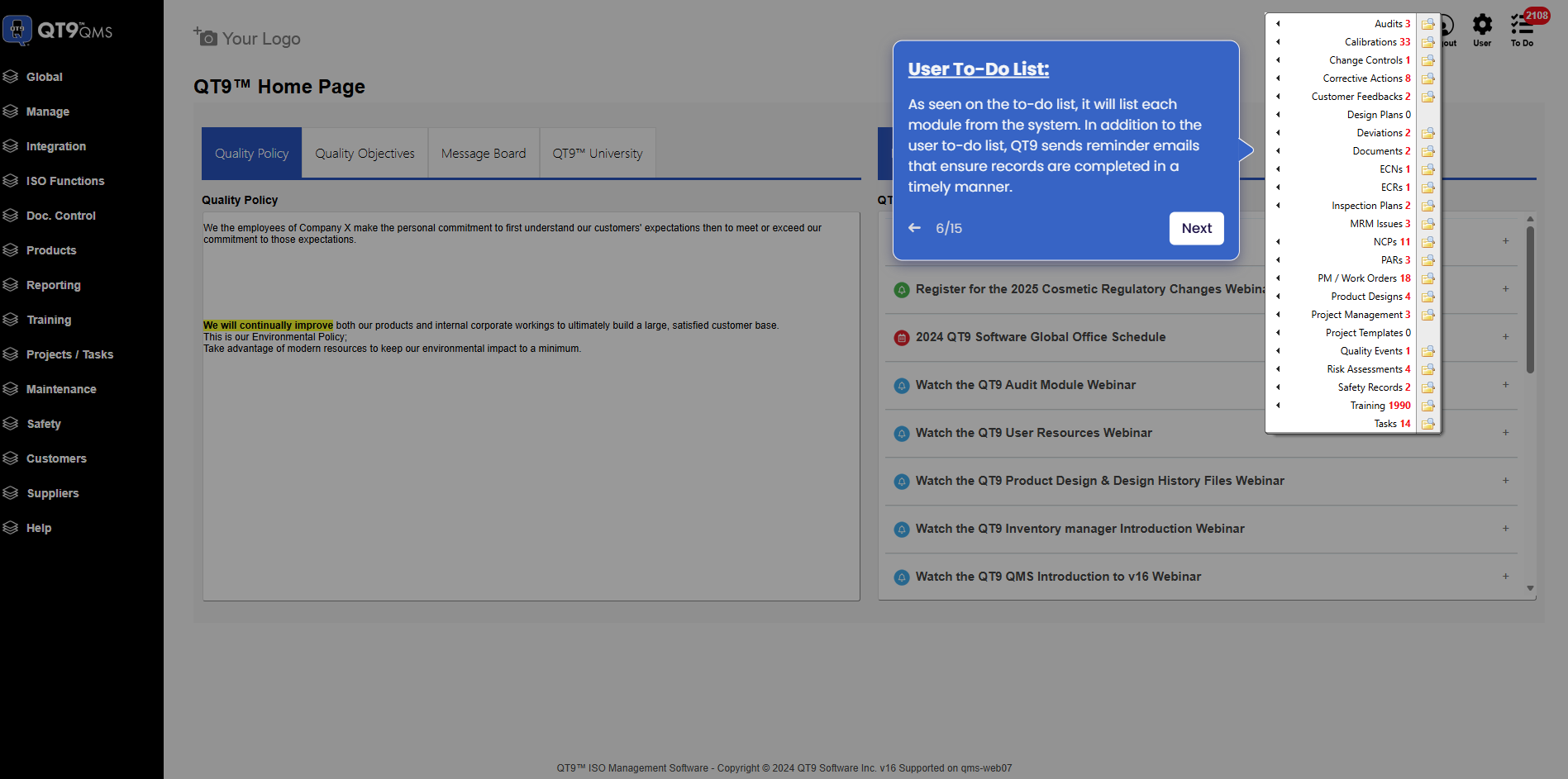
Simplify Quality, Compliance and Operations
Start a Trial
Try QT9 free — no credit card required.
Start Free→
Schedule a Demo
See QT9 live with one of our product experts.
Book a Time →
Get a Quote
Get custom pricing tailored to your team size.
Get Pricing →