QT9 QMS Admin Settings: Permissions, Configuration & Global Controls
October 21, 2025
Full Transcript
Good morning, everyone, and welcome to the webinar. We're so glad to have you guys with us today. In today's session, we're going to be focusing on global admin and power users. So we're going to focus on how to actually administer the system. Now, we're going to cover a lot of ground today, but before we get started, I do want to cover some basic information here about the webinar itself.
So I do want to start with some of the webinar tools that are available to you as a listener during the webinar today. I do want to point out that orange arrow on the vertical webinar toolbar that is going to either expand or collapse your toolbar view. Now that's really important because at the bottom we do have the area where you can enter questions and you can discuss or bring things up with our staff that we have available during our session.
So throughout the presentation, if you do have questions, do make sure you put those into the question area. I am going to allot time at the end for some Q &A, but I do want you guys to know you have support during the presentation itself. Now, a little bit about the webinar series itself. The QMS webinar series is designed to provide our users with the best features, functions, and tips on optimizing your usage of our system.
Now, we're gonna have a pretty wide variety of users in attendance today. So we are gonna stay focused only on global admin and system administration. So I do wanna make sure that we keep the questions and everything focused on that. Now, if you guys do have questions after attending the session and you do need to reach out to us, you can always reach out to our support team at qmssupport at qt9software.com.
We also do have QT9 University. So if you guys are looking for just any form of module training, make sure you guys are checking out the university. We have a ton of great resources there. Our implementation and training team run sessions pretty much daily, Monday through Thursday. So you guys can always jump in and learn from there too.
The last thing I do want to point out here is at the end of the webinar, there is going to be a really brief survey. If you guys could give us your feedback on the content that we're providing. We always want to make sure we're hitting the mark. So if you guys do have some feedback, let us know. We want to make sure that this is useful information for you. And these are things that you guys are benefiting from. So your feedback is vital.
Now, let's get into the actual topic of today. So let's start talking about the topic at hand, and that is what is a global administrator? All right. When we talk about what a global admin really is, all right, before we get into the different functions, let's talk about the high level. All right, a global admin has full access to QT9. So what do I mean by that? They can access
any site and any record under any site. So they have the ability to see everything. So even if you're in a site that contains 50 different locations, a global admin can see and interact with every record at any site. That also means that your global admins will appear in any drop down inside the system, whether that be for a responsible party and assigned user, for a task, for an approver or a verifier.
All right, so global admins can fill any role within the organization. Global admins also have the ability to determine the site structure. So we're gonna talk about site administration today, so it is important for you guys to keep in mind global admins decide what that site structure is. Global admins also have the ability to update and change module settings for alerts.
They can look at module preferences. So as an example, any module that has approvals, your global admins can determine the minimum number of approvals. The other key thing that your global admins have access to are your data import area.
So we're gonna talk about a lot of information today. We're gonna talk about some of the more discrete functions that a global admin can do, but at a high level, it's important to understand what a global admin really does for your organization. Now, you guys probably know this, but there are differing levels of administrator in the system. Global admin happens to be the highest. Now.
One other key thing I do want to point out here is that there are other levels of administration or admin available. Now, you can see the hierarchy here on the screen. A global admin is the highest form or the highest level of access. Below that is a site admin. Site admin means that if somebody's a site administrator, that means at a specific site, they have access to every module. They have limited access to the manage maintain menu.
Now, a big common question we get is how data admin interacts with everything else because data admin, it fits into the hierarchy, but it has a very specific role. Data admin actually doesn't give you any rights without having site admin. All the data admin setting really does is give you full access to the manage maintain menu, which we're going to talk about today throughout our presentation. Now,
The lowest level of admin that we have are module admins. And again, these are provided on a by-site basis. So document admin means that if somebody's a document admin, that means they can be a responsible party for any document request. They can show up as an approver for any document request, and they have the ability to publish documents. So module admin doesn't give anything above
that module. It's specific to that module. All right, so I put a couple examples here with document admin, preventative maintenance admin.
Now, what I do want to start jumping into is getting into the system itself and showing you some of the differences and really starting to dive into what global admins really can do. All right, but again, I do want to point out this is going to keep you in good stead when you're thinking about the way your admins are structured. So remember, global admin is the top, site admin, data admin are kind of parallel.
Module admin is the lowest level of the admin function that's out there. All right, so always remember that.
Now, let's get into a little bit more about global admin and let's see it through the lens of the system. So I'm gonna bring up Qt9 QMS. Now as a global admin, a couple key things I really want to point out to you is that global admin have access rights to this global menu and to this manage maintain menu and also the integration menu. Now, global is the top level.
when you guys make decisions at the global settings level, you are making decisions for every site underneath it. Now, we're gonna talk about that as we go. But the key thing I want you guys to understand is when we talk about the global settings, you are dictating the rules for every site underneath your URL or your organization.
All right, so I want to make sure that we understand that upfront. Now, the key things that we're really going to focus on today is site administration, we're going to focus on global settings, we are going to talk about user defined fields, the manage maintain menu, and we're also going to talk about user administration. Those are kind of like the key elements or the key ingredients of ⁓ a strong power user inside the system, especially at the global level.
So where we're going to start is site administration. So that is located here under that global menu under Site Admin. Now you're going to see that there are two locations here. You've got Site Admin and Site Group Administration. We're going to start with just Site Admin.
Now, as many of you know, right, site is one of the key elements here. So if you've never been exposed to this, let's answer the first question. What is a site? All right, a site is an individual business unit. And what I mean by that is that each site has its own documents, its own corrective actions, its own non-conforming products. Those are key elements of a site. All right, remember.
each individual, each site can have its own docs. Now, that being said, a lot of our ⁓ companies or users maybe have one or two sites. We have a lot of larger customers that have 50 or more sites. All right? Keep that in mind. Now, when we do talk about sites, all right, let's really get into this. When you...
When you start the system, you're only gonna have a single site in here. When you click into that site, you can actually edit that site. And at each site that you have, you do have the ability to set some individual items. So you can determine the name of the site and the site code. All right, the site code is the shorthand version of that site. Now you may be wondering, well, what does that site code actually get used for?
That site code becomes the prefix of any document code that you use in document control if you have our document coding system turned on. All right, so site name and site code are important. Also, new with version 17 is the ability to determine a date format. So if you are in ⁓ a different country that uses a different date format than we do in the United States, we've got you covered.
All right, so, and this is set at the site level. Each site can have its own date format. You also have the ability to toggle on your month abbreviation. So if you do want your sites to show up or your, the dates in your sites to show up with the prefix as like December 15th, 2025, you can have it look just like you see on the screen here if you check month abbreviation.
Now there is one other setting here that people tend to overlook and that is the corporate training site.
So what is a corporate training site? All right, a corporate training site essentially means if you tag a site with that, that means that you can share documents, job titles, employees and training profiles for any site. So what we mean by that is essentially if something is checked as a corporate training site and you've got a job title that is the same across your entire organization, you do have the capability to use
that corporate training site so you're not duplicating that information in multiple locations. Very, very helpful.
All right, so corporate training site, you just see guys know in current structure, you can have multiple sites with corporate training site. Very important.
Now, each site that you have here, again, can have its own documents, its own records, important to keep in mind. The other thing I do want to address with sites is we do have some customers where they may have two or three sites, but they all share the same quality system. They all share the same documents. They all share corrective actions, things of that nature. In that case, they may only have one site, even though they have three physical locations. So,
Site can really be subjective based off your usage case. All right, keep that in mind.
Now, one other thing that I do want to point out here is Site Group. Now, Site Group Administration, this setting is, this is only gonna show up if your global settings dictate it. But let's talk about what a Site Group really is, all right? A Site Group is a way to group your sites together and aggregate their data within a module grid. So I've got a really simple Site Group structure here. So our corporate site is Chicago.
All right, so that's our corporate site. We do have Site Group for production, which is our Aurora site and our Detroit site. And we have our Site Group for distribution and logistics. So Indianapolis and Naperville. By having Site Groups, what this allows us to do is if I have, let's say for example, corrective actions at both Aurora and Detroit, I can look up the Site Group and I can see all the corrective actions in the grid from that Site Group.
All right, so site group is a very, very helpful way if you are in a multi-site configuration to group your different locations together and to be able to aggregate the data a little bit better. Now, if you want to think about this at a larger scale, let's say that you are an organization that has ⁓ sites in North America, you have sites in China, and you've got five sites in Europe and three sites in Africa. You can have a site group for each
for each continent and you could associate the sites by continent. So just pointing out for multinational companies, this is a great way to keep track of where these locations are.
All right, so site, so a lot of the administration piece starts with the number of sites you have in your site groups. All right, very, very important.
Now, once you've got your sites established, now we have to start establishing the rules that every site is going to work off of. All right? And where we do that here is under global and under settings.
Now, the global settings, there's a lot of different tabs here and it's really easy for people to get caught up or intimidated by the amount of information here. I'm here to tell you that this is a simple area when you realize or if you think about the way this is actually structured. So we're gonna start with the more simple settings and we're gonna work our way up to the more complex settings.
All right, some of the most simple settings that we have are the quality policy and the objectives, the message board and the logo. Now, you have the ability to set a quality policy for the entire organization and quality objectives for the entire organization if you choose. You also over here on the right have the ability to do the quality policy by site. So if I check that box and save, what this means is that the site administration level, I can
I can indicate the quality policy by site. If I don't have this done by site, I am saying at the corporate level, we have this here.
All right, so quality policy, quality objectives, these are really simple to populate. If I can give you guys any advice with this, I would try to stick with plain text and use the formatting tools that we have available. So quality policy, quality objectives are super simple. Message board is also really simple. So if you have messages that you want to share with your team, maybe you have upcoming audits, maybe you have some type of an announcement that you want to put out there,
Your message board is always available on the home screen. So if there is something that you want to post there, you can put it in the message board. All right, and again, message boards can be done for the entire organization, or you can do message board by site if you choose.
The other thing that we do have here is the logo. Now, this is one of the easier locations, but it's important to realize why the logo is so useful. The logo isn't just something that appears up here on the branding at the top of the screen. This also appears on every printout of the system. Now, and when I mean every printout, I mean every record. So let's talk about corrective actions, non-conforming products, audits. These are all things that the logo is going to amend to.
The only exception to that rule are documents from DocControl because we don't add anything to your documents. But for anything else, as far as your any other printout of the system, this logo is going to be amended to that printout. So keep that in mind.
All right, so you can update your logo here at any point in time. So if your branding changes, you can update it here. The last thing you guys do want to take note of is if you are making changes, you have to keep it within the size and the format. So it can be no larger than 200 by 75 pixels, and the image must be either a PNG, a GIF, or a JPEG.
All right, so these are three of the easier settings that are available here. All right, these are pretty self-explanatory. Now, the settings that tend to give people the biggest panic when they look at it first is the alerts and the approvals and miscellaneous. All right, so when you look under the alerts tab, you're gonna see there's a bunch of sub-menus. Now, I don't want you to panic when you see all the separate tabs here, but.
Here's the key thing. At its core, for all these tabs that you see here under the Alerts tab, what you're really determining is when the system is gonna be notifying people about assigned records. All right, it's really that simple.
All right, so that being said, for audits, we use audits as the example here. 20 days prior to an audit, in this case, it is going to start showing up in the daily notification emails. All right, so when we talk about reminder time, 20 days, so 20 days prior, this is gonna show up in those daily notification emails. Now, if you guys haven't seen these before, or if you guys don't know what we're talking about with a daily notification email,
You guys decide on your daily notifications how often they come out. But what is contained in a daily notification email is really a summary of everything you owe the system. And it comes out one time per day. Or it comes out every Monday, Wednesday, or Friday. Or every Tuesday or Thursday. You ultimately decide what that notification occurrence really is. But.
When you see any of these settings in here, whether it's deviations, whether it is ISO actions, anything here, what you're really telling the system is 20 days prior or however many days prior is when it's going to start populating your daily notification email to remind you that you have something to work on.
All right, you're, use a global admin, you get to make that decision.
All right, and you can see here for other module or for the other modules here, really what we're doing here is we are defining reminder times. All right, same thing with ISO actions. Verification reminder time, preventive action reminder time, maintenance, calibration reminder time, preventative maintenance reminder time. So again, when you think about alerts in macro, you really have to think about it. All you're really doing here is determining how long before you want to be notified.
All right, so there's no need to look at the different areas here in Panic. Now, the only unique settings really in Alerts, in my experience, is Document Control, because in here, you have a few different settings. Primarily, you're determining your reminder time, but you're also determining your document frequency here. All right, so this is a little unique. So in this case, you still are determining alerts on affected departments about new documents.
your determining document review frequency, which again goes into the notifications or alerts, and then of course your document review reminder time. So you are, this is all relating to that alerts.
All right, now the other thing that we do have here that's under your alerts, but is important to realize here is under the user tab. Because in here, this is where you guys can determine your user login password expiration time. Now this is a little bit different, but the key thing here is you can determine as a global admin how often your passwords expire. So if you want this to happen every six months,
every three months, every 12 months, you get to make that determination. So that is something that is unique to the alerts area under user.
So with alerts, as you can see, this really isn't as complex as you may have thought. All right, it's actually pretty streamlined, pretty straightforward. Now, the other thing that we do wanna talk about here is approvals and miscellaneous. Now, in my experience with the system, this is the one that people look at and immediately panic because there's a lot of subtasks and a lot of decisions to be made here. But approvals and miscellaneous really appear to be complex.
However, this area is really straightforward. It primarily determines two things, the minimum number of approvers that most modules require for approval and
you basically get to determine or define some preferences within the validated system. That's it. There isn't anything in here that's really changing or breaking the way the system works. So keep that in mind. All right, so when we look at this, and we'll use ISO actions as the example here, we're making one decision on the presentation of the module with the Kappa mode with either standard or eight discipline layout. But what we're really
predominantly doing here is determining the minimum number of approvers for corrective actions, preventive actions, and nonconforming products. All right, very, very straightforward.
Now, let's talk about this in a little more detail. All right? Now, there are some areas here that have a lot of settings. We'll use document control as an example. Now, even though we can make so many different options here or so many different decisions on settings, this doesn't change the validated system that you purchased. These all behave within the validated system. So,
Document control is probably the most complex module setup that we have. What we are looking at here, in this setting or in this area, there's a lot of different structure that we have, but a lot of this really is preference. So what do I mean by that? You can decide with document revision training, so if a document revision is going to generate a training record, do you want that training record created
after the document has been published or after it's been approved but before it's been published. You get to make that determination. And again, any changes I make here have no impact on the validation of the system. But again, even though I can make decisions on different elements here, I'm still making some preference decisions and I'm still deciding the minimum number of approvers.
at a high level, that's all we're really doing.
Now, there are some unique areas that you may wanna keep in mind. So under the General tab, there are some unique items to General, such as inactivity lockout for the system. Now, if you guys haven't seen this before, this is like the screen lock on your computer. So if you set an inactivity to 15 minutes and you don't do anything in the system for that timeframe, the system is going to lock you out. Now, that doesn't mean,
that it's going to kick you out and release the license. What it means is that it is going to lock you out like the screen lock on your computer to where you have to re-authenticate to continue working in the system. So when you think about inactivity lockout, it is much more of a security measure than it is a license management measure. Now, I am gonna teach you guys today how to actually kick somebody out of the system if you're a global admin. We're gonna talk about that a little bit later on.
but inactivity lockout is more for your security. You also do have the ability to determine default offset. So if you guys, again, haven't seen this, default offset really is where you have the ability to set the system for your time zone. The system is technically coded in UTC and you use the default offset to make sure that your timestamps are correct for your time zone. So here in central time for us, we are at a negative five offset.
When we do fall back, that ⁓ will change to negative four or negative six, depending on where you are. So just pointing out, default offset is an important element to make sure that your timestamps are correct. I would recommend for anybody, if you don't have those default offsets, reach out to us. We can provide them for you based on your time zone.
Now I did talk a little bit about site groups a little bit earlier on. So under the global menu, you saw that I have the site group administration. The setting that toggles that on or off is right here. So if I check, use site groups, that site group administration tab will appear. If I deselect it, that means it will disappear. So do keep that in mind.
Now there are a couple other small features over here that you guys want to be aware of with Concurrent User List. So when you guys go to the system or when you guys hit the main page for the first time, it's going to show you how many licenses are tied up or currently available. If you check the box here, that'll actually hide the users. It'll just show you the number of licenses available.
Now we do have some of our customers that are very security conscious, so they don't want people to know who's actually logged in just on presentation to the system. If you want to hide that list, you can hide it. It's still gonna show you the number of licenses that you have available or don't have available.
The system is also set up for two factor authentication. So if you as a organization require two factor, we do have the ability to use two FA.
Now these are some high level unique settings. I just like pointing these out because I think they're important and I think a lot of people underestimate how useful these really can be.
Now, the other thing I do want to point out here is the adding records in form. This kind of gives you guys an example of what user global admin gets to make a decision on. Because to summarize this area down here at the bottom, it's very simple. If these permissions are checked, this is restricting who has the ability to add new customers, new products, and new suppliers on the fly. So what I mean by that is inside of a corrective action,
If these are unchecked and somebody can't find a customer, they can just create the new customer or create a new product or create a new supplier. So if these are checked, then that's restricting who has the ability to add new customers, new products or new suppliers on the fly. Global admin and site admin, we can do this anytime that we like. For a normal user, if these are checked, they would have to have the module and
customer permissions to add a customer, products permission to add a product, supplier permissions to add a supplier. So these are ones that aren't explicitly ⁓ stated sometimes, but I think they're important for you as a global admin and a super user to really understand.
All right, so when we talk about the general tab, there's a lot of good information here.
The other thing I do want to point out here is over on the far right hand side and that's on the password area. Now this is really unique and for any of our customers here that are in a medical device or any organization that really requires ⁓ part 11, 21 CFR, part 11 compliance, this is an area that you want to be aware of because you do want to make sure you're requiring password for approval. If that setting is checked, all right, I do want you guys to keep in mind
that if that's checked, anytime you do an approval of any form, the system is gonna prompt you for that password. All right, so this just functions as your electronic signature.
Now you also do have the ability to set up minimum password length, case sensitivity, symbol, capitalization, and number for your passwords. You guys get to make that decision. If I can give you any advice, I would make sure that you are aligning with your IT and whatever your IT's policy is.
All right, one other key element here while we are talking about passwords because this is relevant here is single sign-on. QT9 is compatible with SSO configuration. If that is something that you do want to use, you will need to work with your internal IT. We can provide you the correct information, the documentation to set this up, but your IT would need to be an active partner and they would need to be able to set this up from there in. But QT9 can be set up with SSO.
Now as you can tell the approvals and miscellaneous area there's a lot of different tabs with lot of different settings and options. Again remember we're primarily looking at minimum number of approvers and system preferences. I really want to make sure you guys feel more comfortable with that because it's a really important thing to keep in mind.
Now, one of the other major global settings that just about any power user needs to be aware of is UDS or user defined fields. A lot of you have probably seen these in different modules throughout the system. Now, user defined fields are really, really vital. And I say that because user defined fields are your location to truly customize Qt9.
All right, so when we look at the different user defined fields here, we can have different user defined fields for all the different modules that you see here. Some modules have two sets. So as an example for corrective actions, I have corrective action and supplier corrective action. All right, but predominantly each module has their own set of user defined fields. Now as a global administrator or as a power user, it's vital for you to understand that these user defined fields
You can build as many user-defined fields as you want. You can build as many sections with as many questions as you like, and you can make them required. Now, one really important thing that I like to communicate to everybody here. With your user-defined fields, this is not intended to help you recreate fully your form for corrective action inside of QT9. It's a supplement what we already have and to help put in specific data that you may need to track.
One of the easy traps to fall into is to put in 50 different user-defined fields and make them all required. The problem with that is that you're really slowing down the workflow when you do that. So I always like to encourage people to be mindful of that when they are looking at structuring or building user-defined fields. Now, if you guys do want to talk more about this, if you guys do have questions about how to format user-defined fields,
I really encourage you to reach out to support and request a Q &A with implementation so we can talk you through your usage case. There are some times the system may have some things to cover it. There are other times user defined fields may be warranted. I want to make sure that you guys feel comfortable with this. So again, if you need to book time with the implementation team, make sure you reach out to support and they can get you routed to our team. But user defined fields are a really vital location for just about any user inside of the system.
Now I have two last areas that I do want to touch before we move into another important area for our global admins. And I do want to make sure that we talk about how to kick a user out of the system. Now as a global admin, you do have the capability to do it. Now that is under the Portals tab. So under Portals, this is where you can administer the different portals that come with the system. So the customer, supplier, and employee portal. Also, if you do happen to have the document viewing portal,
you can use, you would be able to administer that here as well. But the key thing I want to point out here is current user logins. In here, I can see all of the active users on the system. Now, if I do want to remove somebody, it's really as simple as going over here to the right and clicking on the minus key, and that would log that user off. Now, I bring that up during this session because I think it's vital for you guys to remember that if you use that function, it is going to log them off.
Now, if that person happens to be in the middle of typing in text in a corrective action, if they haven't saved it yet, they're going to lose that information. So if I can give you a piece of advice, it would be to reach out to that user, let them know that they need to be logged off. If they don't log off themselves, then you can log them off. All right, so this is something that a lot of our customers had been requesting from us for a long time. We did put this in in version 16.
So you guys do have the ability as a global admin to remove people from the system or temporarily log them off to allow someone else to log on. All right, so do keep that in mind.
Now one last area that tends to get overlooked by a lot of users is the timeline. For an admin user, this is really important because in here we can see when a user actually went in here.
and made edits to the global settings. So we can see any time things have been modified. So this timeline can be very, very important to see who made changes, especially if you're in an organization with multiple admin. So do keep that in mind.
Now, the global settings menu is a really powerful location. right, now user defined fields, everything that we talked about is for every site. When you make changes in the current structure of the system at the settings area, every site plays by those rules. So whether that's user defined fields, whether that is the number of approvers, when you determine it at the global settings level, it applies to every site.
Now in future versions, that may change, but in current structure, that is how the system operates.
All right, so now that we know the global settings, let's talk about one of the other key locations for an admin, and that is the manage and maintain menu. Manage, maintain is vital because the manage, maintain is where a global admin is populating drop-downs for the different systems. So this is where they are building in types, categories, looking at the audit module. This is where you're adding your list of auditors.
the types of audits that you do, the audit categories that you have, you build your audit questions and your audit checklist, you determine your quality standards, and you build your processes. All right, so keep in mind, for each module that you see here, in order to use the module, you have to make sure that you have the requisite information. So again, for change control, you have to have your types and you have to have your categories.
Now, let's use a module that almost everybody uses and let's talk about what manage maintain really, really does. So I'm gonna go down here to ISO actions because this is where we set up our corrective actions, non-conforming products and preventive actions. Now you're gonna see that we have a couple things here. We have corrective action types, problem types, dispositions and priorities. Now for a global admin, it's important for you guys to remember when you see type,
on any of these. Type is the primary level of categorization. So for a corrective action, corrective action types are the primary level of categorization for corrective actions. Now this is gonna come preloaded with some information from QT9. You can decide if you want to use it or not. But it comes loaded with some information that work for just about any organization. So audit issue, internal audit, major or minor.
management review, non-conforming product, surveillance, audit, major or minor. These are pretty standard across the board, but just pointing out your corrective action types, this is the primary level of categorization for corrective action. So when you think about your action types, you really want to look at this in the context of when I'm looking at my data at the end of the year, I can see for all of my corrective actions, maybe I had 30 corrective actions, 10 were audit issue,
10 were based off of environmental issues. I had five inspection issues and I had five non-conforming product issues. All right, that's just an easy way for me to bucket things. So corrective action type is that primary level of categorization. And with the types and categories, it's very easy to add them. If you want to add something that's not here, you click on the new type, you type in the name and save. It's really that simple.
We can follow the same logic with problem types. Problem types are the secondary level of categorization for a corrective action and the only level of categorization for a non-conforming product. But when we think about this, let's say I'm in a corrective action and I want to have a problem type as well. My corrective action type is audit issue. My problem type could be documentation or process failure.
This just gives me that secondary level of categorization. So think about it. Think about the problem type really as problem category. So corrective action type, problem type or problem category.
So every module is going to have, almost every module here is going to have at least types. Some are going to have types and categories. When you're looking through here, you want to be mindful of what you're building. You are going to have some modules in here that require disposition. So what is your disposition for a corrective action? So use as is, scrap, rework, return to vendor, additional action required. These are all potential dispositions that you could use.
The other key element that is built under the priority area or under the managed maintainer area is your priorities. Now, some modules have their own priorities. So as an example,
We have our ISO action priorities here under this location. Under our, let's see here. Under engineering change, as an example, we have ECR priorities. And then we also have an area down here for just record priorities. So different areas. So under the ISO action priorities, this is where we're building in our priorities for corrective action, non-conforming products, and preventive action.
When we talk about a priority, anytime you see priority as a global admin where your mind should immediately go, it a priority drives or determines a due date. So keep that in mind.
All right, so in this case, if I pick a corrective act or a priority for corrective action is high, that means it's due in seven days. And when we mean due, it means it needs to be submitted for approval by that seven day window. And reminder day, so seven days prior to the due date, it's going to start showing up in the daily notification email. All right, so we're determining how long until this record needs to be submitted or completed and how many days prior is it notifying us. All right, so when you see priority,
This is vital. Now there is the other area for maintain record priority and this actually takes care of a few other modules such as change control, safety incidents, projects, quality events, and risk assessment.
So you can understand why manage maintain is such a vital location for module build out. Now I do want all of you guys to know that when we go through our trainings, all right, whether it's corrective actions, whether it's, know, change control, deviations, anytime you go through a QT9 university training for a module, we're gonna teach you how to use the manage maintain menu for that specific module. So don't feel like you're on your own. You will have help.
when you attend things through the university. We also have a lot of help built into the help center at the bottom of the screen. So manage, maintain should not be an area that's scary to you, because really all you're doing is populating drop downs for your modules. That's it.
All right, so global settings, site administration, manage, maintain, those are three really key locations. The last big thing that a global admin really does is user administration. And that's also another sub area under manage. You have user admin. This is where you can determine or where you can add users to the system. Now we have some great video content. We have some really good information in the help center on how to accomplish this. So I'm not gonna spend a ton of time on it today.
But what I do want to point out is that user administration is a key role for your global admins, all right? So manage user admin is where you can easily add people. You also have the ability to add approval groups inside of the user area. Now, again, if you guys haven't seen the approval groups, again, we do have content on that. We can make sure that that gets shared.
All right, now I know we're right at the 45 minute mark here. So I do want to make sure that we have time for Q &A. I've seen a lot of questions flowing through, which is great, but I do want to have more of an open floor here. So if you guys have any questions that you would like me to discuss, please put those in the question area. I'll be more than happy to go through with you and give you some feedback or at least answer your questions. So I want to give everybody time here. If you have some questions that haven't been addressed in today's session,
drop them into the question chat, I'll be more than happy to try to answer those for you. So I'm gonna give everybody time to enter some questions. While you guys are entering that, I do wanna talk about some of the resources that are available to you while we're getting some questions in. One of the key things that a lot of my super users really do, they are constant and they are constantly at QG9 University. So.
This is where all of the module training occurs. So if you guys do want to see a full presentation on the module, this is where you guys can come to do it. All right? So that being said, you guys do have this. This should always be your first stop. We do run trainings. Like I said, there are eight trainings a week. So you guys can attend as many as you like. You have unlimited access to this, so make sure you guys are utilizing that. The other thing I do want you guys to keep in mind is that you do have the help center. All right?
The Help Center is vital to a lot of our users because this is going to give you a lot of information on how to actually use every element of the system. Some of our users are a lot ⁓ more book-based, where they want to be able to read it, go do it. This is where you guys can go and do that.
All right, so very important. And if you guys do, if after you guys go to the university and check out the help center, if you still have questions, make sure you guys are sending contacts to support. They're there to help.
All right, now I do have some questions coming in here, so let's start addressing some of these.
One question that came in a couple times here, the recording of this webinar is going to be posted here on the newsfeed. So quickly, just so you guys know, ⁓ it will get posted here just like these previous ones. So you do have the ability to go in here and you can actually see we'll post the link so you guys can access it anytime. It's not going to be emailed out, but it will be here in the actual newsfeed.
All right, so we got that one taken care of here. So ⁓ let me see what else we got here.
So we had one question here, can former employees be permanently removed from user administration? So when you guys do anything in the system, that's a really great question. When you guys delete anything in the system, it's always a soft delete. Now, if you remove a user, what we recommend doing is actually going in, selecting that user, and then you can inactivate them and then delete the user. If you inactivate and save, that means that their user is now null and void. They can't log in.
If you delete the user, that just tags them as deleted. Now if you do want to omit them from here, you can change up your sorting here, but they're still going to appear. All right? Because again, it is a soft delete. So once they're inactivated, they no longer have any access to the system, period. actually, mass, like deleting them fully out of the system, the system doesn't allow for that, but it is something important to keep in mind. But that's a really great question.
All right, let's see what else we have here.
So we actually had a really great question here from Tracy. So is there a way to run a report as an admin to see every user with overdue actions? Now, there's not necessarily a report to do that, but as a global admin, one of the things that you have access to, and this is a new feature in ⁓ V17, and that's your audit prep module. This is probably going to do most of what you're looking for, because when you run an audit prep, what this is going to show you is
any documents that are overdue for review, regardless of who has it in their possession. You are going to see any overdue corrective action, non-conforming product and deviation. You're going to see any overdue training. So anybody that's late on training for recurring skill sets or documents, so I can see that here. I can see any overdue gauges for calibration, overdue equipment. So I can see the maintenance activity and the piece of equipment that we have outstanding.
I can see anybody with missing training. So anybody that has a training gap for skill sets and documents, so can see that information. And I can see if we're missing records. So if we're missing, know, audits, if we haven't done any customer surveys, management reviews, supplier surveys. So this is going to give me a high level look at anything looking like that. So Tracy, in your case, running a report, there's not like a direct report that does that.
but the ⁓ audit prep is likely going to be the best tool as a global admin for you.
All right, so let's keep looking through here.
So we actually had a question here. So what are fees for post implementation support requests per hour? Zero. If you need support, if you need a book, if you want to attend meetings in the university, ⁓ if you just need to submit a support request, you don't get charged for it. So I want you guys to keep in mind with what you guys pay for upfront, you guys have unlimited access to the university, to Q &A's with my team, to implementation ⁓ assistance.
We are here for you throughout the duration of your time with QT9. So I want you guys to understand that you are never going to get charged if you reach out for support. All right, you guys pay that upfront. So that's an important thing I want you guys to keep in mind.
All right, let's see what else we have coming here.
So we actually had a really great question here from Sammy. ⁓ they said she's or they're saying that they have a common issue here. So there are times that there are multiple problem types associated with NCP or corrective action. So that's a really great call out. In current structure, we only allow with corrective actions for a single type and a single problem type. Now, what a lot of people like to do with that or a pro tip is if they do have something specific they want to add or they need that secondary level.
you can add user defined fields so you can have an additional layer of types and categories because remember your user defined fields can be pulled into the grid views. So the ability to add an additional layer of categorization or an additional problem type would be in the user defined fields. So ⁓ Sammy, for your question, that would be my recommendation in current structure. In the future though,
that may change, but for right now, the user-defined fields are probably the right response to that question.
All right, just see what else we have here.
All right, so we did see how do, so how do you, so we did have a couple questions on bulk importing of users. We do have some good videos on that. I don't have time to fully go through the full edition of that and just with the time that we have remaining. But if you guys do want some content on that, make sure you indicate that in the survey and we can make sure we send you guys some videos that go over the actual employee user import.
But the key thing is you're going to import them to, if you're adding, if you're talking about users, you're going to bring them into a single site. And then once they are at that site, you can go into the user itself and you can assign the, you can actually assign the different sites that somebody needs access to. Now, the other thing that you can do in here, so if you do need a bulk assign multiple sites to multiple users, that is something that can be done via bulk user admin. All you would really have to do
is select the appropriate users, add them to your list down here, and click on Manage Users to Manage. And then you could say that you want to give them access to, we'll say,
So we want to give them access to Aurora and Detroit. I can set that, and then I can add the user settings, and that will add to multiple. All so you guys do have that capability. All right, so again, if you guys do want to see some information ⁓ on that, let us know in the survey. We'll make sure we get that information to you.
All right, let's check some other questions that we have here.
All right, so one moment here.
So Tim, Tim, you have a have a more complex question that may be something that we want to have an you may want to book a Q &A with our team to go over. So really what Tim is asking is about ⁓ almost like how to configure a special QMR level for businesses where IT or information systems controls the global admin and the quality manager isn't given that level of right. A method that you could use with that is probably giving site admin to every site and then data admin.
That gives you access to everything but the global settings where you would have to interface with your IT in order to make that happen. So typically you would probably be in there as a site admin and then you would have data admin for every site. That's probably the access that you would need if you aren't given the ability to be a global admin. But Tim, if you do want to talk about that in greater detail, my recommendation to you
⁓ would be to book a Q &A with us via support so we can talk through that in greater detail.
We did have a couple of questions about News Feed for on-premise customers. Currently, the News Feed, for some, they may be getting a server error. Once you guys upgrade to the new version or v17, I believe that should be taken care of. If you guys do have any follow-on issues with that, I would submit a support request, and they can talk you through it in greater detail.
All right, I think we've got, I think we got most of the questions there. If we didn't address it fully, again, make sure you guys are, make sure you guys are putting that information here in the chat, or you guys can send it over to support and we can follow up with more detail. But we are pretty much at the end of the time and I wanna be respectful of everybody's time here. So we're gonna go ahead and wrap up. So again, I really appreciate your guys' time and attendance today. We're so glad to have you guys with us.
One thing I do want to remind you guys about is the brief survey at the end. We'd love to get your feedback. We want to know where these are really hitting the market, if there is anything that we can do better. And the last thing we want to leave you guys with here is if you guys have any follow on questions, make sure you guys are reaching out to customer success at qt9software.com. Your customer success team can help you with a myriad of things and they can direct you to the right location. But that is everything I had to cover today. So thank you guys so much. We're so glad you guys attended.
We look forward to seeing you guys in future sessions. Thank you guys very much. Have a great day.
Questions From This Session
What is the difference between a Global Admin and a Site Admin in QT9 QMS?
A Global Admin has access to all sites, records, users, and system settings across the entire QT9 environment. A Site Admin has administrative control over a specific site, including access to all modules within that site, but does not have access to global settings that affect the entire organization.
How do Site Groups work in QT9 QMS?
Site Groups allow organizations to group multiple sites together and aggregate data across those locations. This makes it easier to review records, reports, and quality data for regions, divisions, business units or geographic locations while maintaining separate site-level records.
What are User Defined Fields in QT9 QMS?
User Defined Fields allow organizations to customize QT9 QMS by adding additional questions, sections, and data fields to records. They can be used to capture company-specific information, regulatory requirements, or workflow details without changing the core functionality of the system.
How do Global Settings affect multiple sites in QT9 QMS?
Global Settings establish system-wide rules that apply across all sites. These settings control items such as approvals, alerts, password requirements, user-defined fields, security settings and workflow preferences. Changes made at the Global Settings level impact every site within the QT9 environment.
How do administrators manage user permissions and access rights in QT9 QMS?
Administrators can manage user permissions through User Administration. Access can be assigned through Global Admin, Site Admin, Data Admin and Module Admin roles. Administrators can also control site access, approval permissions, security settings and user responsibilities to ensure employees only have access to the information and functions they need.
Key Takeaways
Presenters
See QT9 QMS in Action
Learn how QT9 QMS helps manufacturers manage supplier audits, corrective actions, and supplier compliance from one centralized platform.
Request a Demo →Explore QT9 QMS in Action
Take a self-guided tour of QT9 QMS and see how organizations manage audits, supplier quality, CAPAs, training, document control and compliance from a single platform.
Launch Interactive Tour →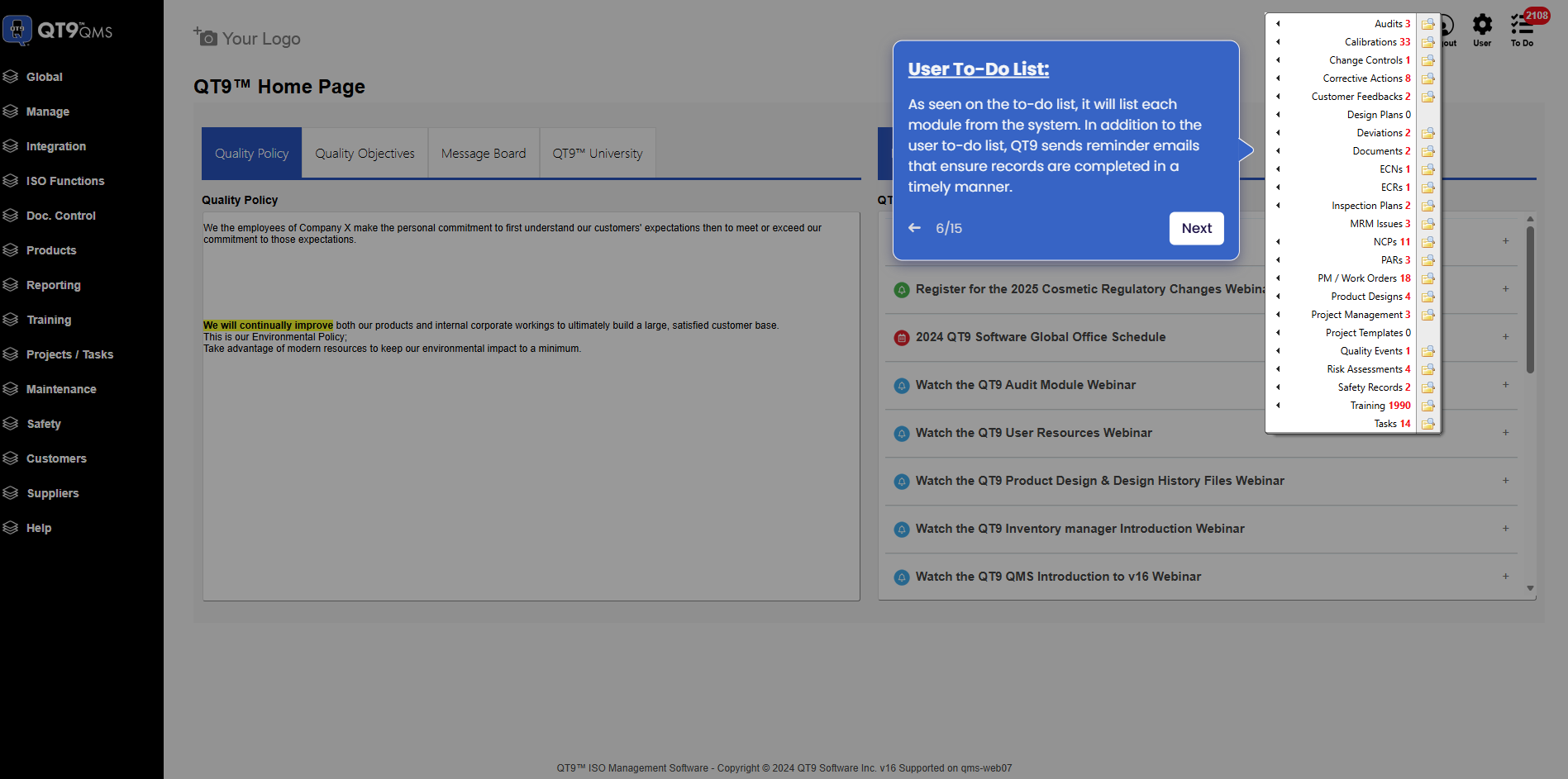
Simplify Quality, Compliance and Operations
Start a Trial
Try QT9 free — no credit card required.
Start Free→
Schedule a Demo
See QT9 live with one of our product experts.
Book a Time →
Get a Quote
Get custom pricing tailored to your team size.
Get Pricing →