Share this
by QT9 Software on October 22, 2026
The data you don’t see can hurt you. When purchasing data lives in an ERP or a spreadsheet and quality data lives in a separate QMS platform, important decisions can be made based on an incomplete picture. Supplier selection is a common example: A supplier’s delivery history and pricing sit in one system, while its quality history sits in another.
A connected manufacturing platform closes those blind spots by putting operational and quality data in one place, so risk can be seen and managed before it becomes an issue.
To show what that looks like in practice, this article follows one supplier decision at a medical device manufacturer — from selection through quality failure to a stronger long-term supplier. The example is based on a real customer scenario QT9 presented during a recent online quality and compliance summit, with company, supplier and product names changed.
At a glance
-
The challenge: A medical device manufacturer needed a fast, reliable supplier for a critical component. Its delivery data and quality data would typically sit in separate systems.
-
What connected data showed: QT9 BI combined delivery data from QT9 ERP with quality data from QT9 QMS. It showed a clear trade-off: the fastest supplier carried the highest quality risk.
-
What happened: The manufacturer chose speed and put the supplier on tightened inspection. When a customer return occurred, linked ERP and QMS records traced it to the supplier. They also showed that half the event’s cost came from work beyond replacement parts.
-
The outcome: Quality and pricing trends led the manufacturer to move the component to a stronger supplier.
-
The takeaway: Connected manufacturing makes supplier risk visible before and after the decision, so it can be managed rather than discovered too late.
What is connected manufacturing?
Connected manufacturing is when a manufacturer’s electronic quality, operations and analytics systems share data automatically, so every record and decision draws on the same source in real time. In connected manufacturing systems, a purchase order, inspection results, nonconformances and corrective actions draw from linked records rather than entries made in disparate systems.
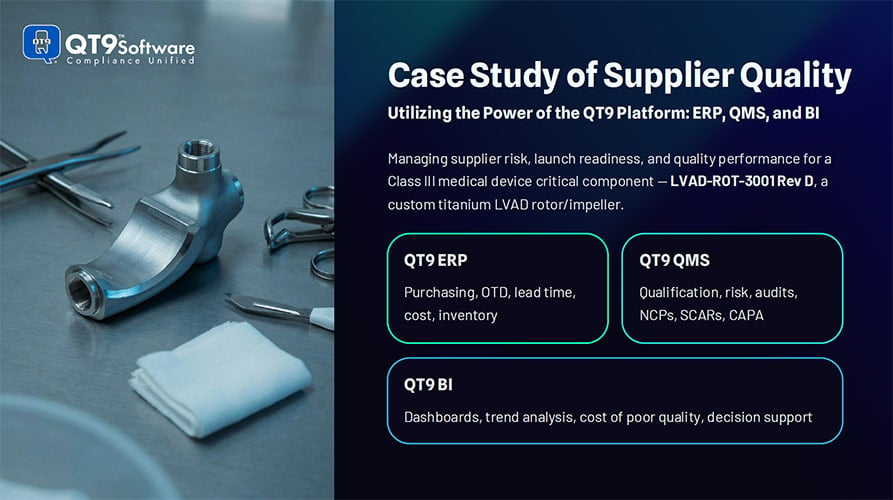
With QT9, a connected manufacturing platform brings together three solutions:
-
QT9 ERP for operational tasks, such as purchasing, inventory management, production, MRP planning and returns.
-
QT9 QMS for quality and compliance systems, such as inspections, supplier quality, nonconformance, CAPA, customer feedback and document control.
-
QT9 BI, business intelligence software for real-time analysis of business data, KPI monitoring and advanced reporting enabling more strategic decisions.
How disconnected data hides risk in manufacturing
Risk often hides in the gaps between business systems. For instance, a regulated manufacturer may already use a strong eQMS, but its operational data may reside elsewhere: inventory in spreadsheets, purchase orders in an accounting package or an older ERP that does not share data with quality.
Those gaps create blind spots in three main ways:
-
Decisions rest on partial data. Purchasing sees on-time delivery and price, but the quality history that should also influence that decision sits in another system.
-
Nothing updates automatically. Spreadsheets depend on manual input, so data is often stale by the time anyone reads it, and rekeying opens the door for inaccuracies.
-
Records must be reconstructed. When a problem appears, teams search across systems to piece together what happened, which slows response time. Audits are also slowed when necessary data cannot be easily found and flows reconstructed.
Connected manufacturing example: one decision, two sides of the data
One area where these blind spots are easily illustrated is supplier quality, since supplier problems span operational and quality activities, and back again.
A medical device manufacturer, we’ll call CardioNova, needed a supplier for a critical part. CardioNova’s customer wanted to get to market quickly, so the manufacturer needed a supplier that provided quality product and fast delivery.
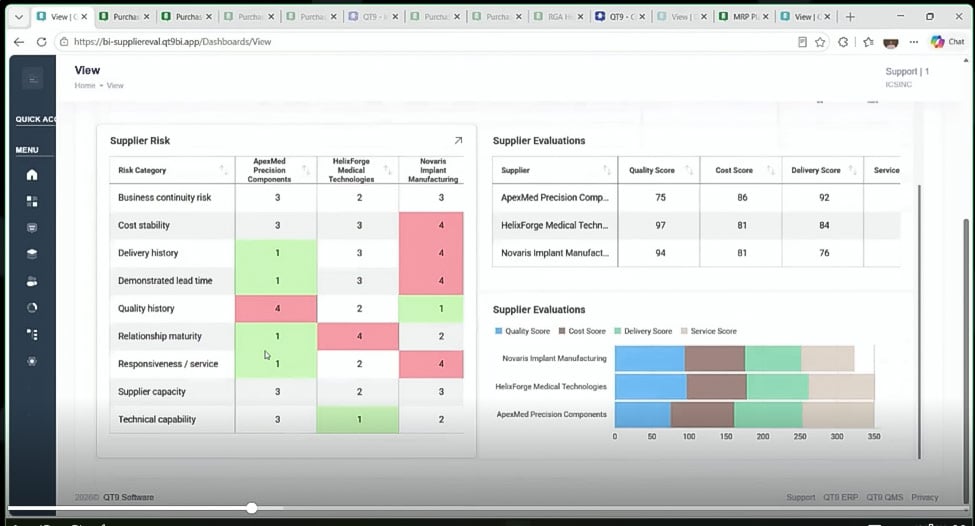
Three suppliers were in the running: Apex Med Precision Components, Helix Forge and Novarus Implant Manufacturing.* Each was evaluated on delivery and quality metrics.

Why CardioNova chose Apex Med
CardioNova weighed the data against its go-to-market strategy, and Apex Med fit that strategy best. Its customer needed to reach market quickly, so delivery performance carried the most weight.
Apex Med's risk assessment confirmed a strong delivery history, demonstrated lead time, a mature relationship and high responsiveness, plus it was the most willing to accept expedites. Helix Forge showed excellent quality and very high technical capability, but it was a newer relationship, which assessment flagged as a risk.
Because Apex Med’s quality gap was known, CardioNova could put Apex Med on a tightened inspection plan to catch quality issues at receiving. It was a calculated risk, taken to get its customer to market quickly.
How business intelligence influenced the decision
In a disconnected operation, delivery data and quality data sit in separate systems, and a trade-off like this one is hard to see clearly. QT9 BI was able to pull supplier delivery and inspection data from QT9 ERP and risk and evaluation data from QT9 QMS into one dashboard. That let CardioNova better visualize potential outcomes, make a deliberate, data-driven choice and build risk controls in from the start.
How connected manufacturing data identified new risk
Several months after initial supplier selection, CardioNova received a customer complaint that was traced to an out-of-tolerance component from Apex Med. Because the return started in QT9 ERP and integrated with QT9 QMS, the data was easily traceable:
-
Customer feedback (QT9 QMS): Linked to the return, this record started the investigation
-
Return goods authorization (QT9 ERP): The return was logged with a quality issue flag and traced to its sales order, lot and serial number.
-
Risk assessment (QT9 QMS): Created from the feedback record to gauge how much risk the issue posed.
-
Corrective action (QT9 QMS): Opened to address the internal escape.
-
Supplier nonconforming product and supplier corrective action (QT9 QMS): Opened against Apex Med.
-
Rework (QT9 ERP): Returned units were reworked with added labor and parts tracked by serial number or lot, and device history records and batch records were updated.
-
Replacement order (QT9 ERP): A replacement order was issued for the customer.
By using a natively integrated quality and manufacturing platform, centralized records are automatically linked, so the path from return to root cause can be followed from a single location.
Connected data reveals the true cost of poor quality
Final examination showed that only half the cost of CardioNova’s return event came from parts supplied by Apex. The other half was attributed to extra labor across the business, such as material review board meetings and account management outreach to customers.
These additional costs would have been hard to quantify with disconnected systems. Replacement parts, expediting, remanufacturing, shipping product back to the customer and time spent on review meetings and customer outreach are recorded in different places, so tying them to a single quality event can be difficult.
By having data already integrated in a connected ERP and QMS ecosystem, QT9 BI was able to quickly illustrate the true costs associated with the return event. The same dashboard can be run for all suppliers or for one, and it supports supplier scorecards. Because the platform is already connected, no extra integration work is needed to build it.
Using connected manufacturing data to choose a stronger supplier
The quality failure raised a bigger question for CardioNova: was Apex Med still the right supplier? Because Helix Forge remained a secondary supplier for CardioNova, data on the performance and pricing was still being tracked. CardioNova went back to that data to reevaluate its choice of supplier.
A purchase price variance report in QT9 BI tracked each supplier's purchase prices and averages over time. The data showed:
-
Apex Med raised its price by 12.5% over three years. It had once been the cheapest supplier, but its pricing crept up until it was not much cheaper than Helix Forge on unit price alone.
-
Helix Forge lowered its price by 5.6% over the same period.
That trend was tied back to quality. Helix Forge consistently made parts to spec, avoiding return events and the extra work that comes with them, which allowed it to price more aggressively.
With delivery, quality and cost data in one view, the full picture was clear. Apex Med's delivery advantage had come with quality failure, a return event in which half the cost came from work beyond replacement parts, and steadily rising prices. Helix Forge had delivered 100% first-pass acceptance while lowering its prices. CardioNova moved the component to Helix Forge.
Could your operation benefit from streamlined, connected manufacturing?
CardioNova's story is specific, but the blind spots behind it are common. Three questions can reveal where blind spots may be in your own operation:
-
Where are your teams entering the same information twice?
-
Where do they search across systems to reconstruct a record?
-
Which decisions could they make sooner if quality and operational data appeared in one place?
Each answer points to a gap where risk can hide. Closing those gaps does not have to mean stitching together separate systems with one-off integrations. QT9 QMS, QT9 ERP and QT9 BI are built to work together as one connected manufacturing platform, so quality, operational and cost data are linked from the start.
-
Inspections across the business: Inspections from sales, manufacturing and purchasing link directly to nonconforming product and CAPA records.
-
Current documents on the shop floor: Controlled documents from QT9 QMS can be linked to bill of materials in QT9 ERP, so employees see the current version while they process their jobs.
-
One-click device history records and batch records: Job, inventory, inspection, documentation and nonconforming product data come together automatically, and a compliance portal lets auditors review records without access to the full ERP.
If your quality and operational data still live in separate systems, see howQT9 QMS, QT9 ERP and QT9 BI work together to bring risk into view before it reaches your customers.
* Disclaimer: The companies and products named in this example are fictional. Any resemblance to actual companies or products is coincidental. The scenario is based on a real customer experience, with all identifying details changed.