
Share this

by Drew Reedy on August 27, 2026
Supply chain forecasting means more than estimating how many finished goods a manufacturer expects to need next year. It looks ahead at how expected demand aligns with the materials, inventory, supplier resources and production requirements needed to meet it.
If a critical component has a long lead time, a large minimum order quantity or limited sourcing options, waiting until production orders are released to address requirements leaves far fewer supplier options.
Supply chain forecasting gives manufacturers an earlier view of those future requirements. It starts with expected demand and provides the forward-looking information needed to prepare materials, inventory and supplier resources to support production. For manufacturers with complex supply chains, that connection matters.
A forecast has limited operational value if it remains separate from material planning and purchasing. When demand forecasts feed Material Requirements Planning (MRP), inventory and purchasing processes, manufacturers gain a clearer picture of what they will need, when they will need it and where supply constraints may need attention.
Contents
What is supply chain forecasting?
How demand predictions inform supply chain forecasting
Supply chain forecasting provides early insight into supplier requirements
How to turn supply chain forecasts into material requirements
How QT9 ERP supports supply chain forecasting
Close the loop between forecasts and actual results
What manufacturers should monitor
Turn forecasts into better supply decisions
What is supply chain forecasting?
Supply chain forecasting is the process of looking ahead at expected demand and the supply conditions that will affect a manufacturer’s ability to meet it.
Demand forecasts provide part of that picture by estimating what customers are likely to need in future periods. Supply chain forecasting extends that view by considering the materials, inventory, supplier requirements and purchasing conditions that will support that demand.
For manufacturers, that means asking questions such as:
-
Which components and raw materials will products consume?
-
What inventory is already available?
-
What materials are already on order?
-
How far in advance do additional materials need to be purchased?
-
Which suppliers will those requirements depend on?
-
How do supplier lead times, order minimums and other purchasing parameters affect future requirements?
-
When will production need those materials?
The goal is not simply to predict demand. It is to give manufacturers earlier visibility into whether expected supply will align with future production requirements.
That becomes especially useful when forecasted demand feeds MRP, inventory and purchasing processes. Manufacturers can compare what they expect to need with what is already available, what is scheduled to arrive and what suppliers will need to provide.
How demand predictions inform supply chain forecasting
Demand forecasting establishes what a manufacturer expects customers to need. Supply chain forecasting puts those expectations into a broader supply context by looking at what materials, inventory and supplier resources will be required to support that demand.
Suppose a manufacturer forecasts a significant increase in demand for a finished product in the fourth quarter. The demand forecast establishes how much product may be needed and when.
The next question is whether the supply chain can support it. Manufacturers need to consider the components and raw materials required, available and incoming inventory, supplier lead times, purchasing requirements and production timing.
This is where forecasted demand becomes operationally useful. When it feeds MRP and related purchasing and inventory processes, manufacturers gain earlier visibility into whether expected supply aligns with future demand.
Supply chain forecasting provides insight into supplier requirements
Supply chain forecasting does not predict that a supplier will fail or that a disruption will occur. It shows manufacturers how much future production may depend on particular purchased materials and suppliers.
Suppose projected demand indicates that production will require significantly more of a particular component eight months from now. That component is available from two approved suppliers. One offers a short lead time and flexible order quantities. The other requires a large minimum order and has a four-month lead time. The second sourcing option requires attention much sooner because the manufacturer has less flexibility in how and when it can secure the material.
The forecast has not predicted a supplier disruption. It has exposed a future supply dependency, giving procurement time to evaluate whether existing sourcing arrangements will support the requirement.
That earlier visibility supports questions such as:
-
Does the supplier's lead time support the expected production date?
-
Should an order be placed earlier?
-
Does the projected volume affect order quantities or pricing?
-
Is there an approved alternate supplier?
-
Are existing supply commitments sufficient?
-
Does the expected increase warrant a conversation with the supplier about future capacity or delivery timing?
Bringing forecasted demand together with supplier and purchasing information brings these dependencies into view before they become immediate purchasing requirements.
How to turn supply chain forecasts into material requirements
Once expected demand is established, manufacturers need to translate finished-goods requirements into the components and raw materials needed to produce them.
Material Requirements Planning (MRP) performs that work.
Determine demand requirements
Manufacturing demand comes from several sources. Each source represents a different level of certainty and timing.
-
Sales orders reflect confirmed customer demand.
-
Scheduled production shows what the manufacturer has already committed to build.
-
Forecasts extend the planning horizon by estimating demand that has not yet become an order or production job.
Bringing these demand sources together gives manufacturers a more complete view of what production is likely to require. That is especially important for materials with long supplier lead times.
If a component takes four months to arrive, but customer orders are typically placed only six weeks before production, waiting for confirmed orders may not leave enough time to secure the material.
Forecasted demand provides an earlier signal, allowing MRP to account for anticipated requirements before they become immediate production needs. From there, MRP translates finished-goods demand into the component and raw-material quantities required to support production.
Break demand down through the BOM
A forecast for a finished item does not tell Purchasing which raw materials to buy.
The Bill of Materials (BOM) identifies the components and subassemblies required to make the product. MRP expands those requirements through the BOM so demand for a finished item becomes demand for the materials underneath it.
For a multi-level assembly, that calculation continues through subassemblies and their components. QT9 ERP enables multi-level BOMs and calculates material requirements down to the component level.
Compare requirements with available supply
Gross material requirements are not the same as purchasing requirements. If manufacturing will need 10,000 units of a component, planners also need to know how many are already in stock and how many are scheduled to arrive.
MRP accounts for inventory and materials already on order before calculating what additional supply is required. QT9 ERP’s MRP module analyzes current inventory, open sales orders, production schedules and existing supply when generating purchasing recommendations.
Apply timing and purchasing requirements
A materials plan also needs to account for when supply must arrive. Supplier lead times, safety stock, economic order quantities and purchasing minimums affect how much needs to be ordered and when.
A component required five months from now creates little immediate pressure if it is routinely available within a week. A component with a six-month supplier lead time requires attention before the same production requirement becomes urgent.
QT9 ERP’s MRP module factors supplier lead times and safety-stock rules into material planning and lets manufacturers configure purchasing parameters such as economic order quantities and minimum purchase amounts.
The forecast provides the starting signal, while material, inventory and supplier data determine how the manufacturer should respond.
How QT9 ERP supports supply chain forecasting
QT9 ERP supports the demand and supply connection behind supply chain forecasting. Its Forecasting module provides the demand side of the equation, while MRP, Inventory Control, Purchasing and Supplier Management connect those forecasts with the supply information manufacturers use to plan materials and production.
Rather than keeping projected demand separate from those processes, QT9 feeds anticipated demand directly into the planning environment.
Create longer-range demand forecasts
QT9 ERP Forecasting allows manufacturers to create item-level forecasts for purchased or manufactured items using daily, weekly or monthly periods.
Forecasts can extend up to 24 months, providing additional planning time for long-lead materials, supplier commitments and future production requirements.
Those forecasts provide a longer-range demand signal that MRP can evaluate alongside current orders, inventory and other supply information rather than waiting for production jobs alone to create material demand.
Feed forecast demand directly into MRP
QT9 ERP feeds forecast demand directly into MRP calculations. The system supports demand coming from forecasts, sales orders, open production jobs and manual purchase requests within the planning environment.
MRP then evaluates what those requirements mean at the material level:
-
Calculate required quantities for components and raw materials
-
Expand requirements through multi-level BOMs
-
Subtract available inventory
-
Account for materials already on order
-
Factor in supplier lead times
-
Apply safety-stock and purchasing parameters
-
Identify shortages and excess inventory
-
Generate purchasing recommendations
This gives manufacturers a direct path from expected finished-product demand to the materials required to support it.
Connect forecast demand with Purchasing
QT9 ERP enables creation of purchase orders from forecast-driven demand, MRP requirements or direct entry. Its Purchasing module also manages supplier quotes, approval routing, order status, receipts and supplier information.
Forecast-driven purchase orders apply configured supplier requirements such as lead times, minimum quantities and price breaks.
A projected requirement becomes much more useful when the manufacturer sees that the material requires a long lead time, has a supplier minimum or already has supply scheduled to arrive.
Use current inventory to determine what is actually needed
QT9 ERP Inventory Control provides real-time visibility into stock levels and inventory locations and synchronizes inventory with purchasing, sales and production. It also tracks purchased and manufactured inventory by lot or serial number where traceability is required.
Connecting current inventory with future demand helps manufacturers distinguish between what production will consume and what actually needs to be purchased.
That supports two sides of planning: identifying potential shortages early and avoiding unnecessary purchases when existing inventory or open supply already covers future requirements.
Bring supplier information into purchasing decisions
QT9 ERP Supplier Management maintains supplier-specific information including item pricing, supplier part numbers, conversions and lead times.
Two suppliers offering the same component may have different lead times, purchasing terms or pricing. When a supply chain forecast exposes a future requirement, supplier-level information provides procurement with more context for deciding how to fulfill it.
QT9's Supplier Portal extends that visibility to supplier collaboration. Suppliers can view purchase orders, confirm delivery commitments and update delivery schedules, while those interactions remain connected to ERP purchasing records.
The result is a clearer progression from forecasted demand to planned supply and ultimately to a supplier commitment.
Close the loop between forecasts and actual results
Supply chain forecasting becomes more useful when it is treated as an ongoing cycle rather than a forecast created once and left unchanged.
Expected demand changes as customer orders arrive. Inventory changes as materials are received and consumed. Supplier delivery performance changes. Production schedules move. Actual material usage may differ from previous assumptions.
Each of those events produces information that should inform future demand and supply assumptions.
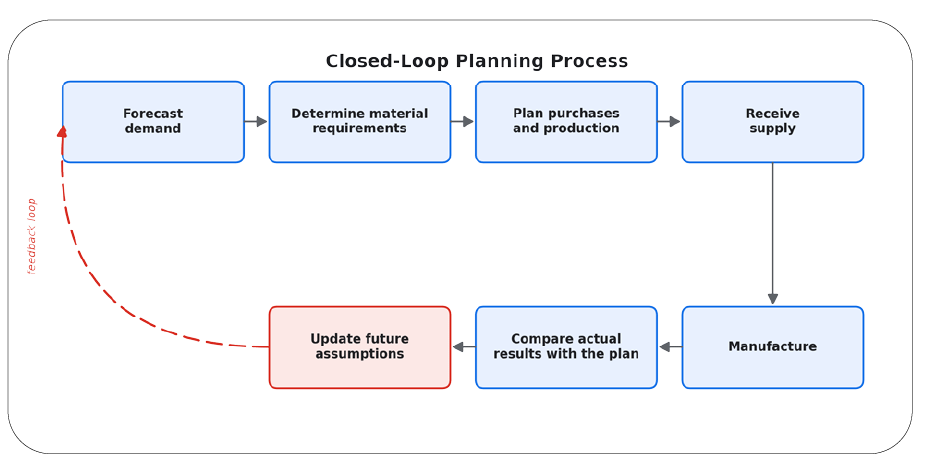
QT9 ERP keeps many of those activities connected across Forecasting, MRP, Inventory Control, Purchasing and Supplier Management. QT9 BI adds reporting and trend visibility across operational and supplier data.
That connection is especially useful for supplier planning. If actual supplier delivery times consistently exceed the lead time being used in MRP, that difference deserves attention. If future demand increases dependence on the same material, the impact of an inaccurate lead-time assumption becomes more significant.
Likewise, if actual demand falls below the forecast, manufacturers need visibility before purchasing additional materials that may ultimately become excess inventory.
Closing the loop keeps both demand and supply assumptions grounded in actual operational results.
What manufacturers should monitor
Demand forecast accuracy is important, but effective supply chain forecasting also depends on whether the supply assumptions supporting future production remain accurate.
The broader question is whether expected demand and available supply remain aligned closely enough to support reliable material, purchasing and production decisions.
Depending on the operation, useful indicators include:
-
Forecast versus actual demand
-
Material shortages
-
Inventory availability
-
Excess inventory
-
Open purchase-order coverage
-
Supplier lead-time performance
-
On-time supplier delivery
-
Material usage
-
Purchase-price trends
-
Production requirements and schedule changes
The important measures are the ones that reveal whether the assumptions behind future material requirements remain valid.
Turn forecasts into better supply decisions
Supply chain forecasting is most useful when expected demand is connected to the materials, inventory, supplier requirements and purchasing conditions that determine whether production can support it.
For manufacturers, the value comes from seeing those requirements earlier. Long lead times, limited sourcing options, order minimums and inventory constraints are easier to address when they are visible months before production needs become urgent.
QT9 ERP connects demand forecasting with MRP, Inventory Control, Purchasing and Supplier Management so manufacturers can move from projected demand to material requirements and supply decisions within the same system. That gives teams a clearer view of what they will need, what is already available and where future supply may require attention.


How Electronic Batch Record Systems Keep Production Moving and Quality Connected