
Share this

by QT9 Software on September 01, 2026
Inventory tracking gives manufacturers visibility into materials and products as they move through the organization. It answers basic operational questions such as what inventory is available, where it is located and how much is on hand. But its value extends much further.
Each receipt, transfer, material issue, production transaction and shipment adds to the history of that inventory. When materials are tracked by lot or serial number, manufacturers can preserve their identity from supplier receipt through production and finished goods.
That makes inventory tracking an important part of manufacturing traceability.
Accurate inventory records help manufacturers manage availability and production while also establishing the connections needed to determine where materials came from, how they were used and where finished products went.
Contents
How inventory tracking works in manufacturing
What manufacturers need to track
How inventory tracking supports lot genealogy
Forward and backward traceability
Why transaction history matters
Inventory tracking improves operational control
How QT9 ERP supports inventory tracking
Inventory tracking builds the record behind traceability
What is inventory tracking?
Inventory tracking is the process of recording the quantity, location, status and movement of inventory throughout its lifecycle.
For manufacturers, inventory may include:
- Raw materials
- Purchased components
- Work in process
- Subassemblies
- Finished goods
- Returned inventory
Tracking begins when materials are received and continues as inventory moves between storage locations, is allocated or issued to production, becomes part of manufactured inventory and ultimately ships to a customer.
This provides a continuously updated picture of inventory rather than a static count.
Manufacturers can determine not only how much of an item they have, but how much is available, allocated to production, on order or located elsewhere. Systems that maintain transaction history also provide a record of how those quantities changed over time.
How inventory tracking works in manufacturing
Manufacturing inventory moves through several operational stages, and each one contributes information to the inventory record.
Receiving
Inventory tracking starts when purchased materials and components arrive from suppliers. Upon receipt, teams collect key information, such as the item name, serial numbers, quantity, supplier, date received and storage location. Lot-controlled materials also include the supplier lot number and an internal lot identifier.
Capturing this information at receipt establishes the starting point for later traceability.
Storage and movement
Materials often move several times before they are used. They may be transferred between warehouses, stockrooms, bins or production locations. Manufacturers need to maintain visibility into those movements so they know both the quantity available and the location of specific inventory.
Lot-level tracking becomes particularly important when multiple lots of the same material are stored at the same time.
A manufacturer might have 500 units of one component in inventory, for example, but those 500 units could consist of three different supplier lots received on different dates. Treating them as a single quantity would obscure important information about their origin and subsequent use.
Production
When inventory is allocated or issued to a manufacturing job, inventory tracking connects material availability with actual production activity. The system records which materials were consumed, how much was used and which job used them.
For lot-controlled inventory, the specific lot matters as much as the item number. If production requires 20 units of Component A, knowing that 20 units were consumed maintains inventory accuracy. Knowing that those units came specifically from Lot A100 creates another level of traceability.
Manufactured inventory
Production creates new inventory that also needs to be tracked. Finished goods, intermediate products and subassemblies may receive their own lot or serial numbers. Manufacturers then need visibility into quantities, locations, availability and subsequent movements just as they do for purchased materials. When production records connect the lots consumed with the lot produced, inventory tracking begins to create lot genealogy.
Shipping
Inventory tracking continues when finished products leave the facility. Shipping departments records deduct available inventory numbers and establish where finished goods went. For lot-controlled products, maintaining the lot associated with the shipment connects manufactured inventory with the customer that received it. At that point, the inventory history may extend from supplier receipt all the way through customer shipment.
What manufacturers need to track
The inventory data that manufacturers need to track depends on their products and processes, but several data points are particularly important.
Quantities
Teams need visibility into inventory on hand as well as quantities that are available, allocated, on order or otherwise unavailable. This supports purchasing, production scheduling and order fulfillment while reducing the risk that inventory shown in the system is not actually available for use.
Locations
Manufacturers with multiple warehouses, stockrooms or production locations need to know exactly where inventory resides. Location tracking also supports transfers, picking and physical inventory activities.
Lot and serial numbers
Lots preserve the identity of groups of materials or products, while serial numbers provide identification at the individual-unit level. These identifiers become essential when manufacturers need to distinguish inventory that shares the same part number but has different production or supplier histories.
Inventory status
Inventory may be physically present without being available. Allocated, expired, quarantined or otherwise restricted materials should remain distinguishable from inventory that can immediately be used.
Transactions
Receipts, transfers, adjustments, production usage and shipments explain why inventory quantities and locations changed. Transaction history provides context that a current balance alone cannot.
Production usage
Manufacturers also need to know which materials went into which jobs. Recording that relationship supports material control during production and becomes the link between inventory tracking and product genealogy.
How inventory tracking supports lot genealogy
Lot genealogy describes the relationships between material and product lots as they move through manufacturing. Inventory tracking provides the records that create those relationships.
Suppose a manufacturer receives three raw materials shipments:
-
Supplier Lot A100
-
Supplier Lot B205
-
Supplier Lot C310
A manufacturing job consumes material from all three and produces Finished Lot FG-500.The inventory system records the withdrawal or consumption of A100, B205 and C310 and the creation of FG-500.
That establishes a relationship. If FG-500 later ships to several customers, shipment records extend that history:
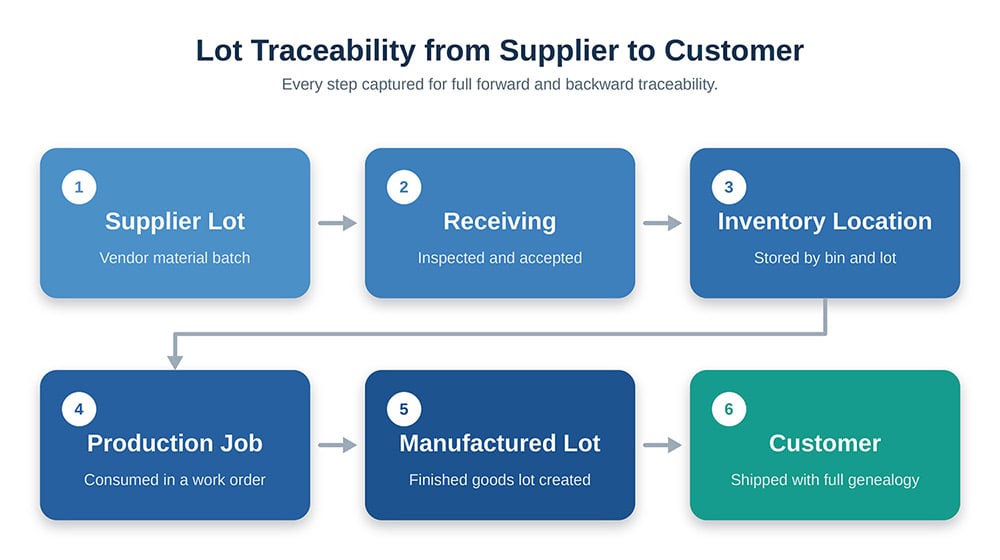
Supplier lots → Production job → Finished lot → Customer shipments
This is lot genealogy.
It does not come from simply assigning lot numbers. It depends on preserving those lot identities as inventory is received, moved, consumed, produced and shipped.
Forward and backward traceability
The inventory and production records that form lot genealogy support two directions of traceability. Forward traceability begins with a material or component lot and follows it through subsequent activity.
For example, if a supplier reports a problem with Lot A100, the manufacturer needs to determine:
-
How much was received
-
Whether any remains in inventory
-
Where the remaining material is located
-
Which jobs consumed it
-
Which manufactured lots contain it
-
Whether those finished products remain in stock
-
Which customers received affected lots
Backward traceability starts with a finished product and follows its history in the opposite direction. If Finished Lot FG-500 develops a problem, teams may need to identify the production job that created it and the specific purchased or manufactured lots consumed during production.
Inventory tracking makes both investigations possible by maintaining the chain of transactions connecting materials, production and finished inventory.
Why transaction history matters
A current inventory balance answers an important question: What do we have right now? It does not explain how the inventory reached that state.
Consider a supplier lot that originally contained 1,000 units but now shows only 150 units in stock. The remaining quantity alone does not tell a manufacturer whether the other 850 units were transferred, adjusted, scrapped, issued to production or incorporated into finished products.
Transaction history provides that context. This becomes particularly valuable during quality investigations and recalls because teams often need to reconstruct activity that occurred weeks or months earlier. Instead of starting with a current balance and working backward through disconnected records, manufacturers can follow the inventory transactions associated with the material or lot.
Inventory tracking improves operational control
Traceability is one important reason to maintain accurate inventory records, but manufacturers also rely on that information to support everyday operations.
Material availability: Real-time visibility into available, allocated and on-order inventory helps production and purchasing teams determine whether materials will be available when needed.
Production planning: Knowing what is currently in stock and what has already been committed to jobs gives planners a more accurate basis for scheduling production.
Inventory accuracy: Recording receipts, transfers, usage and adjustments as they occur helps keep system quantities aligned with physical inventory.
Expiration control: Manufacturers working with shelf-life-controlled materials need visibility into expiration dates so they can identify inventory approaching expiration and determine which lots should be used first.
Multi-location visibility: Tracking inventory by warehouse and sublocation provides a clearer view of material availability across facilities and storage areas.
These operational uses reinforce traceability because they depend on maintaining accurate inventory information throughout the same lifecycle.
How QT9 ERP supports inventory tracking
QT9 ERP connects and records purchased inventory, manufacturing and manufactured inventory so manufacturers can follow materials as they move through operations.
Purchased inventory can be tracked directly from purchase-order receiving, including supplier lot information. QT9 ERP maintains information about available and unavailable lots, quantities on order, inventory allocated to jobs, usage history, receiving history and the parts in which materials were used.
Manufacturers can track purchased inventory across unlimited locations and sublocations, while barcode scanning through Shop Floor Manager records material against manufacturing jobs. Purchased-item detail provides traceability back to the supplier and shows which jobs used a particular lot.
QT9 ERP also supports expiration tracking for purchased materials, including alerts for soon-to-expire inventory and FEFO allocation to scheduled jobs.
As materials move through production, inventory remains connected with manufacturing activity. QT9 ERP supports lot and serial control, WIP tracking and real-time visibility into stock levels, locations and transactions. Inventory data also synchronizes with purchasing, sales, production and shipping.
For manufacturers that require deeper traceability, QT9 ERP supports forward and backward lot tracing from raw materials through finished goods.
Inventory tracking builds the record behind traceability
Inventory tracking gives manufacturers immediate visibility into what they have, where it is and how it is being used. Each inventory transaction also adds to a larger history.
Receiving establishes where materials came from. Transfers show where they moved. Production usage records detail what consumed them. Manufactured inventory identifies what they became. Shipment records show where finished products went.
When those records preserve lot or serial identity throughout the process, manufacturers gain the genealogy needed to follow materials forward and products backward. That makes inventory tracking both an operational necessity and a foundation for manufacturing traceability.
See how QT9 ERP connects inventory, production and lot traceability from receiving through finished goods.
