Share this

by QT9 ERP Software on December 09, 2025
If you work in manufacturing today, it is impossible to ignore the impact of data. In addition to tracking suppliers, materials, production and shipments, manufacturers in regulated industries must consistently and completely document every input and process for both business planning and regulatory compliance.
In the middle of all that complexity sits one concept that ties it all together: traceability.
Traceability helps manufacturers maintain confidence in the materials they receive and the products they make and deliver to customers. It enables teams to respond to issues quickly, solve problems faster and keep production moving.
While Quality Management System (QMS) software addresses traceability for quality events, such as nonconformances and CAPAs, Enterprise Resource Planning (ERP) systems are the cornerstone of design and production data, providing digital traceability and maintaining real-time material tracking, batch/lot history and inventory control.
When track-and-trace capabilities live in ERP, manufacturers gain reliable visibility that minimizes risks and satisfies regulatory mandates. Here we explore the modern ERP and its significance to traceability.
Contents
Core ERP traceability features for regulated manufacturers
Benefits of ERP-based traceability
How manufacturers can strengthen ERP traceability
Look to QT9 ERP for complete traceability
What ERP traceability means
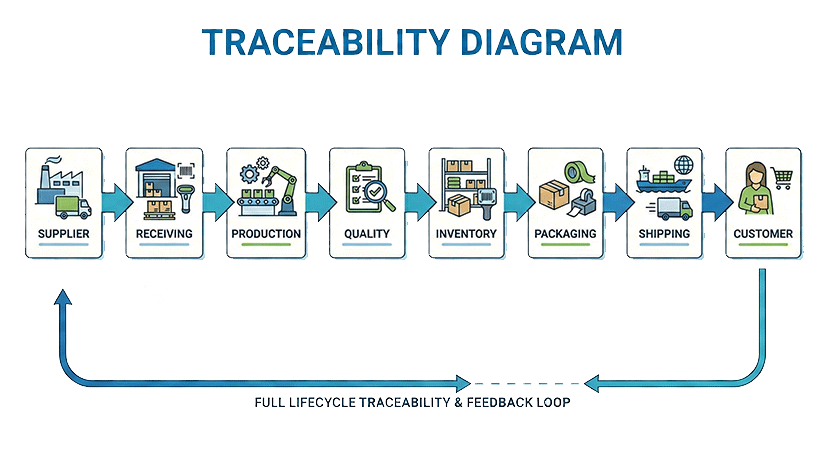
At its core, ERP traceability is the continuous connection between materials, activities and outcomes. It follows every raw material, component, batch, lot and finished product through:
- Material receipt and inspection
- Production and assembly
- Quality tests and potential hold
- Inventory transfers and storage
- Packaging, labeling and release
- Shipment and customer delivery
All of these movements become part of one unified history, stored in one system. That makes it possible to:
- Capture where materials came from
- Document lots and batches and monitor their movements
- Connect quality results to specific batches
- Track which customers received which products
- View the full history of every product
This type of complete record-keeping is useful for much more than compliance. It is what allows operations teams, quality teams, supply chain partners and leadership to make confident, informed decisions.
Bidirectional traceability
Modern manufacturers need traceability that works in both directions.
Backward (downstream) tracing: From a finished product, back through production, through inspection steps and to the exact raw materials and suppliers that were used.
Forward (upstream) tracing: From a raw material or supplier lot, forward into batches, finished goods and customer shipments.
This makes everyday tasks easier, such as investigating an issue, responding to a supplier concern or answering a customer question. It also prepares organizations for unexpected situations like defects, material shortages or recalls, since teams can identify exactly where an issue starts and what it affects.
Why ERP traceability matters
Regulatory expectations for traceability have grown considerably in the last few years. Several forces have driven this trend, including:
Regulatory demands
Regulatory bodies and global standards are becoming increasingly demanding in response to consumer pressure and to protect public safety and resources. Compliance with these regulations call for:
- More rigorous documentation of production controls
- Clearer records of material provenance
- The ability to quickly identify accurate batch and lot histories
ERP-based traceability provides the structured foundation required to meet these expectations at every stage of a product’s lifecycle, from engineering to material acquisition to production.
Complex, global supply chains
Recent industry analyses highlight that manufacturers increasingly rely on multi-tier suppliers and the outsourcing of key processes. Without ERP-led tracking, control of third-party inputs is more at risk, especially when lots or batches must be traced across multiple facilities or partners.
Traceability provides the end-to-end visibility needed to anticipate, mange and mitigate supply chain risks. It also enables faster turnarounds, better inventory management and more efficient quality control.
Rising recall and compliance risks
Regulated manufacturers in life sciences face some of the most expensive recall scenarios in the global market. A 2024 review of FDA enforcement trends shows an increase in product withdrawals tied to inadequate documentation, inconsistent batch records and inability to confirm material origins. ERP-level tracking reduces risk exposure by honing in on affected batches and accelerating recall and investigation.
Customer and partner expectations
Across life sciences and pharma supply chains, downstream entities now demand:
- Proof of material authenticity
- Full chain-of-custody documentation
- Verified batch and lot histories
ERP traceability delivers the digital evidence needed to maintain supplier qualification and customer trust.
Core ERP traceability features for regulated manufacturers
Core ERP capabilities ensure that traceability is not a burden, but a natural part of everyday operations. ERP systems for regulated industries should support traceability through features such as:
-
Lot and serial number tracking from receipt through production to final shipment, using unique identifiers
-
Bidirectional lot and batch traceability for fast backward and forward tracing
-
Supplier tracking, including material origins, receipt information, inspection status and supplier performance history
-
Inventory controls that prevent compliance breaches, such as:
-
FIFO/FEFO management
-
Expiration tracking
-
Quarantine and hold workflows
-
Controlled release processes
-
-
Quality control integration and automated checkpoints, including the ability to tie QA/QC tests, inspections and approvals to lot IDs.
-
Real-time data collection via mobile aps, barcode or RFID scanners to allowing for immediate data capture whether on shop floor or during shipping
-
Return Merchandise Authorization (RMA) processing to help manage product returns using tracking information to identify source of the returned item
-
Scalable architecture, supporting multi-site operations and high-volume production environments.
Benefits of ERP-based traceability
Historically, many manufacturers used spreadsheets, paper logs and local files to track material and production inputs. Those methods have proven to be unreliable, prone to missing data, human errors and manual reconciliation. Implementing lot-level traceability in an ERP system can generate tangible benefits:
Reduced waste and scrap — Because inventory is tracked with digital precision, it is easier to manage older/expiring lots in the ERP environment, allowing companies to mitigate waste via FIFO controls.
Faster root-cause analysis and corrective action — When defective product emerges, teams can trace back through supplier lots, material batches, production lines and quality tests to pinpoint the source, dramatically reducing downtime and rework.
Improved compliance and audit readiness — Traceability via ERP means consistent, centralized and reliable records, which is increasingly critical for regulated industries facing audits and regulatory scrutiny.
Stronger customer and partner trust — Demonstrating end-to-end traceability becomes a differentiator for OEMs, regulators and customers who require transparency and accountability across the supply chain.
Faster, more targeted recall or containment — If a quality issue arises, only affected lots need to be recalled, preserving unaffected inventory, minimizing financial impact and protecting brand reputation.
How manufacturers can strengthen ERP traceability
-
Map your process and data flows: Start with a detailed review of where lot data begins (receipt of raw materials), how it’s assigned (lot number, batch, serial), and how it moves through production, quality checks, inventory and shipping.
-
Define lot/serial numbering rules and data schema: Standardize how lot numbers are assigned (supplier code, date code, batch code, etc.) so traceability is consistent across suppliers and sites.
-
Ensure your ERP supports quality integrations: Ensure all quality events, inspections, CAPA and non-conformance records link to lot/serial data. QT9 ERP is unique in that it provides seamless integration with QT9 QMS.
-
Implement data-capture tools: Automate lot tracking via barcode scanners, RFID or similar device to improve accuracy.
-
Train production, quality and warehouse teams: Make lot scanning, data entry and documentation part of standard procedures and ensure employees understand the importance of disciplined action to data integrity.
-
Test traceability workflows: Simulate a recall or defect scenario to test whether the system can trace affected lots through every stage: supplier → production → shipment → customer
-
Roll out, monitor and iterate: Begin with high-value or highly regulated product lines. Once the process proves robust, scale it to the entire production environment.
Look to QT9 ERP for complete traceability
QT9 ERP is built to give manufacturers the visibility they need without unnecessary complexity. It connects materials, production steps, inspections, inventory movements and shipments in one intuitive system.
QT9 ERP supports:
- Full lot and serial tracking
- Bidirectional lot and batch traceability
- Supplier management and inspection tracking
- Expiration dates, FIFO and FEFO logic
- Barcode scanning
- Mobile inventory and production actions
- Integrated quality events linked to lots and batches
- Multi-site and multi-language support for global operations
The result is a complete, connected view of your materials and products, from supplier to customer.
