Share this
by Christian Reyes on April 21, 2026
Quality teams do not intentionally create inefficient systems. Often they are responding to real events — a complaint, a deviation, an audit finding — and trying to reduce risk quickly.
The most immediate response is often more inspection. Another check. Another review. Another approval step.
Initially, this feels like progress. However, over time it can create something very different: a quality system that appears rigorous but quietly slows down the entire operation.
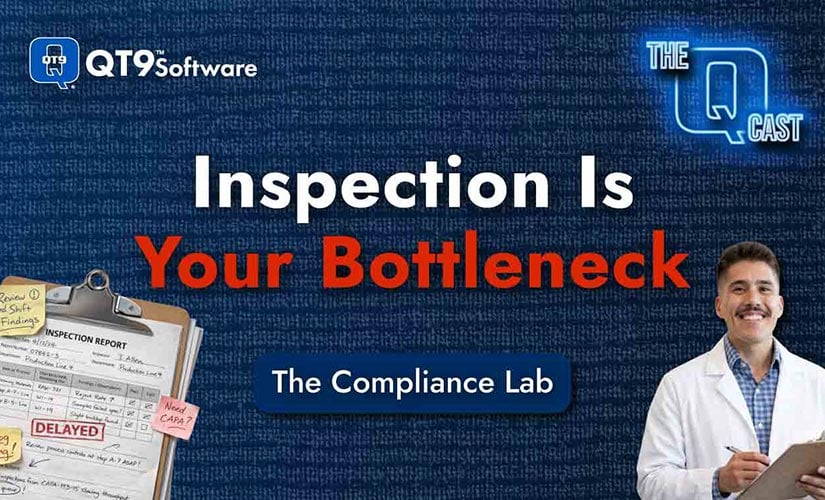
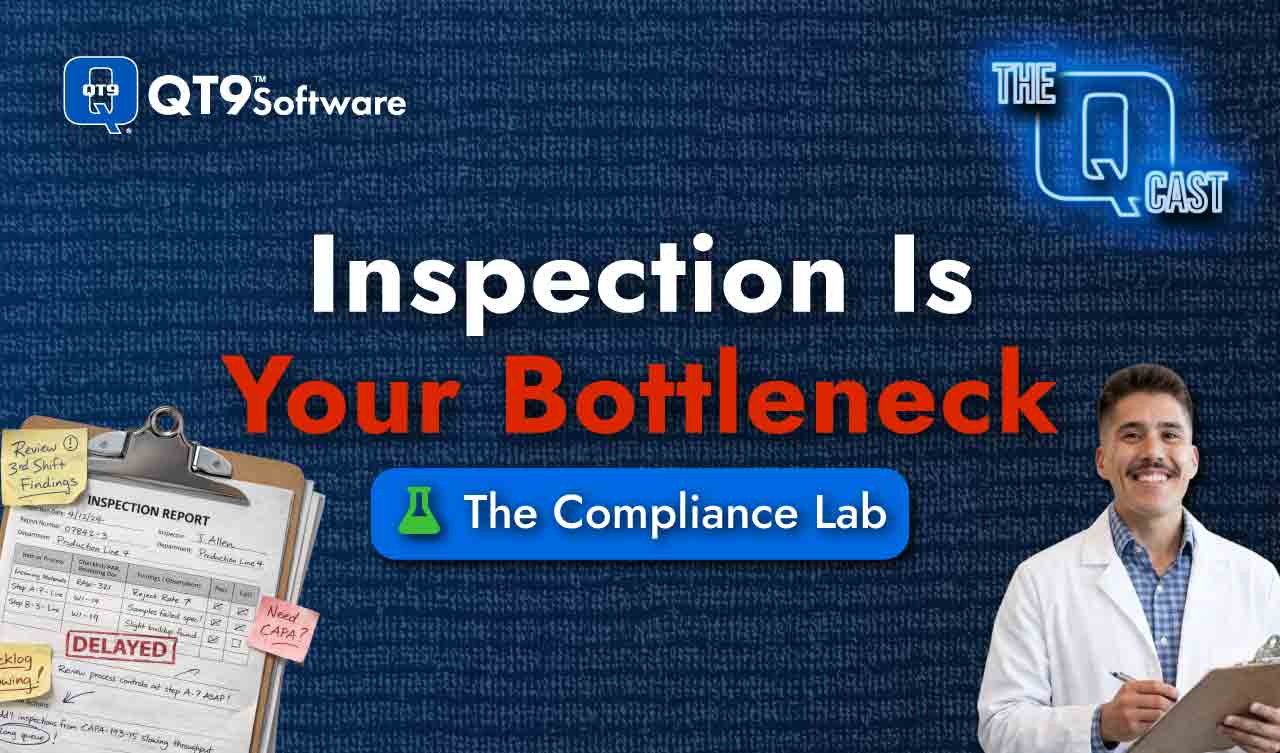
This is the over-inspection bottleneck — when inspection shifts from a safeguard to a constraint on throughput. In the latest QT9 Q-Cast, QT9 Manager and ISO-certified auditor, Christian Reyes, looks at the unintentional quality inspection bottleneck
Contents
The hidden tradeoff in quality inspections
Where quality inspection processes start to break down
Why inspection visibility matters more than inspection time
Prioritizing quality inspections appropriately
Managing out-of-control quality inspection
A practical path to optimizing quality inspection processes
Building a QMS that supports both compliance and throughput
QT9 QMS helps avoid quality-inspection bottlenecks
Prefer to watch?
Watch the full episode, linked below, to dive deeper into how to avoid the over-inspection trap.
The hidden tradeoff in quality inspections
Inspections play an essential role in regulated environments, but they were never intended to carry the full weight of quality assurance.
As FDA guidance suggests, quality should be built into processes, not verified solely through final inspection. ICH Q9 also emphasizes that control effort should align with risk.
Yet many quality management systems drift in the opposite direction. Instead of strengthening process control, organizations layer inspection on top of uncertainty. The result is a system that increases oversight without increasing real understanding.
That tradeoff shows up in measurable ways:
-
Longer release cycle times
-
Growing inspection queues
-
Increased quality workload without proportional defect reduction
At that point, inspection is no longer just verifying quality, it is dictating how work flows through the organization.
Where quality inspection processes start to break down
Over-inspection rarely comes from a single decision. It is the accumulation of many small ones. A CAPA introduces additional review. A supplier issue leads to expanded incoming inspection. A deviation adds another release checkpoint.
Each action is rational on its own. The problem is that they are rarely revisited. Over time, organizations lose visibility into why controls exist in the first place. What remains is a system full of inherited checks, many of which no longer align with current risk.
What is often missing is traceability and visibility:
-
Why was this control added?
-
What risk does it address today?
-
What data supports keeping it?
Without connected systems, those answers are difficult to find. As a result, inspection becomes a default response rather than a deliberate action.
Why inspection visibility matters more than inspection time
Many organizations track how long a quality inspection takes. Far fewer track how long product waits before inspection even begins.
An inspection step may only take 10 minutes, but if material sits in queue for 24–48 hours beforehand, the true impact on release timelines is much larger. Without visibility into that wait time, teams focus on making inspections faster rather than addressing the delays surrounding them.
This is where system-level visibility becomes critical. For instance, a connected QMS like QT9 enables quality teams to monitor inspection as part of the overall workflow, including:
-
Queue time vs. actual inspection (touch) time
-
Total release cycle time across processes
-
How inspection workload is distributed across teams
Because these data points are connected across the QMS, delays are no longer viewed as isolated issues. Teams can see exactly where work is slowing down, why it is happening and how it ties to upstream or downstream processes.
That visibility changes behavior. Instead of defaulting to more inspection, teams can rebalance resources, adjust workflows or address root causes, improving both quality and throughput at the same time.
Prioritizing quality inspections appropriately
One of the most common drivers of over-inspection is lack of risk segmentation. If every product, supplier and characteristic receives the same level of scrutiny, over time this leads to:
-
Unnecessary 100 percent inspections
-
Redundant verification steps
-
Reduced focus on truly high-risk areas
When everything is treated as critical, nothing is prioritized effectively.
A more mature approach aligns inspection effort with actual risk. High-risk characteristics may require full verification, while lower-risk areas can be managed through sampling, supplier performance or process capability.
Strengthening process control
Over-reliance on quality inspection often signals weak process control. If a process is validated and stable, it should not require repeated downstream verification.
The shift toward process-driven quality requires better integration between:
-
Validation activities
-
Training records
-
Process controls
-
Inspection outcomes
When these elements operate in silos, inspection becomes the safety net. When they are connected, inspection becomes confirmation rather than compensation. Instead of relying on inspection to catch issues, organizations should focus on preventing them at the source.
Managing out-of-control quality inspection
One of the biggest gaps in many QMS environments is governance over inspection controls. Checks are easy to add. They are rarely removed. Without a structured approach, inspection grows reactively, often driven by past events rather than current risk.
A more effective approach involves:
-
Defined approval criteria for new inspections
-
Ownership assigned to each control
-
Measurable outcomes tied to effectiveness
-
Clear sunset criteria
This creates accountability and ensures that inspection remains aligned with real risk, rather than becoming a permanent response to temporary issues.
Metrics that reveal quality inspection bottlenecks
A practical path to optimizing quality inspection processes
Improving inspection efficiency does not require eliminating controls. It requires making them smarter.
A focused approach can start with:
Mapping the inspection process
Identify all inspection and review steps. Use system data to distinguish between queue time and actual inspection time.
Connecting quality data
Link inspection results to CAPAs, deviations and supplier performance trends.
Rebalancing controls based on risk
Adjust inspection intensity using data, not assumptions.
Even small changes in these areas can significantly reduce bottlenecks without compromising compliance.
Building a QMS that supports both compliance and throughput
Inspection is essential in any regulated quality management system. Over-inspection is not. When inspection becomes the default response to every issue, organizations often experience slower release cycles, higher costs and reduced focus on root cause improvement.
The goal is not fewer controls — it is better ones.
By combining risk-based thinking, process control and connected QMS data, organizations can maintain compliance while improving operational flow.
QT9 QMS helps avoid quality-inspection bottlenecks
Avoiding over-inspection is not just about policy, it requires the ability to see, manage and continuously evaluate how controls are applied across the system.
This is where a connected QMS platform like QT9 plays a meaningful role.
Because QT9 centralizes inspection, CAPA, supplier management and document control in a single system, it allows quality teams to move beyond isolated decisions and manage inspection as part of a broader control strategy.
In practice, that enables organizations to:
-
Define inspection plans based on supplier performance, historical trends and risk level
-
Connect inspection outcomes directly to CAPAs and deviations, ensuring controls are tied to real issues.
-
Standardize inspection and risk frameworks across sites without creating redundant processes.
-
Track inspection workload and bottlenecks in real time, rather than relying on anecdotal feedback.
-
Establish governance by documenting why controls were added and what data supports keeping or removing them.
This level of visibility and control helps prevent the common pattern where inspections are continuously added but rarely reevaluated.
Instead of reacting to every issue with another check, quality teams can make informed decisions about where inspection adds value and where it does not.
That shift is what ultimately breaks the over-inspection cycle — not by removing oversight, but by making it smarter, more targeted and easier to manage over time.
