Quality Management Software: What It Is, How to Choose It and What to Look For
Quality management software, often called QMS software, is a digital system that manages an organization's quality processes, documentation and compliance activities in one connected environment. A QMS – or Quality Management System – is the complete, recorded framework of policies, processes, procedures and resources an organization uses to consistently meet customer and regulatory requirements.
Quality management software offers an alternative to fragmented data and disconnected QMS processes, by providing an electronic platform that acts as a single, governed source that enforces consistent workflows, automatically captures objective evidence and maintains a complete audit trail across every quality event. Modern quality management software can manage document control, corrective and preventive actions (CAPA), audit readiness, employee training, risk management, supplier quality, change control and inspections in one system.
Manufacturers in highly regulated industries, such as medical devices, pharmaceuticals, aerospace and automotive, need quality management software that provides demonstrable control over quality records and processes. Beyond compliance, centralizing these processes in one platform creates operational value because when quality data resides in one system, rather than across disconnected applications, teams gain real-time insight into trends, are able to catch issues earlier and spend less time reconciling conflicting records.

Why Organizations Invest in Quality Management Software
The case for quality management software is clearest in what its absence costs.
According to Sedgwick's 2025 State of the Nation Recall Index, U.S. regulators recorded 3,295 recalls across five regulated industries—the second-highest total in seven years. Defective units increased 26% year over year, reaching 858 million, including more than 490 million medical devices. The cost of recalls has been rising steadily, reliably costing manufacturers upwards of $10 million.
At the same time, regulatory enforcement is becoming more aggressive. In 2025, U.S. regulators secured the criminal prosecution under consumer product safety law, resulting in prison sentences for company executives at a dehumidifier manufacturer, while also issuing the maximum civil penalty for failing to promptly report known product defects.
Quality management software helps address these kinds of issues and combats poor quality by standardizing and automating critical quality and compliance processes, while improving accuracy and efficiency. It enforces consistent workflows, improves discovery of quality issues before they escalate, and supports regulatory compliance with built-in controls and electronic records.
According to the American Society for Quality, the cost of quality — including prevention, appraisal, and failure costs — can equal 15–20% of annual sales revenue. For many manufacturers operating on single-digit margins, that means quality-related costs can consume a significant share of potential profit.
Core Capabilities of Quality Management Software
Document Control
The foundation of good quality management. It manages version control of everything from SOPs to batch records, as well as approval workflows, electronic signatures and controlled distribution, so that only the most current, approved versions are ever in use. FDA 21 CFR Part 11 requires that electronic records and signatures be trustworthy and attributable, which makes controlled document management a baseline compliance requirement rather than a convenience.
CAPA Management
Structures corrective and preventive action around documented root cause analysis, ensuring that problems are investigated, resolved and verified, rather than simply closed out. Because CAPA is among the most heavily scrutinized areas in ISO, FDA and similar regulatory frameworks, the ability to demonstrate a disciplined, traceable process directly affects audit outcomes.
Audit Management
Modules coordinate audit scheduling, execution and closure, while tracking outcomes. Audit readiness is supported with direct links from each finding to the relevant clause or standard, such as ISO 9001 or ISO 13485. This keeps audits efficient and systematic, producing and organizing the evidence that certification bodies and regulators request.
Employee Training & Tracking
Features assign training, verify completion and retain the records that demonstrate competence. FDA 21 CFR Part 820, ISO 13485 and many similar regulations require that personnel performing quality-controlled work be appropriately trained and that there be documented evidence of that training.
Risk Management
Modules help organizations identify, assess, prioritize and mitigate threats to product quality and regulatory compliance. Risk management is a core requirement of ISO 9001, ISO 13485 and FDA 21 CFR regulations, supporting structured FMEA workflows and risk register documentation that auditors expect to see.
Supplier Quality Management
Applications capture supplier evaluations, surveys and performance tracking, extending quality control beyond an organization’s own operations to the vendors whose parts and components must meet the same compliance obligations, such as AS9100 or IATF 16949.
Change Control
Modules manage how organizations propose, assess, approve and implement changes to processes, documents, equipment or systems. They play a critical role in maintaining compliance with quality standards, such as ISO 9001, FDA 21 CFR Part 820 and GMP, by ensuring changes are properly documented, evaluated and controlled.
Nonconformance & Deviation Managment
Modules help organizations systematically identify, document, investigate and resolve departures from established processes. They are a critical part of quality management systems for compliance with standards such as ISO 9001, FDA and GMP.
How to Evaluate Quality Management Software
Quality teams evaluating quality management software are weighing platforms they will depend on for years, across audits, regulatory changes and organizational growth. Five criteria separate the platforms that hold up from those that create new problems.
Pre-validation and IQ/OQ/PQ Documentation
Pre-validated software means the vendor has already completed Installation Qualification (IQ), Operational Qualification (OQ) and Performance Qualification (PQ) protocols against the system. For regulated manufacturers, this eliminates months of internal validation effort and the consultant costs that come with it. The questions to ask every vendor are specific: What validation documentation is provided with the system, and who is responsible for maintaining it after each software update? A platform that is validated at purchase but leaves all revalidation to the customer simply shifts a recurring burden back to the quality team.
Licensing model
Vendor pricing models can vary significantly, so it’s important to understand what offered licensing entails. Per-user licensing can inflate costs as an organization grows, because every new hire who touches the system adds to the bill. Concurrent licensing allows for simultaneous users rather than total, which scales far more predictably for teams where many people need only occasional access. Also consider what is included with licensing, such as training, implementation, data transfer and validation. A useful exercise is to calculate total cost of ownership at twice the current headcount, since a licensing model that looks affordable at signing can become the largest line item within a few years.
Compliance standard coverage
Not all quality management software platforms support the same standards. Life sciences organizations need FDA 21 CFR Part 11 and Part 820, ISO 13485 and, for the European market, EU MDR. Aerospace manufacturers need AS9100. Automotive suppliers need IATF 16949.
Buyers should confirm that a platform supports their specific standards natively rather than through third-party add-ons, which introduce integration risk and additional cost. As regulations evolve, the platform should be kept current by the vendor rather than reconfigured by the customer.
Deployment options and data residency
Cloud-based deployment offers faster implementation and lower IT overhead, while on-premise deployment gives organizations direct control over their data and may be required by certain security policies. Data residency is a related question that matters increasingly for global operations: European manufacturers should ask whether the vendor offers EU-based data hosting to support GDPR compliance.
ERP integration
Quality events do not happen in isolation from operations. A quality management system software platform that integrates with an ERP system allows nonconformances, inspections and CAPAs to be generated directly from production events, eliminating duplicate data entry and maintaining traceability across quality and manufacturing. Buyers should ask whether the ERP integration is native or API-based, and which data synchronizes in real time versus in batches, since that difference determines how current the information in each system actually is.
Industries that Rely on Quality Management Software
Quality management software is used across regulated industries, but the standards it must satisfy and the records it must maintain differ by sector.
Medical Devices
FDA 21 CFR Part 820 • ISO 13485 • EU MDR
Medical device manufacturers require quality management software that supports design controls, device history records and post-market surveillance while maintaining inspection-ready documentation.
Explore Industry →
Pharmaceutical
FDA 21 CFR Parts 210 & 211 • cGMP • ISO 9001
Pharmaceutical manufacturers use quality management software to manage electronic batch records, deviations and data integrity while supporting FDA inspections and cGMP compliance.
Explore Industry →
Aerospace
AS9100 • ISO 9001
Aerospace manufacturers rely on quality management software to manage first-article inspections, supplier quality and configuration control across regulated supply chains.
Explore Industry →
Automotive
IATF 16949 • ISO 9001
Automotive suppliers depend on quality management software for CAPA, risk management, calibration and continuous improvement across production operations.
Explore Industry →
Manufacturing
ISO 9001 • GMP
Manufacturers use quality management software to standardize document control, supplier management, FMEA and nonconformance processes while maintaining consistent quality.
Explore Industry →
Industry Solutions
Find Your Industry
Explore QT9 QMS solutions built for regulated industries and find the compliance requirements that match your organization.
View All Industries →How QT9 QMS Approaches Quality Management Software
QT9 QMS ships pre-validated out of the box with complete IQ, OQ and PQ documentation, so customers can drastically reduce the time devoted to internal validation. Learn more about QT9’s pre-validated approach. This is one of the platform’s primary differentiators: the validation work that can delay go-live is already complete and documented.
Beyond validation, QT9 QMS includes more than 25 integrated modules in its base offering, including document control, CAPA, audit management, employee training, risk management and more, with no add-on fees for core functionality.
QT9’s concurrent licensing model bases cost on simultaneous users rather than total headcount, so the system does not become more expensive as the organization grows. QT9 QMS deploys in the cloud or on-premise, with EU-based data hosting available for organizations subject to GDPR.
For North American customers, QT9 QMS offers native integration with QT9 ERP through a shared architecture, rather than an external API connection. This enables quality and operational data to move between systems without duplicate entry. Implementations are often completed in as little as 30 days.
More than 1,200 organizations across the medical device, pharmaceutical, aerospace and manufacturing sectors rely on QT9 QMS, which holds a Leader position on G2 with a 4.8 out of 5 rating across more than 120 reviews.
See the full QT9 QMS platform overview at qt9software.com/qms, or schedule a personalized demo to see how it fits your compliance requirements.
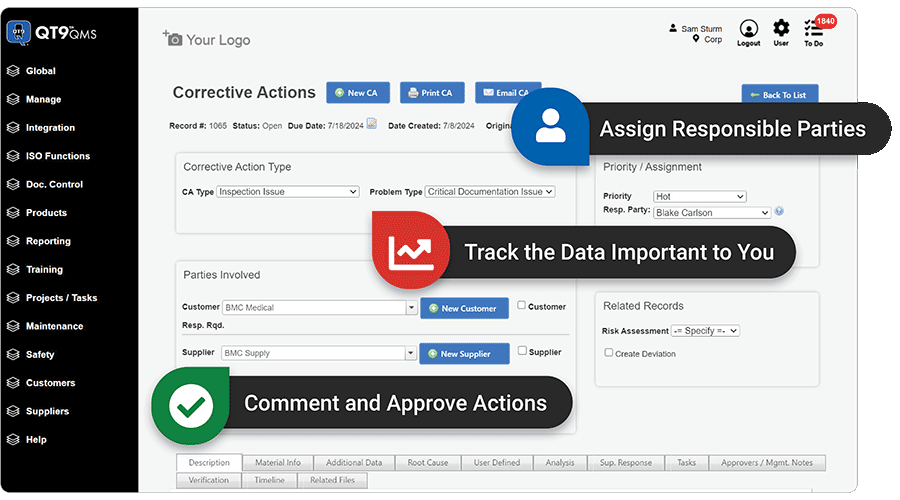
✓ 25+ Integrated Modules
✓ Native ERP Integration
✓ 30-Day Implementation
Ready to Modernize Your Quality Management System?
See how QT9 QMS helps regulated manufacturers simplify compliance, reduce validation time and improve quality across every operation.
Schedule a Demo Start Free TrialQuality Management Software FAQs
Lorem ipsum dolor sit amet, consectetuer adipiscing elit. Aenean commodo ligula eget dolor. Aenean massa. Cum sociis natoque penatibus et magnis dis parturient montes, nascetur ridiculus mus. Donec quam felis, ultricies nec, pellentesque eu, pretium quis, sem. Nulla consequat massa quis enim. Donec pede justo, fringilla vel, aliquet nec, vulputate eget, arcu. In enim justo, rhoncus ut, imperdiet a, venenatis vitae, justo. Nullam dictum felis eu pede mollis pretium. Integer tincidunt. Cras dapibus. Vivamus elementum semper nisi.
A QMS, or quality management system, is the organizational framework of processes, policies and responsibilities that defines how an organization controls quality. QMS software is the technology that implements and enforces that framework electronically. In practice, the software replaces manual spreadsheets and disconnected approval methods with a single system that automatically captures objective evidence and maintains a complete audit trail.
Quality management software is used most heavily in regulated industries where compliance must be demonstrated in order to bring products to market. Medical device manufacturers use it to meet ISO 13485, FDA 21 CFR Part 820 (QMSR) and EU MDR; pharmaceutical companies use it for FDA 21 CFR Parts 210 and 211 (cGMP), GMP and ISO 9001. Aerospace and defense manufacturers rely on it for AS9100; and general manufacturers and automotive suppliers use it for ISO 9001 and IATF 16949. In each sector, quality management software maintains the specific records and workflows that the applicable standard requires.
Pre-validated quality management software is software for which the vendor has already completed Installation Qualification (IQ), Operational Qualification (OQ) and Performance Qualification (PQ) protocols, as many regulations require. These protocols document that the system installs correctly, operates as intended and performs reliably under real conditions. When the vendor provides this validation, the buyer does not have to perform it internally, which can save significant time and cost. For FDA-regulated organizations, pre-validation is one of the fastest routes to a compliant, audit-ready state.
Implementation timelines for quality management software generally range from about 30 days to several months, depending on company size, process complexity and internal resources. Platforms that arrive pre-validated implement faster because the validation effort is already complete, removing a step that often adds months to a project. Data migration, configuration and user training are the factors that most influence the timeline. QT9 QMS, for example, is often implemented in as little as 30 days.
The standards a quality management software platform supports depend on the industries it serves. FDA 21 CFR Part 11 governs electronic records and signatures across FDA-regulated sectors, while ISO 13485 and FDA 21 CFR Part 820 (QMSR) apply to medical devices and FDA 21 CFR Parts 210 and 211 apply to pharmaceutical manufacturing. ISO 9001 is the general quality management standard, AS9100 extends it for aerospace, and IATF 16949 extends it for automotive. EU MDR applies to medical devices sold in the European market. Buyers should confirm that a platform supports their specific standards natively rather than through add-ons.
Simplify Quality, Compliance and Operations
Start a Trial
Try QT9 free — no credit card required.
Start Free→
Schedule a Demo
See QT9 live with one of our product experts.
Book a Time →
Get a Quote
Get custom pricing tailored to your team size.
Get Pricing →