Share this

by QT9 QMS Software on February 24, 2024
ISO 13485 software is an electronic quality management system (eQMS) that automates and centralizes the documents, records and workflows medical device organizations use to support conformity with ISO 13485 compliance. It supports quality activities across the full device lifecycle, from design and development through manufacturing, distribution and servicing.
While ISO 13485 gives manufacturers an internationally recognized framework for quality, conforming to it is demanding work. Coordinating dozens of interrelated processes, often across disconnected systems, is where most quality teams get stuck. This guide covers what ISO 13485 software does, the features and benefits that move the needle, and features to weigh when you evaluate an eQMS platform.
Contents
What features should ISO 13485 software provide?
What are ISO 13485 validation requirements?
Benefits of ISO 13485 software
How do ISO 13485 and FDA QMSR work together?
How QMS software supports quality management across global markets
How to evaluate ISO 13485 software
How much does ISO 13485 software cost?
What is ISO 13485 software?
ISO 13485 QMS software automates and manages the quality processes medical device organizations use to meet requirements of the ISO standard, centralizing tasks, documents and records. Also called an eQMS, the software can support quality activities throughout the medical device lifecycle, from design and development to manufacturing, distribution and servicing.
ISO 13485 is the international standard that specifies quality management system requirements for organizations involved in the medical device industry. Developed by the International Organization for Standardization (ISO), conformity with ISO 13485 demonstrates an organization's commitment to ensuring the consistent safety, effectiveness and compliance of its medical devices.
Who needs ISO 13485 software?
ISO 13485 applies to more than manufacturers of finished medical devices. Organizations involved in the design, production, installation and servicing of medical devices use the standard, along with suppliers and external parties that provide products or services to those organizations.
ISO 13485 software is used by medical device manufacturers, contract manufacturers, suppliers and other organizations that need to establish and maintain controlled quality processes within the medical device supply chain.
The processes each organization manages vary depending on its role, products and applicable regulatory requirements. Many businesses that operate in the medical device industry consider ISO 13485 certification a requirement to do business.
What features should ISO 13485 software provide?
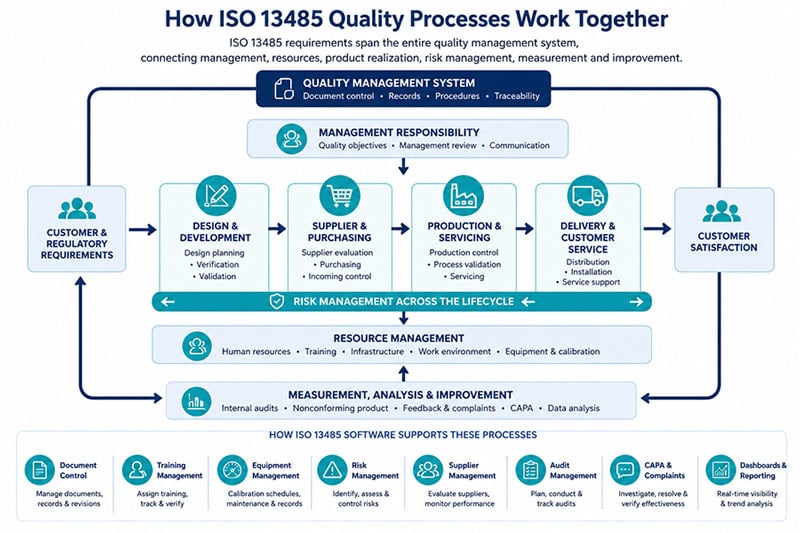
ISO 13485 software provides tools to support quality processes across requirements, including:
-
Quality management system
-
Resource management
-
Product realization
-
Measurement, analysis and improvement
QMS software automates these processes, digitally managing documents, records, workflows and responsibilities, while providing greater visibility across all quality processes.
Document and record control
ISO 13485 document control software controls documents and records, centralizing documentation and supporting controlled electronic review and approval processes. ISO 13485 software shapes and manages document control compliance, including the following:
-
Centralizes and organizes documents so they are accessible anytime, from anywhere
-
Establishes version control to ensure the latest information is used
-
Provides full transparency and traceability with an electronic timeline of document changes
-
Utilizes electronic review and approval with electronic signature compliance
-
Controls access
-
Triggers training related to document changes
ISO 13485 software can also help organizations maintain documentation for individual medical devices and device families. Medical device files can centralize applicable product specifications, procedures, manufacturing information, servicing requirements and other records needed to demonstrate conformity with the standard.
For organizations responsible for design and development, document control software can also help maintain design and development records, including changes, reviews, verification and validation activities. Connecting these records within the QMS improves traceability throughout the product lifecycle.
Management responsibility and quality oversight
Medical device company management has broad-ranging responsibilities under ISO 13485, from creating quality objectives to providing the appropriate resources and environment, to establishing a culture of continuous quality. As a QMS, ISO 13485 software provides the path for both management and staff to meet their quality goals.
Training, calibration and resource management
Automated employee training supports regulatory compliance and promotes a culture of quality by connecting document and system changes to employee training events. QMS software allows training to be created and assigned based on job duties. Employees get email prompts and reminders to complete training, and management gets a real-time view of employee training progress.
Equipment and facilities maintenance requirements can also be automated using ISO 13485 software. Instrument calibration applications can generate maintenance schedules, reminders and reports to produce a verifiable audit trail, confirming equipment has been properly maintained.
Product realization and risk management
The requirements for product realization touch multiple stages of the medical device lifecycle. ISO 13485 software can help organize and structure activities throughout these stages, including design and development, purchasing, production and supplier quality activities.
Risk management applications allow you to harness data to identify and monitor potential risks, automating associated tasks such as creating, evaluating and reporting on risk assessments. Risk assessments are integrated from a variety of additional integrated applications, such as corrective actions and engineering change requests (ECRs).
ISO 13485 software can automate supplier management, such as supplier evaluations, data mining and trending, and communication, making it easier to keep track of supplier activities and products.
Monitoring, measurement and continuous improvement
Section 8 of ISO 13485 calls for monitoring med device customer requirements via feedback, complaint handling, regular audits and appropriate internal controls. ISO 13485 software automatically manages documentation and reports with full traceability, including customer feedback tools that can integrate with the rest of the quality management system.
Automated customer feedback lets you digitally track customer complaints and other communication so you can chart and trend findings and link to CAPA or risk management. Corrective and preventive action (CAPA) applications provide tools to manage all CAPA processes, from root cause analysis to approvals and verification of effectiveness.
What are ISO 13485 validation requirements?
ISO 13485 requires validating software used within a quality management system, as well as software used in certain production, service, monitoring and measurement activities.
For manufacturers evaluating ISO 13485 software, this means considering more than whether a platform includes the right applications. Organizations should determine how the software will be used, assess the risks associated with its intended use and understand what validation documentation and services the software vendor provides.
Software updates and revisions should also be considered. Organizations need a process for evaluating changes that could affect the software's validated state after scheduled updates and for determining whether additional validation activities will be necessary.
Validation Responsibilities
Benefits of ISO 13485 software
ISO 13485 software offers a comprehensive solution to address the challenges of compliance and quality management, offering a central repository for device information, creating efficiencies and helping ensure that manufacturers are meeting regulatory requirements. Primary benefits include:
-
Integration of quality processes
-
Audit preparedness
-
Traceability and version control
-
Streamlined risk management planning and control
-
Automated document and record control
-
Real-time monitoring and reporting
Connecting these processes can improve visibility across the QMS. A nonconformance, for example, may lead to a CAPA, risk assessment, supplier action or document change. When those activities are managed within the same system, quality teams can follow the relationship between them and maintain a more complete history of the actions taken.
How do ISO 13485 and FDA QMSR work together?
The FDA’s Quality Management System Regulation (QMSR) took effect on February 2, 2026. It amended the medical device quality system requirements in 21 CFR Part 820 and incorporated ISO 13485:2016 by reference, bringing the FDA’s quality management framework into closer alignment with the international standard.
ISO 13485 certification does not by itself establish complete FDA compliance. Medical device manufacturers serving the U.S. market must also comply with applicable FDA-specific requirements and other provisions of U.S. law.
An eQMS can help organizations manage many of the documents, records and connected quality processes relevant to both ISO 13485 and QMSR. Organizations should evaluate whether a system also supports their specific FDA requirements, intended uses and validation obligations.
How QMS software supports quality management across global markets
ISO 13485 provides medical device organizations with an internationally recognized framework for quality management. This can be particularly valuable for companies operating across multiple markets or managing quality processes across several locations.
Conformity with ISO 13485 does not eliminate the need to identify and meet regulatory requirements that apply in individual jurisdictions. Organizations should determine which requirements apply based on their role and the markets they serve, then incorporate those requirements into their quality management system.
An eQMS provides a common foundation for core quality processes while giving organizations the flexibility to manage additional procedures, records and controls required for specific markets.
How to evaluate ISO 13485 software
Organizations evaluating ISO 13485 software should first determine whether the system supports the quality processes relevant to their operations. Depending on the organization, these may include document control, training, CAPA, nonconformance, audits, supplier quality, risk management, change control, complaints and equipment management.
The ability to connect these processes is also worth evaluating. Quality events often lead to related activities elsewhere in the QMS, so users should be able to link records and follow their history without repeatedly entering the same information.
Other considerations include validation support, electronic approvals and signatures, audit trails, user permissions, configurable workflows, reporting, multi-site capabilities and integrations with other business systems.
Usability should also factor into the decision. Employees across different functions may interact with the QMS, from completing assigned training to reviewing documents or responding to corrective actions. The system should make it straightforward for users to see their responsibilities and complete required actions.
Finally, consider the level of implementation, training and ongoing customer support available from the software provider. These services can affect how effectively an organization adopts and maintains its quality system over time.
How much does ISO 13485 software cost?
The cost of ISO 13485 software can vary considerably depending on a vendor’s pricing model. When choosing QMS software, pay especially close attention to the following factors:
-
Cost per license
-
The number and type of licenses your organization requires
-
Scalability of the platform
-
The number of modules/applications included
-
The cost to add modules or features
-
Data limitations and costs
-
Implementation timing and costs
-
Training and support costs for current and future employees
-
Validation costs
-
Maintenance, subscription or other added fees
Licensing: The most common license types are per-user and concurrent. Per-user licensing is just as it sounds — one license per individual user. Some QMS software providers charge per user but offer pricing options based on functionality. For instance, if a user needs “read only” access, associated fees for that type of license will be lower.
QT9 offers concurrent licensing, which allows organizations to create unlimited individual user accounts. Licensing is based on the number of users who can access the system simultaneously. For example, five concurrent licenses allow any five authorized users to be logged in at the same time. Each user retains unique login credentials, helping maintain individual accountability and traceable system activity.
Applications included: Many QMS software providers offer pricing plans that start with a base of capabilities and increase in cost as extra capabilities are added. Make sure your non-negotiable functions are part of the core applications provided in the plan you’re considering and be aware of which applications are add-ons and at what cost.
Data limitations: You’ll also want to consider how much data the platform is able to store for you or if there are costs associated with different levels of data storage. Also note whether there are maximum data or document storage limitations.
Implementation and training: Be sure to find out if software implementation and training are included in presented costs or if there will be additional charges. Find out what kind of services are included and at what cost. For example, training may be included but limited to online resource libraries rather than instructor-led services.
Additional fees: Be sure to ask about any other added fees, such as annual subscription fees or charges for software updates. Some QMS software providers charge for customer support, for example. You’ll want to make sure you factor additional fees into your cost examination.
Scalability: Consider whether the QMS software you’re considering offers applications that you can grow into as you either master other applications or as your business evolves and grows. Will there be an extra cost down the road when you need those capabilities?
Choosing ISO 13485 software
ISO 13485 software gives medical device organizations one connected system for the documents, records and quality processes the standard requires, with the traceability, version control and audit readiness that disconnected systems struggle to sustain. As device portfolios and market footprints grow, that connected foundation is what keeps a quality system manageable rather than something teams are forever chasing.
QT9's highly rated QMS offers 28+ standard modules to help you streamline your ISO 13485 tasks, backed by full customer support. Explore QT9 QMS today.
