
Share this
by QT9 Software on September 10, 2026
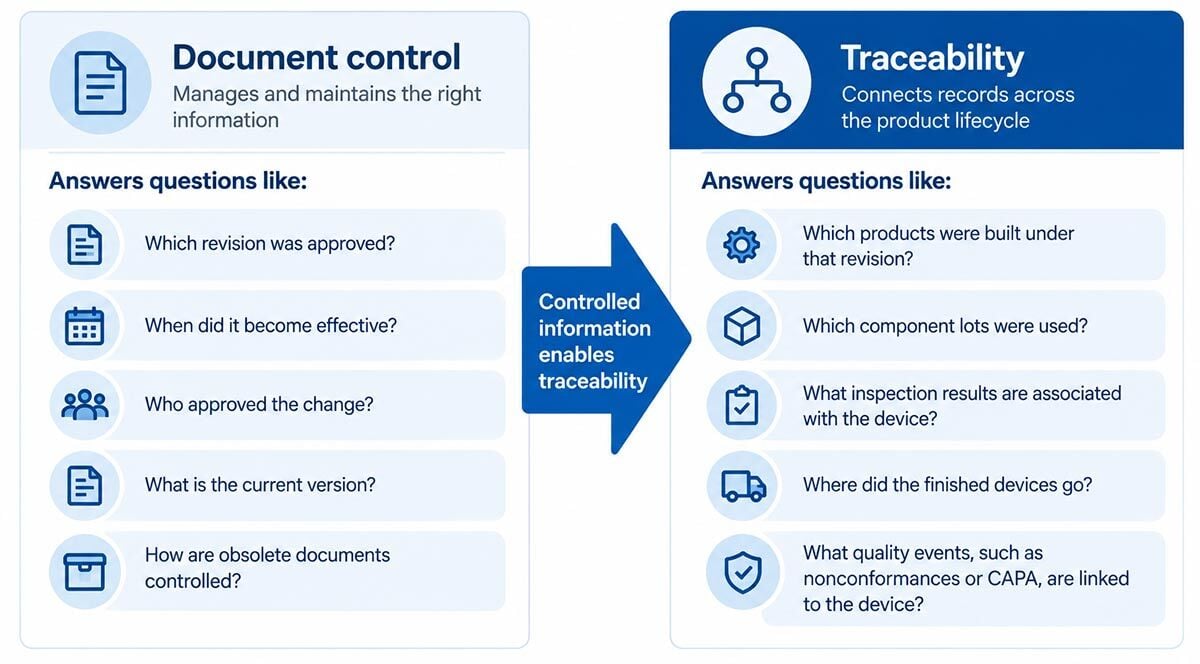
Document control establishes the foundation for reliable quality and compliance records by managing product revisions, approvals, effective dates and access to the most current information. Medical device traceability, however, is influenced by what happens beyond the document itself.
In practice, that means that manufacturers must connect requirements and specifications outlined in controlled documents with operational records, such as bill of materials, inspection results, device identifiers and distribution history. Those connections become especially valuable when manufacturers need to assess the impact of a change, defect or supplier issue. In those situations, records need to form a defensible chain of evidence.
Regulators expect medical device manufacturers to maintain that kind of visibility across the product lifecycle. U.S. FDA requirements under 21 CFR 820, the EU Medical Device Regulation (MDR), ISO 13485 and GMP shape how manufacturers manage quality and product records in order to bring a device to market.
Traceability starts with effective document control and extends into product design, supplier quality, manufacturing, inspection, distribution and post-market monitoring. The stronger those connections are, the easier it becomes to identify affected products, investigate problems and demonstrate that the organization acted on reliable information.
Contents
What is medical device traceability?
Why document control is the foundation of traceability
What is a medical device traceability matrix?
What are medical device traceability requirements in the U.S.?
How the EU MDR approaches medical device traceability
What are ISO 13485 traceability requirements?
What closed-loop medical device traceability looks like
Connecting quality and production traceability with QT9
What is medical device traceability?
Medical device traceability refers to the ability to identify and follow a finished device, component, material or operational activity by tracking the records associated with its design, manufacture and distribution.
That makes traceability broader than medical device tracking or medical equipment tracking. Tracking generally answers questions about the location or distribution of a particular device. Traceability connects a particular device or batch to the details behind its existence.
For example, a complete trace may connect a finished device to a serial or lot number, manufacturing order, component lots, supplier records, inspections, current specifications, production deviations, approvals and shipment history. If a defect emerges, the trace should also connect the affected product to a nonconformance, CAPA, complaint, supplier action or change control record.
Why document control is the foundation of traceability
Traceability depends on controlled information that can be linked to the work performed. A production record, for example, should show which approved specification, work instruction or drawing was in effect at the time of manufacture. Inspection results should connect to the acceptance criteria and revision used to evaluate the product. When a change or corrective action occurs, manufacturers also need to establish what changed, when the change took effect and which products were produced before and after it.
Together, these connections create the record history needed to understand how a device was made and how changes may have affected it.
Records also contribute to the product documentation manufacturers must maintain for each device or device family, the Medical Device File (MDF). Under ISO 13485 and QMSR, a medical device file contains or references documents needed to demonstrate conformity with applicable requirements, including product specifications, manufacturing and servicing procedures. Production records, often maintained electronically, provide the history of a specific device, lot or batch and can connect that product back to the requirements and processes used to manufacture it.
Proper compliance documentation provides a chronology: Version history, approval records, effective dates, electronic signatures, audit trails and obsolete-document controls establish which requirements governed the product at a particular point in time.
The strongest medical device traceability systems preserve those relationships instead of forcing an auditor or investigator to reconstruct them manually.
What is a medical device traceability matrix?
A medical device traceability matrix is a structured document that maps and links every stage of a device’s development, from initial user needs to final device testing and after-market risk management. It provides evidence that product requirements have been carried through design outputs, risk controls, verification and validation activities.
Matrices are particularly important in the design and development phases of a medical device lifecycle. A useful matrix allows a reviewer to establish evidence of actions from any direction. That means that starting with a standard or regulatory requirement, the reviewer should be able to identify the corresponding design output and verification evidence. Starting with a test result, the reviewer should be able to determine which requirement it verifies.
Once a device moves into production, manufacturers also need to connect design changes to controlled specifications, manufacturing instructions, inspection criteria, supplier requirements and employee training. If those records are managed in separate systems or disconnected processes, it becomes harder to assess the full impact of a change.
What are medical device traceability requirements in the U.S.?
When the FDA's revised 21 CFR Part 820 (QMSR) took effect in February 2026, the changes reinforced the importance of documented evidence and connected quality records.
In the U.S., 21 CFR Part 821 allows the FDA to require tracking for certain Class II and Class III devices. Manufacturers of these devices must maintain procedures and records capable of tracing affected devices through distribution and, when applicable, to the patient, along with a quality assurance program to verify the tracking system works. These requirements are intended to support rapid notification and recalls when a device presents a serious health risk.
How the EU MDR approaches medical device traceability
In the EU, medical device traceability requirements under the Medical Device Regulation (EU MDR 2017/745) focus on identifying devices and maintaining visibility across the supply chain. Article 25 requires economic operators to be able to identify who directly supplied them with a device and any health institution or health care professional they directly supplied. Distributors and importers must also cooperate with manufacturers or authorized representatives to support an appropriate level of traceability.
Article 27 establishes the Unique Device Identification (UDI) system to support device identification and traceability. The UDI includes a device identifier, or UDI-DI, that identifies the manufacturer and device, and a production identifier, or UDI-PI, that identifies the unit of production. The regulation also addresses placing the UDI on device labels or packaging and storing UDI information across the supply chain.
Together, these requirements are intended to help manufacturers and other economic operators trace devices through distribution, improve supply-chain transparency and support actions such as investigations and product recalls when a problem is identified.
What are ISO 13485 traceability requirements?
Under ISO 13485:2016, Clause 7.5.9, medical device manufacturers must establish documented procedures for product traceability when traceability is a regulatory requirement. Those procedures should define the extent of traceability required and the records that must be maintained.
For implantable medical devices, the standard goes further. Manufacturers must maintain records that identify the components, materials and relevant work environment conditions that could affect the device's safety and performance. They must also require suppliers and distributors involved in the distribution chain to maintain records that support traceability and make those records available for inspection when required.
In practice, ISO 13485 traceability means manufacturers should be able to connect a device to the materials, components, production activities and distribution records needed to reconstruct its history. The required level of detail depends on the device and applicable regulatory requirements.
What closed-loop medical device traceability looks like
Closed-loop medical device traceability goes beyond recording where a product came from and where it went. It uses traceability data to influence what happens next in production and quality processes. In a closed-loop system, data captured from materials, equipment, inspections and production is evaluated against defined requirements and fed back into the process so manufacturers can stop, hold or correct an issue before it moves further downstream.
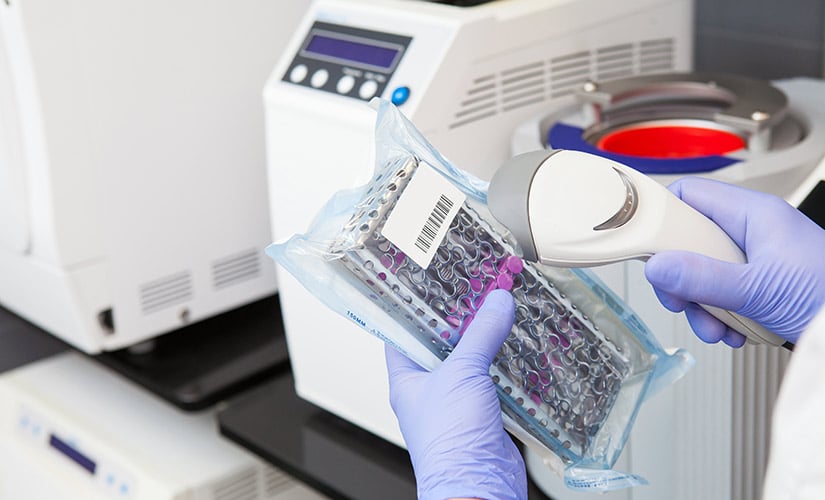
For example, a barcode scan at final inspection provides basic traceability. A closed-loop system can take that same scan and compare it with supplier documentation, inspection results and equipment calibration status. If one of those conditions falls outside requirements, the system can place the unit on hold or prevent it from moving to the next stage.
The same principle applies when quality and production systems are connected. A failed inspection can trigger a production hold, a supplier nonconformance can affect procurement activity and a corrective action can be linked back to the original traceability record. This feedback between operational and quality data is what turns traceability from a passive recordkeeping process into an active quality control system.
Traceability helps reconstruct a device’s history, while closed-loop traceability uses that history and current process data to prevent known quality issues from continuing through production or distribution.
Connecting quality and production traceability with QT9
At QT9, we see medical device traceability as more than a document control function. Controlled documents are part of the trace, but manufacturers also need to connect those documents to the materials, production activity, inspections and quality events associated with a device.
QT9 QMS and QT9 ERP work together to meet these challenges. QT9 QMS manages quality processes like document control, design controls, CAPA, nonconformances, supplier quality, training, complaints and change management. These records help establish the quality history behind a device, including what requirements were applied and how quality issues were addressed.
QT9 ERP extends that visibility into manufacturing operations by managing production, inventory, purchasing, work orders, lot and serial information and shipping activity, as well as medical device files. When operational and quality data are connected, manufacturers can trace a device from incoming materials through production and distribution while also linking that history to inspections, nonconformances and corrective actions.
That connection is especially important for closed-loop traceability. A quality event should not remain isolated in one system while production continues in another.
When QMS and ERP share traceability data:
-
A failed inspection can trigger a production hold
-
A supplier nonconformance can affect procurement
-
A corrective action can remain tied to the original traceability record
That feedback between quality and operations is what helps manufacturers move from passive recordkeeping to active process control.
For medical device manufacturers, the result is a more complete and usable product history. Instead of piecing together information from separate systems, teams can more readily determine:
-
Which materials were used
-
How a device was produced
-
What inspections were completed
-
Which quality events occurred
-
Where the finished product was shipped
That kind of connected traceability can support investigations, audits, recalls and ongoing quality improvement.
The goal is not simply to digitize more records. Our goal is to help manufacturers connect the records that already matter so traceability can support both compliance and day-to-day decision-making. When quality and production information work together, medical device traceability becomes a practical part of how the organization manages risk, quality and manufacturing performance.
