Share this

by James Schloz on November 03, 2026
Quality failures in highly regulated manufacturing sectors carry heavy consequences. When a nonconformity emerges, whether on the production floor or through a vendor defect, identifying the issue is only the first step. The true measure of a robust quality management system lies in how effectively the organization investigates, resolves and prevents that issue from happening again.
Corrective action requests (CARs) and supplier corrective action requests (SCARs) are used for documenting nonconformities, identifying root causes and driving effective corrective and preventive action across internal processes and the supplier network. Understanding how to deploy, manage and verify these requests ensures compliance with strict regulatory standards and protects the end user from potential harm.
Contents
Core responsibilities in the corrective action process
What is the corrective action process?
Navigating CARs and SCARs in a digital QMS
Streamline CARs and SCARs with QT9 QMS
What are CARs and SCARs?
A corrective action request is a formal document initiated within an organization to address a systemic defect, process failure, customer complaint or audit finding. The CAR requires the responsible department investigate the nonconformity, perform a root cause analysis and implement a corrective action to prevent recurrence.
A supplier corrective action request operates on the same principles but is directed externally. When a manufacturer receives defective materials, experiences a delivery issue or uncovers a compliance problem originating from a vendor, they issue a SCAR. This formally requires the vendor to investigate their own processes and submit a supplier response detailing how they will fix the root cause.
While a CAR addresses internal quality breakdowns, a SCAR is the primary mechanism for enforcing supplier quality. Both are essential components of a compliant corrective and preventive action (CAPA) process.
When to issue a CAR or SCAR
Not every minor anomaly requires a full corrective action request. Issuing a CAR or SCAR for a one-off error that does not impact product safety or performance drains resources. Quality managers should issue these formal requests when encountering:
-
Systemic or recurring defects that indicate an underlying process failure
-
Safety or regulatory compliance risks
-
Significant customer complaints or warranty returns
-
A major internal or external audit finding
For organizations adhering to FDA 21 CFR Part 820, ISO 13485 or ISO 9001, documenting the rationale behind corrective actions is not optional. Regulatory bodies require manufacturers to prove they have a closed-loop system for addressing nonconformances. A well-documented CAR or SCAR provides the objective evidence auditors need to see that an organization takes quality defects seriously and possesses the framework to resolve them permanently.
Core responsibilities in the corrective action process
Executing a successful corrective action requires clear delegation of duties. Manufacturer CAR responsibilities typically fall to a cross-functional team led by a quality manager or a designated responsible owner. This internal team must document the initial nonconformance, perform the investigation, implement process changes and gather objective evidence of improvement.
Supplier corrective action responsibilities shift the burden of investigation to the vendor. The supplier must acknowledge the SCAR within a specified timeframe, apply immediate containment measures to halt the shipment of defective goods, perform their own root cause analysis and submit a formal corrective action plan for the manufacturer to review and approve.
What is the corrective action process?
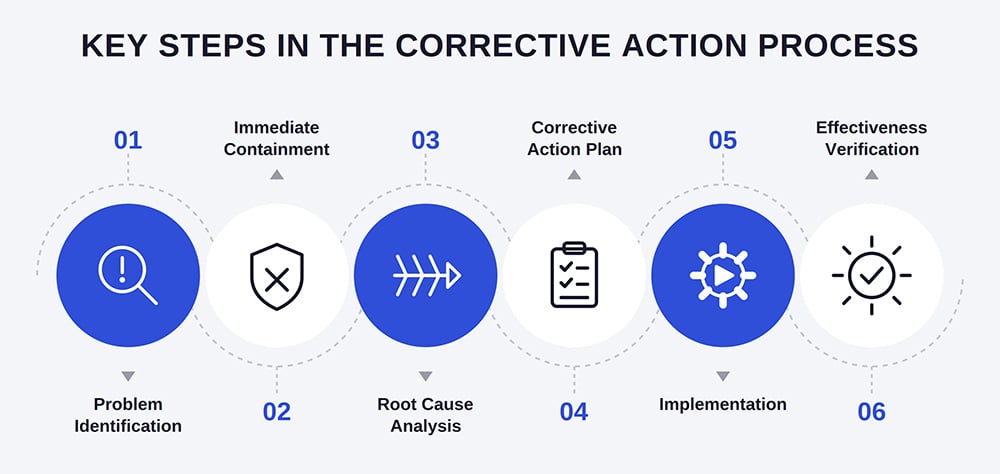
Resolving a major quality issue requires a structured, repeatable methodology. Most corrective action workflows follow the six fundamental steps outlined below.
1. Problem identification and nonconformance description
The process begins by clearly defining the problem. A vague description makes investigation almost impossible. The initial request must include the specific requirement specification that was violated, the purchase order, part number, lot number, batch number and the exact quantity affected.
2. Immediate containment
Before searching for the root cause of the nonconformity, the organization or supplier must stop the bleeding. Immediate containment involves isolating the affected product to ensure no more defective items reach the next stage of production. This typically requires placing inventory in quarantine, initiating a stop shipment order or sorting materials for rework.
3. Root cause analysis
Treating the symptom does not prevent recurrence. The responsible owner must determine exactly why the failure occurred. Standard methodologies for root cause analysis include the 5 Whys technique and the Fishbone diagram (Ishikawa diagram). These tools help investigators drill down past human error to uncover fundamental flaws in training, machinery, materials or methods.
4. Developing the corrective action plan
Once the root cause is identified, the team must draft a corrective action plan. This outlines the specific changes required to eliminate the root cause, assigns tasks to team members and establishes a target date for completion. For a SCAR, the manufacturer must review and approve the supplier’s proposed plan be-fore execution begins.
5. Implementation
The approved plan is put into motion. This phase might involve rewriting standard operating procedures, calibrating equipment, introducing new testing protocols or retraining staff. Documenting every action taken during this step is crucial for compliance.
6. Effectiveness verification
What happens after the corrective action is made? The process does not end simply because a new procedure is in place. After a designated period, quality teams must conduct effectiveness verification. This involves reviewing a new inspection report, analyzing recent test data or conducting a follow-up audit to confirm the solution worked. Only when objective evidence proves the root cause has been eliminated can the quality manager grant closure approval.
Navigating CARs and SCARs in a digital eQMS
Managing the multi-step corrective action process through manual or disconnected systems invites critical compliance failures. Manual tracking often leads to missed target dates, lost supplier responses and incomplete documentation for regulatory audits.
A digital quality management system streamlines the entire CAPA lifecycle. Purpose-built QMS software, like QT9 QMS, connects every phase of the corrective action process automatically. When an inspector logs a failed test or an auditor records a nonconformity, the software can automatically escalate the issue into a formal CAR.
QT9 QMS software simplifies this by routing the request through a centralized CAPA module. Instead of chasing department heads for updates, the system logs an assigned responsible owner, sets automated email alerts for approaching deadlines and tracks all root cause analysis documentation in one secure location. This ensures full traceability from the initial nonconformance description through final closure approval.
Handling external SCARs is equally streamlined through the QT9 Supplier Web Portal. Rather than emailing sensitive quality documents back and forth, manufacturers can issue a SCAR directly through the QMS. The external supplier receives an alert, logs into a secure, restricted-access portal and submits their root cause findings and corrective action plan directly into the manufacturer’s system.
This portal eliminates data silos and ensures that supplier quality data ties directly back to the original purchase order and part number. By centralizing the workflow, manufacturers can monitor vendor performance in real time, enforce strict response deadlines and maintain the comprehensive objective evidence required to satisfy FDA and ISO requirements.
Streamline CARs and SCARs with QT9 QMS
Corrective actions do not have to be an administrative burden. With a structured investigative process and the right quality management system, routine quality failures become powerful drivers of continuous improvement. QT9 QMS gives you that foundation with a closed-loop CAPA module that manages internal CARs and supplier SCARs from the first nonconformance through verification of effectiveness.
Corrective actions can be created automatically from inspections, audits, nonconforming products, customer feedback and other QT9 QMS modules, so every request stays connected to the issue that started it. Integrated root cause analysis and the 8D problem-solving method guide the investigation, while approvals, unlimited tasks, priority levels and automated overdue alerts keep each request moving. Once the fix is in place, scheduled verification of effectiveness confirms it worked, and every record lives in one central, searchable database that strengthens audit readiness.
Supplier corrective actions are just as efficient. Through the QT9 QMS Supplier Web Portal, included at no extra charge, you assign SCARs directly to suppliers, who log in to respond, post comments and attach files instead of trading emails. Their responses sync with the CAPA module, and supplier performance data links to risk management so recurring problems inform supplier risk decisions. Organizations that also run QT9 ERP can tie corrective actions to purchasing records and vendor data for an even more connected view.
QT9 QMS is pre-validated and backed by unlimited support and training, so your team has help from implementation through day-to-day use. Start a free trial or schedule a demo to see how QT9 QMS handles CARs and SCARs from start to finish.
ISO 9001:2026 - What Requires Action and What Does Not