
Pharmaceutical ERP Software Built for FDA-Regulated Drug Manufacturing
Manage formulation, batch manufacturing, electronic batch records, inventory traceability, quality events and financial operations in a single validated ERP platform designed for FDA 21 CFR Parts 210/211 and Part 11, and global pharmaceutical compliance.
Production and Manufacturing Leadership
Gain real-time control of batch manufacturing operations.
- Electronic batch records executed across production
- Lot genealogy tracking across raw materials and finished batches
- Shop floor visibility across batch manufacturing operations
- Deviation detection before batch review and release
Quality and Regulatory Teams
Maintain regulatory oversight and FDA inspection readiness.
- Audit trails and electronic signatures supporting FDA compliance
- Deviation and CAPA tracking across production and quality
- Validated manufacturing processes supporting cGMP environments
- End-to-end batch traceability across materials and distribution
Supply Chain and Operations Leaders
Keep production running with reliable materials and inventory control.
- Approved supplier management and vendor qualification
- Lot-level inventory tracking across warehouses and facilities
- Material staging and batch preparation for upcoming production
- MRP demand forecasting supporting continuous manufacturing
Finance and IT Leadership
Gain financial transparency and deploy a secure ERP platform.
- Cost of goods tracking by batch and product
- Inventory valuation and margin analysis across SKUs
- Role-based system controls supporting secure operations
- Scalable infrastructure supporting multi-site manufacturing
Trusted by Regulated Manufacturers
Used by manufacturers across life sciences, pharmaceuticals, medical devices, aerospace and advanced manufacturing.
Built for Regulated Manufacturing
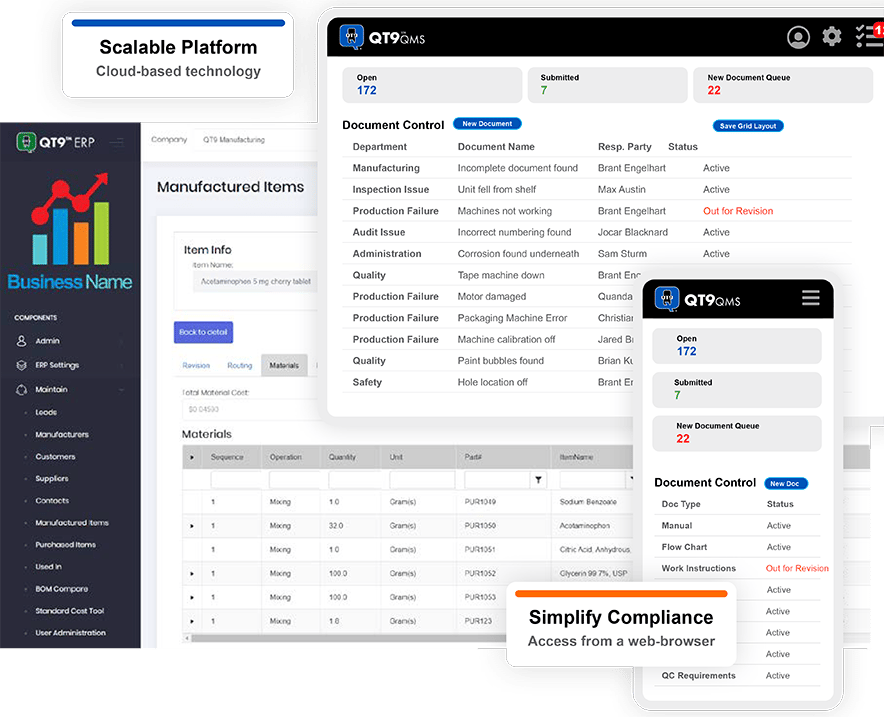
Unified ERP + QMS Platform
Scalable for Growing Operations
Operational Benefits of Pharmaceutical ERP
QT9 ERP helps pharmaceutical organizations reduce compliance risk, accelerate batch release and maintain full operational visibility across manufacturing, quality and financial operations.
Accelerate Batch Release
Move batches from production through quality review using structured digital workflows that eliminate delays and incomplete documentation.
Reduce Compliance Risk
Maintain complete traceability and audit trails across manufacturing, quality, and inventory activities.
Improve Operational Control
Replace fragmented systems and paper batch records with a unified manufacturing platform.
Scale Pharmaceutical Manufacturing
Support multi-site production, new product lines, and expanding regulatory markets within one ERP system.
Challenges Pharmaceutical Manufacturers Face
Production records, quality documentation, and inventory transactions often exist across multiple systems or paper logs, slowing batch review and increasing documentation risk.
Without integrated material tracking, maintaining full genealogy from raw materials through finished drug distribution becomes difficult.
Manual documentation increases the risk of transcription errors, missing signatures, and incomplete batch records during inspections.
When ERP and quality systems operate separately, deviations, CAPA actions, and batch documentation become difficult to synchronize.
Incomplete documentation and inconsistent workflows increase regulatory risk during FDA inspections.
Pharmaceutical ERP Software Built for Regulatory Control and Batch Traceability
Pharmaceutical ERP software is an enterprise resource planning system built specifically for regulated drug manufacturers. It unifies batch production, inventory management, quality oversight, validation documentation, and financial operations within a compliant platform designed to support FDA 21 CFR Parts 210 and 211, 21 CFR Part 11, and global regulatory requirements. Unlike generic ERP systems, pharmaceutical ERP must enforce process control, maintain complete lot traceability, and operate within validated manufacturing environments.
Pharmaceutical manufacturing operates under strict current Good Manufacturing Practice standards. Every ingredient, batch, and production step must be documented, validated, and traceable to meet regulatory expectations. QT9 ERP supports compliant electronic records, secure audit trails, controlled documentation, batch review workflows, and structured approval processes to help manufacturers remain inspection-ready across domestic and international markets.
QT9 ERP delivers purpose-built functionality for manufacturers of active pharmaceutical ingredients, finished dosage forms, sterile injectables, biologics, and OTC products. The system supports electronic batch records, complete lot genealogy, formulation management, material reconciliation, controlled release workflows, and multi-site visibility. Pharmaceutical companies gain the operational control and documentation structure required to scale production while maintaining precision and regulatory confidence.
Core Pharmaceutical Manufacturing Capabilities
Drug Strength Definition
Direct Impact on Dosage and Efficacy
Critical for Patient Safety
Verified Throughout Manufacturing
Required for Regulatory Compliance
Maintained Through Data Management
ERP Features Built for the Pharmaceutical Manufacturers
Electronic Batch Records
Easily create, manage and access digital batch records with built-in traceability.
Batch & Lot Traceability
Track ingredients and finished goods through every stage with full traceability.
Data Integrity
Maintain data integrity with audit trails, password protections and eSignatures.
Compliant Workflows
Standardize production with validated processes and controlled documentation.
Inventory Tracking
Automatically flag expired or soon-to-expire raw materials and finished goods.
CAPA Management
Built-in corrective and preventive action tracking integrated with production data.
Supplier Management
Manage supplier qualifications, performance and documentation in one place.
Multi-Site Support
Manage operations across multiple plants and entities from a single, unified system.
Pre-Validated Platform
QT9 ERP comes fully validated saving you time and costs.
Pharmaceutical Professional Services for cGMP Compliance and System Implementation
Expert validation, electronic batch record configuration, serialization integration, and ERP optimization services tailored for pharmaceutical manufacturers.
- Validation consulting: IQ/OQ/PQ execution and documentation support
- Electronic batch record design: Custom EBR templates matching your paper batch records
- Serialization integration: Configure DSCSA/FMD compliance with serialization vendors
- Pharma chart of accounts setup: GL design for cGMP cost accounting
- On-site go-live support: QT9 consultant on-site for first production batches
- BI report development: Custom reports for yield analysis, OOS tracking, stability monitoring

Pharmaceutical Compliance Readiness
Electronic Signatures
- Password-protected signatures on batch records, inspections, and approvals
- Multi-factor authentication (MFA) for enhanced security
- Signature meaning tied to user action (e.g., "Approved by QA")
- Signature manifestation (printed name, date, and meaning on all records)
Audit Trails
- Immutable record of every inventory transaction, BOM change, and approval
- Timestamp, username, action, old value, new value
- Audit trail review and certification for FDA inspections
- Search and filter by date range, user, or transaction type
System Controls
- User access controls with role-based permissions (production, QA, regulatory, finance)
- Password policies (complexity, expiration, history)
- Session timeout and automatic logout
- Secure, validated system with no "back door" data manipulation
Manufacturing Controls
- Written procedures (SOPs) linked to operations
- In-process controls with acceptance criteria
- Equipment identification and assignment to batches
- Time limits for completion of production steps (configurable alerts)
Material Controls
- Approved supplier lists and incoming inspections
- Quarantine until released by QC
- FIFO/FEFO inventory rotation
- Prevention of unapproved material use
Laboratory Controls
- Sample management (retain, stability, reference)
- Link test results to batches
- OOS investigation workflows
- Certificate of Analysis (COA) generation
Records and Reports
- Master production records (BOMs)
- Batch production records (EBRs)
- Laboratory records (inspections)
- Distribution records (shipping with lot numbers)
System Validation
- IQ/OQ/PQ documentation provided by QT9
- Validation maintenance for system updates
- Revalidation for major configuration changes
- Annual system review and certification
Change Control
- Engineering Change Notifications (ECN) for BOM revisions
- Change control module for documents and SOPs
- Impact assessment and approval workflow
- Effective date management (when change takes effect in production)
Scenario: Contract Manufacturing Organization (CMO) manufactures tablets, capsules, and liquids for 20+ pharma clients. Each client has unique formulations, packaging, and regulatory requirements.
QT9 ERP Solution:
- Customer-specific BOMs: Different formulations per client with approved master records
- Lot segregation: Track inventory and WIP by customer for zero cross-contamination risk
- Client portals: Customers view order status, batch records, and COAs online
- Contract manufacturing workflows: Customer POs → production jobs → invoicing with material + labor + overhead
- Multi-client reporting: Batch records, COAs, and stability data formatted per client requirements
Scenario: Biotech startup developing and manufacturing sterile injectable for oncology. Clinical trial batches (Phase I/II) with scale-up to commercial manufacturing.
QT9 ERP Solution:
- Small batch capability: 10-100 vial batches with full GMP documentation
- Aseptic filling workflows: Compounding → filtration →filling → visual inspection →packaging
- Media fill validation: Track validation batches separately from commercial batches
- Stability sample tracking: Retain samples at 0, 3, 6, 12, 24 months with test schedules
- Clinical trial lot distribution: Track which patients received which lots for pharmacovigilance
- Electronic batch records: FDA-ready documentation for IND/BLA submissions
Scenario: Large Over-the-Counter (OTC) manufacturer produces pain relievers, cold/flu products, and vitamins. 1M+ tablets/day across multiple production lines.
QT9 ERP Solution:
- High-volume production: Large standard batch sizes (500K tablets) with fast cycle times
- Multi-line scheduling: Schedule 5+ compression lines simultaneously with material staging
- Serialization integration: DSCSA compliance with unit/case/pallet aggregation
- Retailer-specific packaging: Different bottle sizes and labels for Walmart, CVS, Walgreens, Amazon
- MRP & forecasting: Auto-generate POs for excipients and packaging materials based on sales forecasts
- Financial reporting: COGS by SKU, margin analysis, inventory turnover
Unified ERP and QMS Platform for Pharmaceutical Manufacturers
Pharmaceutical manufacturers cannot afford disconnected systems between production and quality oversight. QT9 ERP and QT9 QMS operate as a single unified platform that eliminates duplicate data entry, fragmented batch documentation, and cross-system reconciliation.
Quality events can originate directly from manufacturing activity. Production data, laboratory results, deviation records, and documentation remain synchronized in real time, creating a connected digital environment across formulation, production, quality review, and compliance.
Instead of managing separate software vendors and complex integrations, you gain one architecture, one database, and one accountable partner supporting your entire pharmaceutical operation.
Financial Management for Pharmaceutical Manufacturing
- COGS by batch: Material, labor, overhead allocated to each production lot
- Variance analysis: Standard cost vs. actual cost with root cause tracking
- Inventory valuation: FIFO, Average, or Standard costing methods
- Waste and scrap tracking: Record losses with reason codes (out-of-spec, expired, damaged)
- Inventory accounts: Raw materials (API, excipients), packaging, WIP, finished goods
- COGS accounts: Material, direct labor, manufacturing overhead, quality testing
- Expense accounts: R&D, regulatory affairs, stability testing, clinical trials
- Revenue accounts: Rx sales, OTC sales, contract manufacturing, licensing
- Track validation costs, regulatory submission fees, and inspection preparation
- Allocate quality and compliance costs to product lines
- Budget tracking for stability testing and post-market surveillance
- Gross margin by product, customer, and therapeutic category
- Inventory turnover and days on hand
- Manufacturing efficiency (yield, cycle time, cost per batch)
- Cash flow forecasting with long lead times for raw materials
- AR/AP aging and payment processing
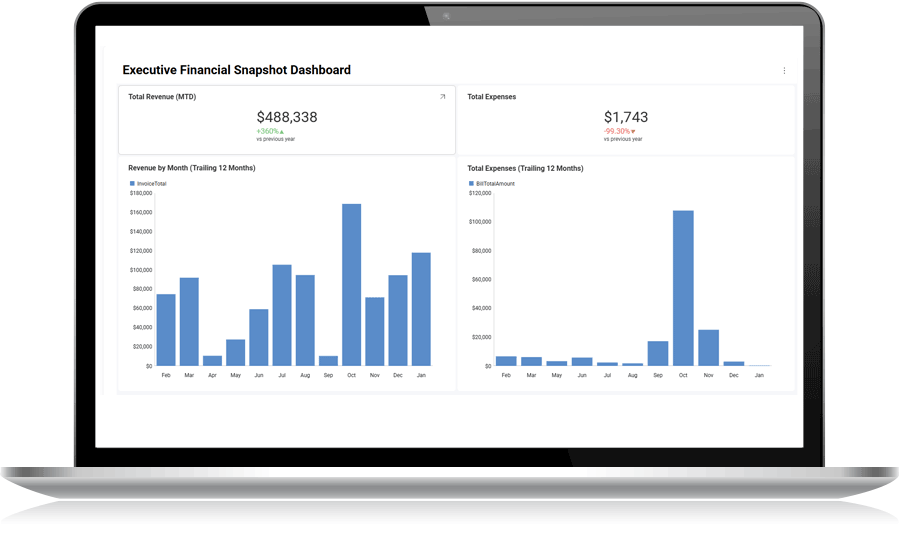
Standard Financial Reports
- Balance Sheet with inventory detail
- Profit & Loss by department, product line, or customer
- Cash Flow Statement with working capital analysis
- Trial Balance and account detail
- Comparative financials (month-over-month, year-over-year)
Manufacturing KPIs and Analytics
- Gross margin by product, customer, and sales channel
- Inventory turnover and days on hand
- Manufacturing efficiency: planned vs. actual hours
- On-time delivery percentage
- Order backlog and revenue pipeline
- Purchase price variance by supplier
Pharmaceutical Product Types Supported
Solid Dosage Forms
- Tablets: Immediate-release, extended-release, enteric-coated, chewable, ODT (orally disintegrating)
- Capsules: Hard gelatin, soft gelatin, HPMC vegetarian capsules
- Powders: Bulk powder, unit-dose sachets
- Granules: Effervescent, sustained-release
Typical Workflow: Blending → Granulation (wet or dry) → Milling → Compression/Encapsulation → Coating (optional) → Packaging
Liquid Dosage Forms
- Oral solutions and suspensions: Syrups, elixirs, emulsions
- Injectable solutions: IV solutions, small-volume parenterals (SVP), large-volume parenterals (LVP)
- Sterile products: Aseptic filling, terminal sterilization
- Lyophilized products: Freeze-dried vials for reconstitution
Typical Workflow: Compounding → Filtration → Filling → Sterilization (autoclave or aseptic) → Inspection (visual/automated) → Labeling → Packaging
Semi-Solid Dosage Forms
- Ointments, creams, gels: Topical dermatological products
- Transdermal patches: Drug-in-adhesive, reservoir systems
- Suppositories: Rectal, vaginal
Typical Workflow: Mixing/Emulsification → Homogenization → Filling (tubes, jars) → Inspection → Packaging
Biologics & Biosimilars
- Monoclonal antibodies (mAbs)
- Vaccines
- Recombinant proteins (insulin, growth factors)
- Cell and gene therapies
Typical Workflow: Cell culture → Harvest → Purification (chromatography) →avirus inactivation → Filtration → Formulation → Filling → Lyophilization (optional) → cold chain storage
API (Active Pharmaceutical Ingredient)
- Chemical synthesis: Multi-step reactions, crystallization, purification
- Fermentation: Antibiotics, amino acids, enzymes
- Extraction: Plant-derived APIs, natural products
Typical Workflow: Reaction → Crystallization → Filtration → Drying → Milling → Bulk packaging
OTC (Over-the-Counter) Products
- Pain relievers: Acetaminophen, ibuprofen, aspirin
- Cold & allergy: Antihistamines, decongestants, cough suppressants
- Digestive health: Antacids, laxatives, anti-diarrheals
- Topical products: Sunscreen, acne treatments, hydrocortisone creams
Compliance Note: OTC products follow FDA monographs and cGMP requirements. QT9 ERP supports OTC manufacturing with same rigor as Rx products.
Compounding Pharmacies
- Custom formulations: Patient-specific dosing, allergen-free formulations
- USP <795> (non-sterile compounding) and USP <797> (sterile compounding) compliance
- Small batch production: 1-100 unit batches with full traceability

Why Pharma Companies Are Choosing QT9
QT9 customers have successfully passed FDA inspections with zero 483 observations related to the ERP system. Our electronic batch records, audit trails, and validation documentation meet FDA expectations.
Pharmaceutical manufacturers don't have time for 2-year ERP implementations. QT9 delivers:
- 6-12 month implementation timeline from kickoff to validated go-live
- Unlimited training included in implementation package
- Pharma-specific templates for BOMs, inspection plans, and batch records
- Validation support: IQ/OQ/PQ documentation and validation consulting
- No per-user licensing: Concurrent user model keeps costs predictable
- Startups and compounding pharmacies start with core formulation and production tracking
- Add serialization, stability management, and multi-site operations as business grows
- Enterprise pharma manages multiple facilities, product lines, and regulatory jurisdictions
- No rip-and-replace: QT9 ERP grows with your business
Built to Support International Pharmaceutical Compliance

FDA 21 CFR Parts 210/211
Current Good Manufacturing Practice for finished pharmaceuticals in the United States

ISO 9001
International Quality Management System Standards
ISO 17025
International standards for accuracy and reliability of testing and calibration laboratories

PIC/s
Pharmaceutical Inspection Co-Operation Scheme
FAQ: Pharmaceutical ERP
Yes. QT9 ERP generates electronic batch records (EBRs) that automatically compile all manufacturing data: materials consumed (with lot numbers), operations completed (with timestamps and signatures), inspection results, and equipment logs. EBRs are 21 CFR Part 11 compliant with electronic signatures and audit trails. One-click PDF export for archiving and FDA inspection.
QT9 tracks supplier lot numbers at receipt, records exact lots consumed in each batch (via Lot Override), and maintains forward/backward traceability. In a recall scenario, you can instantly identify: (1) which finished batches used a suspect raw material lot, and (2) which customers received affected finished batches. Full traceability from supplier → batch → customer.
QT9 ERP is integration-ready for serialization systems (Systech, Antares, Tracelink, etc.). We can capture serial numbers at packaging, track aggregation (unit → case → pallet), and generate transaction documentation. Serialization integration is scoped as professional services based on your specific vendor and requirements.
Yes. QT9 supports sterile manufacturing workflows including aseptic filling, terminal sterilization, visual inspection, and lyophilization. Electronic batch records capture environmental monitoring data, sterilization parameters, and visual inspection results. Suitable for small-volume parenterals (SVP), large-volume parenterals (LVP), and biologics.
QT9 ERP handles manufacturing, inventory, purchasing, sales, and financial management. QT9 QMS handles quality system documentation (SOPs, training, CAPA, audits, deviations, complaints). Both systems integrate natively. Most pharma manufacturers need both ERP (for operations and batch records) and QMS (for quality system compliance). See QT9 QMS Integration for details.
Validation typically occurs during implementation (Phases 2-4). Installation Qualification (IQ) documents system configuration. Operational Qualification (OQ) functionally tests all modules (4-6 weeks). Performance Qualification (PQ) runs user acceptance testing with real workflows (4-6 weeks). Total validation timeline: 2-3 months concurrent with implementation.
Yes. QT9 ERP supports multi-site operations with centralized visibility. Track inventory at internal manufacturing sites, 3PL warehouses, and contract manufacturers. Each site has its own inventory locations, but executives see consolidated reporting. Contract manufacturing workflows: Issue materials to CMO → receive finished goods → capture CMO batch records.
QT9 can track stability samples (retain samples with test schedules), but dedicated stability management requires QT9 QMS. The QMS stability module manages test protocols, accelerated/long-term studies, OOS investigations, and trending analysis. Most pharma manufacturers use ERP for batch production and QMS for stability programs.
More Manufacturing ERP Resources

Five Signs You’ve Outgrown Your ERP System

ERP in Supply Chain Management: How Manufacturers Gain Control, Visibility and Predictability

Best Software for Inventory Management in Regulated Manufacturing
Try QT9 for free
Ready to unify your business processes? No credit card needed.